Mobile Customs Control – Great minds think alike

Beitbridge inspection area6 December 2010 saw the rollout of a new electronic tool for customs inspectors at Beitbridge border post. The need for a hand-held device was identified following the rollout of a new workflow system, called Service Manager, to various Customs offices over the past few months. Although the changes introduced recently were aimed at moving Customs to a totally paperless environment, customs inspectors still had to print out their instructions on paper, manually write down the inspection results and then recapture these onto the system back in the office.

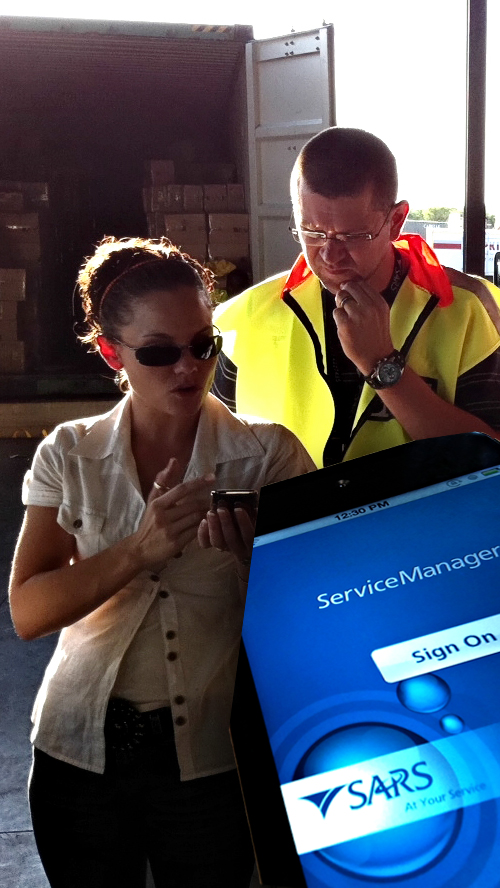
The use of an iPod by a Customs officer to conduct a physical inspection at Beitbridge this week introduces significant enhancements over the previous manual process. SARS has been liaising with iPod experts in various countries around the world over the past few months to develop this function and procure the devices.

The solution comprises an Apple iPod Touch which has been configured to operate SARS’ automated inspection workflow application – Service Manager. The introduction of a hand-held device therefore means that all the functions of Service Manager are now at the inspector’s finger-tips. Inspectors receive their instructions on the iPod, capture the results and make recommendations which then go to the finalisation/adjustment inspector. They can even take photographs with the iPod if they need further clarification on the goods they are inspecting. Inspectors no longer have to go back and forth to the office and their next job can be assigned to them on the spot. This is expected to substantially reduce the time spent on physical inspections and minimise human error.

Initially 34 iPods were procured for Beitbridge, WiFi technology was made available at the port and training of affected staff undertaken. All physical inspections at Beitbridge were being conducted with iPods and will be rolled out to the other Customs border posts throughout 2012.

While SARS’ solution is the first known Apple solution of its kind, similar solutions have been introduced recently within the US Bureau for Customs and Border Control and the Australian Border Control Agency offering varying types of functionality, including the integration of RFID technology by the Australians to monitor and track cargo movements. Life for Customs officers is a whole different and will continue to evolve if it expects to remain in touch with modern era fraud and scams.

Customs Connect 2 – SA Customs Modernisation

Customs Connect 2The year 2011 has proven both challenging and beneficial for many in the South African Customs community. New business opportunities offered via the Customs Modernisation Programme materialised and provided the service providers ample scope to improve their service offerings to clients in the freight forwarding and clearance space. Leveraging off tried and tested technology tools already employed by SARS in the Tax business, the implementation of E@syScan provided significant efficiencies in the customs clearance processing response times, although the jury is still out on whether such efficiencies have in fact translated into cost-savings for the customs trade. In this regard it is up to trade itself to assess if the traditional cost of printing reams of paper and employing a runner to deliver manual documents to Customs is significantly reduced by the new electronic supporting document process. Could be an interesting exercise.

On the SARS front, the implementation of a new automated case management, and inspection workflow is nothing short of a revelation in so far as traceability and improved efficiency. Similarly, such efficiency needs to translate into cost savings. Certainly there are less manual interventions in the process, the emphasis now moves to working more smartly as regards the booking and conducting of physical inspections. True this has been a huge learning curve for all. Refinements and fine-tuning of the process moving forward will undoubtedly release the expected results to the point where most will wonder how they ever managed in ‘manual mode’ in the past.

To close off the year, SARS has just published its second edition of its electronic Customs bulletin – Customs Connect. Please take the time to read and digest.

Price of Modernisation – technology encroachment and people displacement

An interesting dynamic has developed with the introduction of ICT in business. In the customs and trade environment there are a few fundamental objectives around which technology has proven to be effective –

  • Elimination of tedious labour intensive paper delivery and manual distribution processes.
  • The ability to generate more work, in dramatically shorter timeframes thereby improving customer expectation and service delivery.
  • Seamless replication of a common message or instruction across a broad spectrum of stakeholder’s networks to enable better planning and execution of ‘the next steps’ in the supply chain process.
  • Rules driven automated processes that eliminate human intervention and more specifically, human intuition. Why? Because people make mistakes.

We see this everywhere. Electronic trading with your bank, customs broker, revenue service, or online shopping store. All these enterprises have developed (and to a large degree perfected) complex rules-based systems which work effectively 90% of the time. Your trouble occurs if your transaction happens to fall into the 10% category. Once again companies have recognised that there is a role for people to play. It also happens to be a conditioned environment based on the principle of tiers and handovers – the Call Centre. This is where the ‘customer’ generally encounters an ignoramus at first; and hopefully, through the process of escalation, finally speaks to someone with the knowledge to assist and resolve the enquiry. All the same, this is a faceless experience and the chances are you may never get to speak to that ‘consultant’ again, in the time of need.

In time the branch offices will close, with online facilities having become the way of life. No more need for the maintenance of real estate, storage vaults for paper records, and costly expenditure on people you once grew fond of as your local branch manager and friendly staff. Peace of mind has given away to convenience. The extent of technological advancement in many organisations is such that with payment mechanisms all being electronic, any impact or potential for disruption to day-to-day operations is virtually negated in the event of industrial action. The cost to business benefit of a new system far out-weighs the onerous responsibility of maintaining a traditional branch office – it’s a no-brainer!

In as much as man has been weary of progress since the invention of the wheel, so today, the average employee questions the rationale of it all, and where his/her future lies. And herein lies the dilemma – what to do with all the displaced people. In the private sector it’s rather simple (if not tragic) – just retrench the excess. For government departments and parastatal organisations, i.e. semi-autonomous branches of government, it’s not that easy. Nobody can be put out onto the street. It is therefore up to individual employees to consider their options. It’s time to wake up, you are still fortunate. Bursary programmes are available, so seek out an opportunity to improve your lot in life, perhaps in a totally different field from the one you have become accustomed to.

Empty container depots adding to industry’s costs?

FTW published an article recently in regard to ‘empty container depots’ and their apparent negative impact on cost and response to industry needs. It was duly noted that while so much focus was accorded to Port delays, little is said about the additional costs caused by empty container depots. Many of these in fact hold, clean and distribute empty containers on behalf of shipping lines some of whom are not equipped to service the industry due to ill-equipped facilities.

Shipping lines complain about the turnaround of their vessels at the port, but take little interest in ensuring a quick turnaround of vehicles at their appointed container depots. The report continues: “Transporters are delayed for hours at major depots while waiting for containers to be turned in, cleaned and then released for export cargo. Most of these depots do not work 24 hours in line with the port and transporters, which further limits the ability of transporters and industry to perform”. I think this deserves some further thought and consideration, and for this I’ll provide a customs-slanted view.

Firstly, in other parts of the world, the same mentality prevails whenever a port or customs system is replaced or upgraded – an avalanche of vitriolic sentiment, followed by line operators threatening to institute port delay surcharges and the like. To place matters into true perspective – yes, the port and customs services are there for the benefit and support of the supply chain, and should run and be maintained to offer efficient operation even in the event of catastrophe or a burgeoning logistics market demanding increased capacity and responsiveness. 9/11 provided a catalyst for Customs Inc. to initiate an unheard of demand on trade to increase its internal security mechanisms and even provide information in advance of the lading of a vessel at a foreign port. The US lines were the first to climb on the band wagon in support of heightened security and quickly acted to ensure that their regional offices were able to assist foreign shippers in supplying the required ‘advanced information’ at a nominal charge – varying between $25 and $60 per bill of lading. Sure, this was the cost necessary to ensure lines met their new stringent reporting requirements to the US Homeland Security to obviate possible penalties of $5,000 and up. Nonetheless, the same lines, when asked to provide the local authorities the same courtesy, recoil and look for all sorts of excuses to avoid the subject. Sure, it is understood that only the US has the right to make such demands, not any anyone else. I have followed most other advance cargo reporting requirements with similar amusement.

You see, lines were prepared to make suitable arrangements for US-bound containers such as pre-booking empty containers. Now when the requirement is extended to other parts of the world there is an immediate issue. Simply, and as the article correctly deduces, supply chain security implies that everyone changes – even the empty container depots.

As the local port authorities and your customs service are spending millions in upgrades to meet the demands of the future, so too is the same required of trade. Unlike commercial entities, your customs service remains one of the few who in the world that has not instituted a customs service fee. Certain traders and intermediaries in the industry might complain that recent developments at SARS have seen their costs increase due to new transactional requirements, for example the electronic supporting document issue. This I will discuss on its own in a separate post. The bottom line is that the FTW article is an important cue for those container depots concerned to get their act together. The heat will undoubtedly be turned up on them once SARS introduces its new export clearance and cargo reporting requirements. South Africa needs smaller to medium enterprises offering dedicated services. Perhaps it’s time for the lines (those who operate such facilities) to consider outsourcing these activities to more dedicated enterprises. Read the FTW article here!

Customs Status Codes – more visibility for traders

An update of Customs Modernisation Release 2 will be implemented at participating Customs branch offices on 24 September 2011. Amongst several enhanced features and bug-fixes, a set of new Customs status codes are included to provide improved visibility for traders as concerns the processing of their goods declarations on the Customs’ system. A year ago, few would have anticipated a fully automated process. This undoubtedly signals less and less human contact between trader and Customs with a gradual, but purposeful intention to re-focus Customs’ effort towards trader management and post clearance audit – in other words before and after the transaction. While some would contest the phasing out of customs human intervention and intuition, this is unfortunately trade-off that needs to be made in order to ensure that scarce resources and skills be freed up to address the new non-transactional facet of the modernisation programme. Another significant fact is that while all these changes occur on current existing systems. Future transition to a more modern integrated technology solution should therefore pose no significant impact to trade as the bulk of the work and effort is being accomplished in these early phases.

Shakeup!

Unpacking of the Customs draft Bills reveals more and more surprises – despite the fact that there is still no site of the subordinate rules. Without any shadow of doubt, the ‘clearing and forwarding industry’ will be hardest effected by the ‘change’.  Why is this? Well there are a number of factors.

Firstly, this industry has always faced the immediate brunt of the law. Customs historical focus on the goods declaration – to ensure optimum revenue collection – has always relied on a high degree of competence and compliance from this sector.  As mentioned before, ITC has made significant inroads in this industry to the extent that specialisation in qualified entry clerks (for instance) is no longer an attribute in this sector. Consequential developments, and in particular, the creation of an deferment scheme gave ‘clearing agents’ even more flexibility to manage cash flow and minimise administrative burden. Several clerks and runners either lost their jobs or were otherwise absorbed in the company.  The first round of accreditation also gave forwarding brokers some leverage to accrue their client base. This did however prove ineffective from a compliance point of view especially where shady shippers merely used brokers for their apparent accreditation. Many brokers did however institute due diligence mechanisms to vet existing and prospective clients to ensure their own credibility and compliance with SARS.

Secondly, the specialised skills in valuation, tariff and trade remedies became more difficult to hold onto. This expertise will be found now mostly in the big ‘audit firms’. Still, the larger forwarding houses have retained some of these skills as it is vital to their overall service offerings to local conglomerates and multi-national clients.

Thirdly, the emergence of ITC service providers has likewise created a niche industry that for all intents and purposes seeks increased business knowledge and understanding of the customs compliance regime. Growth in this sector can be attributed to an organic increase in the need to service a greater and more mechanised supply chain. This has been particularly beneficial to the Customs Modernisation Programme as these entities have been relied on to champion the ICT change externally for Customs.

Naturally, the ‘clearing and forwarding’ sector will bound to feel some pain, as there would appear to be no less emphasis of Customs’ pressure on them to maintain ‘seemingly impossible’ levels of compliance. Forwarders would also no doubt feel some level of grievance in that there is still no visibility of parity in the supply chain. By this I mean the allocation and expectation of binding agreements (legal obligations) by SARS on other supply chain operators – carriers, transit sheds, terminals, etc.  Truthfully, this is being done albeit slow and tedious.

Change, despite all the anxiety it creates, brings about opportunity. My wish is that all parties recognise this and make the best of the situation, irrespective of the challenges. In this latter regard challenges relate to the mercenary-like approach of some role-players versus, honesty and business acumen of others. In todays’ world, being scrupulous and morally right does not always translate into being successful or prosperous. Modernisation implies that everyone changes! Some casualties are inevitable.

Next up: We’ll discuss the attributes of the bills in terms of liability, compliance and punitive measures.

Mandatory reporting of Cargo Carrier Code

On Sunday, 31 July 2011, SARS will implement a stepping stone towards full cargo/declaration matching and acquittal. All goods declarations must reflect a valid cargo carrier code as part of the house waybill number data field.  The requirement was implemented successfully in the sea cargo environment some years ago with the launch of the old Manifest Acquittal System; the challenge now lies largely within the air cargo community.

The ‘House Waybill” data field comprises two parts – The first part must reflect the Cargo Carrier Code (Eight-digit Alpha Numeric Code). This is the code assigned by the Automated Cargo Management (ACM) system to the entity who issued the House Bill of Lading e.g. the Groupage Operator or his appointed agent in the Republic. The second part must reflect the actual number of the transport document.

By way of faciliatory gesture to legitimate importers who may be blissfully unaware of the non-compliance of their forwarding agent / carrier, SARS will allow the insertion of a specific code “ZZZ99999” for non-compliant cargo reporters. This code must only be used in the event the cargo reporter is not registered with SARS for submission of cargo reports to ACM. The facility is a temporary measure which will be withdrawn after a short period.

In the event a declarant inserts the aforementioned code, the associated declaration will be selected by the customs system for scrutiny by a customs official. In order to remedy any delay to an otherwise legitimate import, the unregistered cargo reporter must immediately identify themselves to SARS by way of disclosing their company name and contact details to enable SARS to expedite registration of the entity for ACM compliance. The sooner this is accomplished the quicker the importer can obtain release if there is no further outstanding impediment.

Subsequent registration of the non-compliant carrier could also result in the imposition of a penalty against the entity concerned. Therefore as of 31 July 2011, declarants will need to be more vigilant concerning the status/standing of their local forwarding agent in regard to compliance with SARS reporting requirements. Once the temporary dispensation above is withdrawn, the effect of a customs intervention will directly impact on the release of an importer’s goods.

Freight forwarders, Customs Brokers and Service Providers are urged to make their clients and business partners aware of the new developments to mitigate disappointment.  For more information refer to the SARS Modernisation webpage.

Modernisation Release 2 under scrutiny

Significant changes to South African Customs internal declaration processing and inspection procedures were introduced just over two weeks ago under the banner of Release 2. From the outset it was clear that while technical developments had attained a level of stability through a substantial testing process, both internally and with external traders, the real impact would only be gauged upon implementation, or to quote a ‘sage’ in SARS – when the users begin to use the system in anger.

For traders, the biggest challenge lay in two areas: use of the new E@syScan software – a facility to scan, package and submit shipping documents to Customs – the intellectual property having been provided ‘free of charge’ to the industry’s service providers for integration in their proprietary offerings to the business community. Secondly, the operational interaction of traders with Customs branch offices in regard to the new case management and inspection system.

As was expected, there were some issues which challenged users, particularly in the area of amendment declaration processing (VOCs) and the inspection process. Tempers flared and patience was pushed to the limit. In some instances  delays resembled the kind of customs response times last seen prior to implementation of EDI in 2000. There were times too, when frustration levels so overwhelmed local customs staff, the issues spewed over to confront head office personnel.

Let’s not forget that there are no exemptions from financial loss during times like these. It’s not as though supply chain operators are going to be lenient and forgiving for shortcomings and delays in other quarters. No, these are the times of frustration and distress. On the one hand, the potential (and reality) of loss of business, and on the other, a yearning desire for better insight and judgement as to what to do when things are haywire.  At the heart of this lies the technology with it’s numerous interfaces, store and call procedures, dealing with the millions of instructions per second on which hang the expectations of all the users across the country. It matters not how much scenario testing and training occurred prior to implementation – this is the real deal.

The shortcomings of Customs have been highlighted by many, but the pandemonium and chaos at service provider call centres and indeed at clearing and forwarding houses escapes scrutiny and criticism. A finger-pointing exercise is most definitely counter-productive. What has been planned through the Modernisation Programme is indeed with the best intentions of the country in mind – of this most parties will agree. The fact that people’s comfort zones are jolted is what causes the pain.

With the logic and decision-making of customs and trade business activities becoming more and more embedded in the information systems we use, the frustration and helplessness of the user will continue until such time as these systems stabilise and the users become more trusting. The ‘challenge’ for systems builders and users lies in their ability and willingness to communicate and exchange the issues, solutions, and temporary workarounds. Clearly we have some way to go in this department. Users want systems and the convenience they bring. They are however not very forgiving when things go wrong; tolerance and understanding in short supply. Get used to this; there are at least another half-dozen forthcoming Modernisation Releases. In Part2 I’ll discuss some of the transitional pains which lie ahead. I also encourage readers to share their views on the matter – please be constructive.

Why are customs and excise taxes treated differently and left outside of the fold of the Tax Administration Bill?

SARS moved forward in creating a new legislative framework for tax when updates to the Tax Administration and Customs Control Bills were published for comment. Werksmans Attorneys Director Alison Wood says contradictions between the Bills may cause delays.

Read the full article titled Second Draft Customs Control Bill – why are customs and excise taxes treated differently and left outside of the fold of the Tax Administration Bill?

Source: Creamer Media

Customs Bill makes Local Headlines

The Business Day has published an article featuring the Customs Bills. Prominent attention has been given to the question of penalties under the new dispensation. Given months of industry analysis of the Bills, I think it is a welcomed occurrence that the topic has reached the press. For the full article please click  HERE!

Penalties for non-compliant Cargo Reporters

Recently SARS issued a communication signalling its intention to penalise non-conforming cargo reporters as of 1 July 2011, if they fail to report their cargo manifests electronically to SARS. Following international practice, all parties who engage in the contract of carriage of goods internationally are obliged to report the details of such cargoes. While customs has traditionally placed more emphasis on the correctness of the goods declaration alone – due to it being the sole means of duty and tax assessment and collection of revenue, the introduction of measures to safeguard the supply chain and combat other forms of nefarious activities, implies that all supply chain operators are ‘known’ and share in the responsibility for their actions and activities.

Perhaps seen in this guise, the whole matter of supply chain security encompassing the universal adoption of the Authorised Economic Operator (AEO) concept seems less appealing than it did a few years ago. Yes, Customs wants to know more and more about your business and who you do business with. Freight forwarders / Clearing Brokers have borne much of the brunt from customs over the years, it’s now time for parties involved in the conveyance of cargoes to come forward and be counted.

Because international shipping by its very nature transcends borders, it has always been difficult for national authorities to apply effective controls over information and parties who in all honesty are representatives/agents for those supplying the ‘original’ shipping documents. What the law now says is that those acting on behalf of foreign principles, liable for the import leg of imported goods are obligated to submit the ‘manifest information’ of those goods (electronically) to SARS.

For those customs brokers who operate as freight forwarders, this is in essence a further requirement which SARS places on your organisation. In essence a freight forwarder has a dual requirement with SARS – declaring the manifested contents of a consignment, as well as making due clearance for regulatory compliance and payment of duties. Another party with a similar dilemma are certain ‘ground handlers’, specifically those who are contractually responsible for the inbound operations of foreign air carriers, as well as the deconsolidation of aircargo upon arrival in their transit shed. They too must report the aircargo manifests electronically to SARS, and secondly to report the outturn of such goods, once unpacked for temporary storage and customs clearance and release.

The NVOCC or Vessel’s Agent must also report all cargo – for which they are contractually responsible – for the inbound leg into the Republic. These parties represent the foreign carrier and must consequentially report the carrier’s manifest (electronically) to SARS.

SARS is for now focussing principally on the reporting of master and house (sea and air)cargo manifests in this phase. Other reports are to follow.

Details for the registration for reporting electronically to SARS’ Automated Cargo Management (ACM) system have been widely distributed, and for sake of convenience are available for download here.

Consequences for non-compliance post 1 July 2011

SARS has put into place mechanisms to identify non-reporters. In such instances customs officers will call for administrative penalties to the extent of R1000,00 for each ‘manifest’ not reported. Moreover, should SARS take measures to ensure that these penalties are not ‘passed on’ to the importer – this would surely defeat the object of SARS’ intentions? Shortly, we’ll discuss the future matching of electronic cargo reports and goods declarations, but first lets endeavour to accomplish the first milestone.

Help with applying CPCs is here!

Apply-CPCs-betterSARS has recently produced a two-part guide to assist Customs Users in the application of Customs Procedure Codes (CPCs). This comes on the back of several enquiries concerning procedures from both the trade community and customs officers. The guides have been prepared in two parts to begin with.
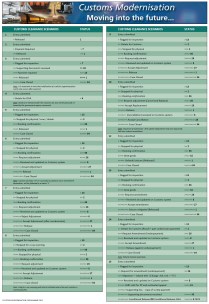
Part 1 provides the user with a table of the permissible CPCs against which he/she can identify the appropriate codes that preceed that which appears in the table. For example, if you wish to clear warehoused goods, in bond, from one customs warehouse to another customs warehouse using CPC E43 42, then you must already have lodged a preceding clearance with CPC E42 00; E42 20; or E42 37. Part 2 provides the same table of CPCs, this time illustrating what CPC codes are available for use for a secondary or followup clearance. For example, , if your original or primary declaration declared goods directly into a Customs Warehouse under CPC E40 00, then your follow-up or subsequent options will be A10 40; A11 40; A13 40; A14 40; A15 40; E41 40; E43 40; F53 40; H67 40; J80 40; or K85 40.

It is important for the Customs User to understand that these are the ONLY applicable CPC combinations, and that the customs system will not permit any variations on these. Most computer service providers have likewise built-in system rules which only allow the CPC codes as permitted. It is precisely because of past mis-use of purpose codes that lead to CPCs being introduced. Users will also now notice that any CPC combination where the previous procedure code is not ’00’ must reference a previous customs declaration. This therefore provides a complete audit-trail of a transaction from point of entry/exit through to its final state, providing the trader improved evidence of his/her compliance with the law. In the coming months, my companion blog Paperless Customs Clearance will provide detailed guidance for all CPCs.

 Related articles

Modernisation Release 2 – Trader Pocket Guide

Customs Trader Pocket Guide 2nd EditionImporters, exporters, freight forwarders, specialist trader practitioners and service providers can visit the SARS Customs Modernisation webpage and download the 2nd edition of the “Trader Pocket Guide“. Traders will find other companion documents on the webpage, in particular the “Guide to SAD Forms“. This publication will help and assist the customs user to locate the appropriate block/space for required declaration data fields. In addition, the new updated “CPC Chart” and “Guide for Application of Customs Procedure Codes” are also available for download. Stakeholders are encouraged to look out for subsequent notifications which will be uploaded to the webpage as the implementation of Release 2 progresses.

SARS e-newsletter – Customs Connect

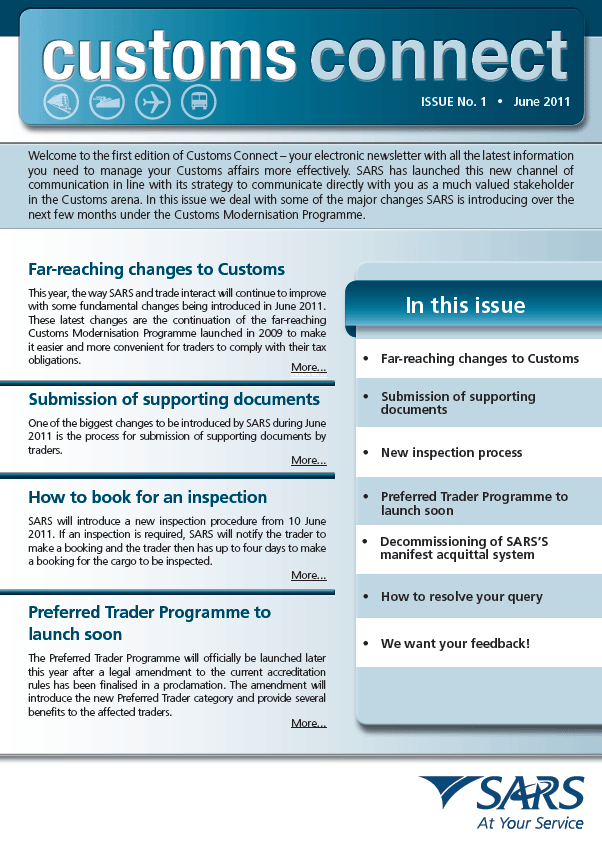
Customs Connect Issue 1SARS has just introduced a new communication medium directed specifically for external stakeholders. It is called  ‘Customs Connect’. Given the ever increasing need for public awareness and outreach in regard to on-going developments in the Customs Modernisation Programme, it is necessary to expand the scope of information to as wide an audience as possible. SARS encourages all external parties (including trade associations) in the local and regional trade community to read and circulate this newsletter. It can be accessed through the Customs Modernisation webpage, and will bring regular updates on modernisation issues.

Automated Cargo Management – Whipping up Industry Awareness

Following the recent posts on this subject, SARS took to ‘walking the talk’ this week. Over the last month a significant increase in registrations with Customs as well as vast improvements in successful electronic manifest data submission has occurred, mainly in the sea freight industry, however. This week’s initiative took the campaign to the hub of air cargo in southern africa – Oliver Tambo International Airport. Meetings were arranged with various stakeholders and industry bodies to reinforce customs cargo reporting requirements. The campaign was intended to offer an alternative approach to the usual formalities of the bi-monthly modernisation meetings. If necessary, further campaigns will be undertaken leading up to the mandatory enforcement of electronic manifest and cargo report submission for air and sea cargo operators in the very near future. SARS will soon be announcing a final cut-off date for voluntary registration for ACM and electronic submission, after which punitive measures will be introduced. Watch the Customs modernisation webpage for further details.