Revisiting the national transit procedure – Part 2

You will recall a recent challenge by trade to SARS’ proposed implementation of mandatory clearance of national transit goods inland from port of initial discharge – refer to Revisiting the national transit procedure – Part 1.

First, some background

Now lets take a step back to look at the situation since the inception of containerisation in South Africa – some 30 years ago. Customs stance has always been that containerised goods manifested for onward delivery to a designated inland container terminal by rail would not require clearance upon discharge at initial port of entry. Containers were allowed to move ‘against the manifest’ (a ‘Through Bill’) to its named place of destination. This arrangement was designed to expedite the movement of containers from the port of discharge onto block trains operated by Transnet Freight Rail, formerly the South African Railways and Harbours (SAR&H) to the inland container terminal at City Deep. Since SAR&H operated both the national railway and the coastal and inland ports, the possibility of diversion was considered of little import to warrant any form of security over the movement of containers by rail. Moreover, container terminals were designed to allow the staging of trains with custom gantry cranes to load inland manifested containers within a ‘secure’ port precinct.

Over the years, rail freight lost market share to the emergence of cross-country road hauliers due to inefficiencies. The opening up of more inland terminals and supporting container unpack facilities, required Customs to review the matter. It was decided that road-hauled containers moved ‘in bond’ by road would lodge a customs clearance (backed with suitable surety) for purposes of national transit. Upon arrival of the bonded freight at destination, a formal home use declaration would be lodged with Customs. Notwithstanding the surety lodged to safeguard revenue, this has the effect of deferring payment of duties and taxes.

Diversification of container brokering, stuffing and multi-modal transport added to the complexity, with many customs administrations failing to maintain both control and understanding of the changing business model. Equally mystifying was the emergence of a new breed of ‘players’ in the shipping game. Initially there were so-called ‘approved container operators’ these being ocean carriers who at the same time leased containers. Then there were so-called non-approved container operators who brokered containers on behalf of the ocean carrier. These are more commonly known as non-vessel operating common carriers or NVOCCs. In the early days of containerisation there were basically two types of container stuffing – full container load (FCL) and less container load (LCL). The NVOCCs began ‘chartering’ space of their containers to other NVOCCs and shippers – this also helped in knocking down freight costs. This practice became known as ‘groupage’ and because such containers were filled to capacity the term FCL Groupage became a phenomenon. It is not uncommon nowadays for a single FCL Groupage container to have multiple co-loaders.

All of the above radically maximised the efficiency and distribution of cost of the cellular container, but at the same time complicated Customs ‘control’ in that it was not able to readily assess the ‘content’ and ownership of the goods conveyed in a multi-level groupage box. It also became a phenomenon for ‘customs brokers/clearing agents’ to enter this niche of the market. Customs traditionally licensed brokers for the tendering of goods declarations only. Nowadays, most brokers are also NVOCCs.  The law on the other hand provided for the hand-off of liability for container movements between the ocean carrier, container terminal operator and container depot operator. Nowhere was an NVOCC/Freight Forwarder held liable in any of this. A further phenomenon known as ‘carrier’ or ‘merchant’ haulage likewise added to the complexity and cause for concern over the uncontrolled inland movements of bonded cargoes. No doubt a disconnect in terms of Customs’ liability and the terms and conditions of international conveyance for the goods also helped create much of the confusion. Lets not even go down the INCOTERM route.

Internationally, customs administrations – under the global voice of the WCO – have conceded that the worlds administrations need to keep pace and work ‘smarter’ to address new innovations and dynamics in the international supply chain. One would need to look no further than the text of the Revised Kyoto Convention (RKC) to observe the governing body’s view on harmonisation and simplification. However, lets now consider SARS’ response in this matter.

SARS response to the Chamber of Business

Right of reply was subsequently afforded by FTW Online to SARS.

Concerns over Customs’ determination to have all goods cleared at the coast – expressed by Pat Corbin, past president of the Johannesburg Chamber of Commerce and Industry in last week’s FTW – have been addressed by SA Revenue Service.  “One of the main objectives of the Control Bill is the control of the movement of goods across South Africa’s borders to protect our citizens against health and safety risks and to protect the fiscus. “In order to effectively determine risk, SARS has to know the tariff classification, the value and the origin of imported goods. This information is not reflected on a manifest, which is why there is a requirement that all goods must be cleared at the first port of entry into the Republic.“It appears that Mr Corbin is under the impression that the requirement of clearance at the first port of entry has the effect that all goods have to be consigned to that first port of entry or as he puts it “to terminate vessel manifests at the coastal ports in all cases”. This is incorrect. “The statutory requirement to clear goods at the first port of entry and the contract of carriage have nothing to do with one another. Goods may still be consigned to, for example, City Deep or Zambia (being a landlocked country), but they will not be released to move in transit to City Deep or Zambia unless a declaration to clear the goods, containing the relevant information, is submitted and release is granted by Customs for the goods to move. The release of the goods to move will be based on the risk the consignment poses to the country.“It is definitely not the intention to clog up the ports but rather to facilitate the seamless movement of legitimate trade. If the required information is provided and the goods do not pose any risk, they will be released.”

So, where to from here?

The issue at hand concerns the issue of the ‘means’ of customs treatment of goods under national transit. In Part 3 we’ll consider a rational outcome. Complex logistics have and always will challenge ‘customs control’ and procedures. Despite the best of intentions for law not to ‘clog up the port’, one needs to consider precisely what controls the movement of physical cargo – a goods declaration or a cargo report? How influential are the guidelines, standards and recommendations of the WCO, or are they mere studies in intellectual theories?

Hong Kong Customs Moves Forward With E-Lock Plans

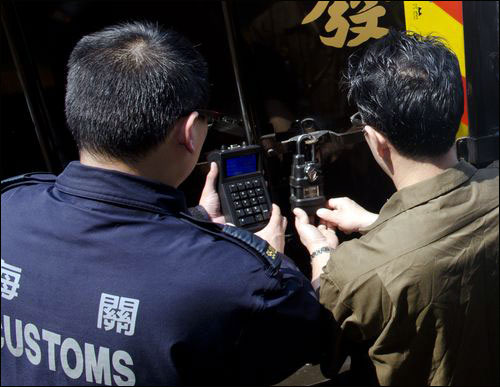
The Hong Kong Customs and Excise Department (C&ED) reports that RFID-based container locks can effectively improve the security, convenience and visibility of the customs process for cargo entering the airport. In November 2011, C&ED began testing three types of electronic locks (e-locks) in order to speed up the process of performing customs checks on containers filled with cargo. The solution, known as the Intermodal Transhipment Facilitation Scheme (ITFS), was implemented as a way to streamline the clearance of cargo passing through customs at Hong Kong International Airport for cargo destined for areas both domestic and outside of Hong Kong. The installation and consulting services were provided by the Hong Kong R&D Center for Logistics and Supply Chain Management Enabling Technologies (LSCM), according to Frank Tong, LSCM’s director of research and technology development.

An electronic lock with an active RFID tag is being used to secure freight passing through
customs and Hong Kong International Airport, ensuring that the cargo remains tamper-free,
while also expediting the clearance process.

The Hong Kong C&ED estimates that the system reduces the amount of time required for clearing each container through customs, from two to three hours down to five minutes, since customs officials can now be assured that the containers have not been opened between their inspection at the border control point and their arrival at the airport. What’s more, the agency can now collect a digital record of where each container has been, along with when it was inspected.

Cargo is loaded into freight containers or directly onto trucks—such as those operated by United Parcel Service (UPS)—in Mainland China, and is then transported to a customs control point located at the border with Hong Kong, where C&ED officials inspect the cargo and clear it for entry into Hong Kong. Following that clearance, the shipment continues on to Hong Kong International Airport’s cargo terminal, where the goods are unloaded from the container or vehicle, and are placed into an air cargo container. Once this has occurred, the cargo is moved through another customs control point at the airport, where C&ED again inspects and approves or rejects its passage.

To speed up this process, the R&D Center implemented the use of an e-lock for the customs agency, consisting of a physical lock activated by a built-in active RFID tag, designed to receive a transmission from an RFID reader that allows the lock to be opened or closed. Three types of e-locks are currently being used, provided by three different vendors: Long Sun Logistics Development Ltd, CIMC Intelligent Technology Co. and CelluWare Research Laboratory. Each of the three products employs a different frequency—433 MHz, 315 MHz and 2.4 GHz—but all comply with the ISO 17712 standard for mechanical seals designed for freight containers.

LSCM has installed fixed RFID readers (provided by the three e-lock vendors) at two border control points—Lok Ma Chau and Shenzhen Bay—as well as at Hong Kong International Airport. When a shipment first arrives at either border control point, C&ED’s staff attaches an e-lock, reads the ID number encoded on its built-in RFID tag via a handheld reader, and links that ID with the vehicle registration number of the truck transporting the container. The transporting company must pre-register each vehicle with the Hong Kong C&ED prior to its arrival; the truck’s ID number is listed in the agency’s database, and the customs official can confirm that the vehicle is, in fact, the one expected.

That data, along with the specific cargo being transported, is then stored on the Hong Kong C&ED’s integrated tracking software platform, developed by LSCM, which collects and processes the data and then displays it for customs officials when necessary. The system stores the e-lock ID number linked to the vehicle ID, and transmits instructions to the e-lock, along with a password, thereby causing it to lock. The device also requires a physical key, which remains in the driver’s possession. In this way, two actions must be completed before the container or vehicle can be unlocked: The e-lock must be electronically unlocked via a password from a customs official, and the driver must use a key to physically open the padlock.

The shipment is then transported approximately 42 kilometers (26 miles) to the airport. The e-lock comes with a built-in GPS device that tracks the vehicle’s location as it moves. In that way, the e-lock stores a record of where the vehicle has been. When the lock is later read at the airport, the back-end software compares the actual GPS data against the container’s expected route. The system can issue alerts in circumstances in which an e-lock is found to have lost a GPS signal, or, based on GPS data, the truck appears to have deviated from the intended route.

At Hong Kong International Airport, a C&ED official either selects the container for inspection, or simply instructs the system to issue an unlocking command with the matching password; the container is then brought to a site where the cargo is removed and then loaded onto an aircraft, says Steve Wai-chiu Chan, a C&ED special duties officer. If the container is selected for inspection, the e-lock remains locked. In this scenario, a truck driver would be instructed to await a C&ED officer, and would be unable to unlock the container without providing the proper password. The C&ED officer, upon arrival, would then use a handheld device to read the e-lock, instructing it to unlock by providing the necessary password.

LSCM installed a total of 38 readers at the two land border control points, five logistic hubs at the airport and a marine control point known as the Kwai Chung Customhouse, for items arriving by sea (at the Marine Cargo Terminal located at the airport). Altogether, by February of this year, 109 containers had been equipped with the e-lock device. An average of 100,000 consignments pass through the border daily, and the ITFS e-lock system is utilized for about 17 percent of that cargo.

The solution has enabled a faster customs clearance process, as well as providing a digital record of what was unlocked, and thus inspected, and when this occurred. The system also improves security, since only officers who know the proper password can access the container. Ultimately, Chan says, “it enhances the Hong Kong logistic industry’s competency and reinforces Hong Kong’s position as a world-class logistics hub.” Source: RFID Journal and a word of thanks to Andy Brown (Tenacent) for bringing the article to my attention.

SA auto industry to gain from 2013 policy shift

Trade remedies are by their very nature complex and most often ill-thought-out. This is said not so much from an entity whom gains to benefit from such an incentive scheme but more from an administrative and compliance perspective. These schemes require more than your average customs and trade consultant; someone who in fact not only knows  customs and trade law very well, but the motor industry as well. Similarly, on the side of the administrating authority an equally adept and experienced team is required to audit this process. I would like to believe that every attempt has been made to ensure that clear legal and procedural guidelines are in the offing, compared to the current MIDP process. On the other side of the coin, exactly how will the local community benefit from the ‘auto cartel’s’ new fortune? Based on SARS recent publication of its Compliance Programme it is noted that the tobacco and textile industries are singled out for scrutiny. Has the motor industry been purposely overlooked?

The SA motor industry stands to benefit from the introduction of a new programme next year, which will affect firm-level strategies, according to Standard Bank research analyst, Shireen Darmalingam. The Automotive Production Development Programme (APDP) aims to raise volumes to 1.2 million vehicles produced per annum by 2020, and to diversify and deepen the components supply chain. The new programme replaces the Motor Industry Development Programme (MIDP), which has been in existence since 1995. The soon-to-be phased out programme centred, among other things, on encouraging motor vehicle and component exports by allowing duty-free imports or reduced import tariffs, depending on the level of local content of exports.

Darmalingam said the replacement of the MIDP should not be viewed as a failure but rather as a point from which to move on and encourage further development of the SA motor industry. She said the APDP would offer the local automotive industry a sense of certainty through to 2020, which should encourage further growth.

“Whether the APDP will benefit certain industries more than others is still a contested question. Indeed, it appears that some benefits may be in favour of larger firms. Nonetheless, all firms are in line to benefit from the new APDP programme.” She said there was a concern that multinational companies were choosing to source leather products from suppliers closer to the major markets. She added that there was a further concern that the APDP, which aimed to provide a production incentive rather than an export incentive, might impact negatively on export-orientated component companies such as those in the leather sector.
However, she said sectors that supplied the aftermarket should benefit from the shift in policy, from MIDP to APDP, due to be implemented from January next year. Source: Business Live


USCBP and EU sign C-TPAT Mutual Recognition

U.S. Customs and Border Protection (CBP) and the European Union (EU) signed today a Mutual Recognition Decision between CBP’s Customs-Trade Partnership Against Terrorism (C-TPAT) program and the EU’s Authorized Economic Operator (AEO) program.

U.S. Customs and Border Protection Acting Commissioner David V. Aguilar and European Union Taxation and Customs Union Directorate Director-General Heinz Zourek sign the Mutual Recognition Decision between CBP’s Customs-Trade Partnership Against Terrorism program and the EU’s Authorized Economic Operator Program.

CBP Acting Commissioner David V. Aguilar and Director-General Heinz Zourek, European Union Taxation and Customs Union Directorate (TAXUD) signed the decision, which recognizes compatibility between the EU and the U.S. cargo security programs.

“Today’s decision on the mutual recognition of the EU and U.S. trade partnership programmes is a win-win achievement: It will save time and money for trusted operators on both sides of the Atlantic while it will allow customs authorities to concentrate their resources on risky consignments and better facilitate legitimate trade,” said Director-General Zourek.

C-TPAT is a voluntary government-business initiative to build cooperative relationships that strengthen and improve overall international supply chain and U.S. border security. C-TPAT recognized that U.S. Customs and Border Protection can provide the highest level of cargo security only through close cooperation with the ultimate owners of the international supply chain such as importers, carriers, consolidators, licensed customs brokers, and manufacturers. Source: US CBP

Related article

SARS issues Compliance Programme 2012/13 – 2016/17

SARS has issued its inaugural SARS Compliance Programme, a high-level overview of its plans for the next five years to further grow compliance with tax and customs legislation. More so than perhaps any other time in history, the current global economic conditions have thrust domestic resource mobilisation into the spotlight, highlighting sustainability built on a foundation of tax compliance. Countries lacking this solid base have found their room for manoeuvre in these uncertain times severely curtailed and, in some cases, completely absent. The impact of self-reliance on self-determination is self-evident.

Many tax administrations publish similar compliance programmes (including Australia, Brazil, Canada, Denmark, Netherlands, New Zealand, Poland, Spain, Sweden, Turkey, USA, UK) and SARS has based it’s Compliance Programme on their ground-breaking work. To download and read the SARS Compliance Programme, click here! For Customs specialists and trade practitioners no less than 3 priority areas involve Customs –

Illicit cigarettes: the trade in and consumption of illicit cigarettes is detrimental to the fiscus and to the health of South Africans. SARS interventions will continue to focus on clamping down on cigarettes smuggled via warehouses as well the diversion of cigarettes destined for export back into the local market. SARS also plans to modernise it’s warehousing management and acquittal system.

Undervaluation of imports in the clothing and textile industry: Undervalued imports pose a significant risk not only to the fiscus but to local industry and job creation. SARS will continue to work together with other government agencies and industry stakeholders to clamp down on this practice including through the establishment and frequent revision of a reference pricing database to detect undervaluation, increasing inspections as well as supporting an integrated border management model.

Tax Practitioners and Trader Intermediaries: Regulation of this industry will be pursued to ensure that tax practitioners and trade intermediaries are all persons of good standing, are fully tax compliant in their personal capacity and provide a high quality service and advice to their clients. SARS will also develop a rigorous risk profiling system to identify high risk practitioners and trade intermediaries.