America – shees verry beeeeg!

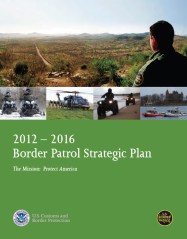
Publication of the latest USCBP Border Patrol Strategic Plan reflects and builds on the transformation of the United States’ relationships with Mexico and Canada, particularly in the areas of border management and security. The joint Declaration of Principles for the 21st-century border represents an enhanced and strengthened commitment to fundamentally restructure the way we manage our shared border. The depth and breadth of cooperation that occurs now between the United States and Mexico was unthinkable even a few years ago. Similarly, the Beyond the Border declaration between Canada and the United States has an equally significant potential in what is already our historically extraordinary relationship with Canada. These developments have created unprecedented opportunities with both Mexico and Canada, in which DHS and CBP will play a defining role, to improve our security and economic competitiveness – and CBP will play a defining role in taking advantage of those opportunities. The Border Patrol in turn is key to advancing CBP’s security agendas with Mexico and Canada, working with its law enforcement counterparts in each country to identify and mitigate threats.

The U.S. Border Patrol is a premier law enforcement organization, recognized around the world for expertise, capabilities, and professionalism. CBP’s officers and agents are the frontline, the guardians of the Nation’s borders. We honor and are proud of them, and we thank them for everything that they do to protect America and the American people. Source: CBP.gov

So there you have it – for a real dose of commercialized Customs and what it can do for the good folks in America, and anywhere else in the world for that matter, check out the strategic plan by clicking here! You’ll be forgiven if you thought you were reading an edition of Jane’s Defense & Security Intelligence & Analysis. Most customs and border management agencies around the world can only dream about such impressive kit! 

Related items

US Customs – Testing new way to decrease border dwell-time for travellers

In an ongoing effort to reduce wait times at the International Bridge, U.S. Customs and Border Protection Office of Field Operations will pilot a project to bring vehicles to the inspection booths in less time.
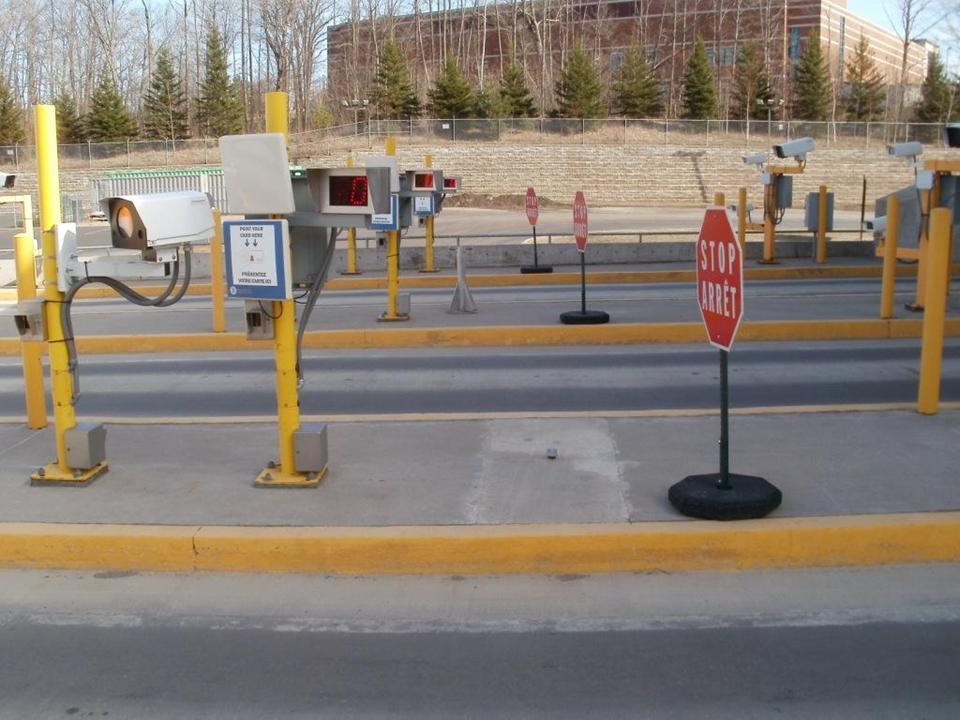
The stop signs will be placed in all three upper lanes and will shorten the “pull up” distance to the booth. This allows vehicles to queue up quicker. “Efficacy in movement is paramount to this project’s success. We are always trying to improve the flow of legitimate traffic while enforcing the laws of the United States,” said Patrick Wilson, CBP Sault Ste. Marie Assistant Port Director.

The Sault Ste Marie port of entry has a unique design that separates commercial traffic from car traffic, creating an upper and lower plaza. The focus of this project will be on the upper plaza only and will not affect the flow of traffic on the lower plaza.

Stop signs will be placed in all three upper lanes beginning Friday, April 20. The stop signs will shorten the “pull up” distance to the booth. This allows vehicles to queue up quicker. The stop signs will be placed near Radio Frequency Identification readers where the traveling public can display their Western Hemisphere Travel Initiative RFID-enabled document to pre-populate the officer’s computer screens.

CBP is testing the theory that they can process more travelers each hour by reducing the amount of time it takes each vehicle to get to the inspecting officer. This pilot project will incorporate a two-stop sign process. Upon entering the upper plaza, vehicles will be required to stop at the first existing stop sign. As the vehicle ahead clears, travelers will move to the next new stop sign and present their ID to the RFID reader. Once the vehicle at the inspection booth clears, travelers will proceed to the inspection booth.

Vehicles with trailers/campers are asked to use the lower plaza lanes so as not to impede the functionality of installed equipment. LED signage will be adjusted to notify motorists of this change.

CBP officers will direct traffic periodically during this project to help educate travelers on this new process. “We continue to look for efficiencies in our processes to improve the border crossing experience. If we can save a couple of seconds of inspection time per vehicle, the time savings should reduce each traveler’s wait,” said Assistant Port Director Wilson. Source: http://www.cbp.com

Border Posts, Checkpoints and Intra-African Trade

You may recall earlier this year the African Development Bank and the WCO agreed to a partnership to advance the economic development of African countries by assisting Customs administrations in their reform and modernization efforts.

The AfDB’s regional infrastructure financing and the WCO’s technical Customs expertise will complement each other and improve the efficiency of our efforts to facilitate trade which includes collaboration in identifying, developing and implementing Customs capacity building initiatives by observing internationally agreed best practice and supporting Customs cooperation and regional integration in Africa.

In addition, the partnership will seek to promote a knowledge partnership, including research and knowledge sharing in areas of common interest, as well as close institutional dialogue to ensure a coherent approach and to identify comparative advantages as well as complementarities between the WCO and AfDB. Customs professionals, trans-national transporters and trade practitioners will find the featured article of some interest. It provides a synopsis of the key inhibitors for trade on the continent, and will hopefully mobilise “African expertise” in the provision of solutions and capacity building initiatives.

How to resolve regional transport problems?

The Freight-Intra Africa Trade Conference in Pretoria, this week, has featured several news articles in the local media, and no doubt some foreign tabloids as well. The Minister of Transport has cleared up the cause of the ills plaguing cross border and regional transport. At least we are now fully informed that [historical] design issues and operational inefficiencies at South Africa’s landborders, and Beit Bridge in particular, are the fundamental causes of under-performance in intra-Africa trade.

“In most cases, the delays at the borders are caused by operational inefficiencies, which result in the duplication of processes. This is a serious cost to the economies of the countries that conduct their trade through such border posts,” the Minister said.

One has to seriously question who advises the minister which leads to such statements, and whether or not these advisers have visited any land borders in recent months.

Now the remedy – Government has budgeted and approved R845-billion for infrastructure development over the medium-term, with a significant proportion, about R262-billion of this investment being earmarked for transport infrastructure and logistics projects. Can anyone question government’s commitment in this respect? Not really. However, the Minister was quick to point out government would resolve inefficiencies at the borders by establishing a mechanism that will bring all border entities under a single command and control structure to address the fragmentation in border operations. “The ultimate vision is to create one-stop border operations to facilitate legitimate trade and travel across the borders”.

The proliferation of border management agencies (integration of enforcement and regulatory authorities under one umbrella) – which has seen the demise of many customs administrations over the last decade – has not proven an effective vehicle to manage cross border travel and trade. It is difficult to see how facilitation procedures can co-exist under a command and control environment. What the situation does create is the opportunity to consolidate a budget for security expenditure. Various Sources: Engineering News, Business Live, Fin24.com and personal opinion.

Mobile Customs Control – Great minds think alike

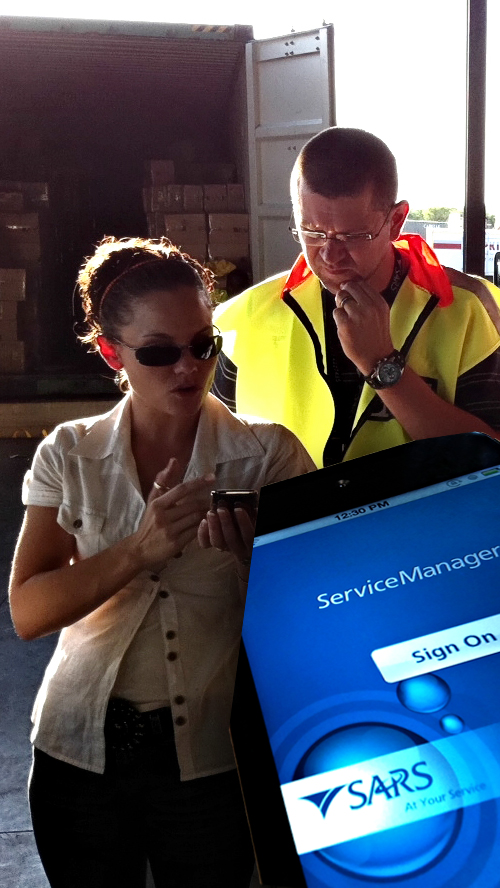
Beitbridge inspection area6 December 2010 saw the rollout of a new electronic tool for customs inspectors at Beitbridge border post. The need for a hand-held device was identified following the rollout of a new workflow system, called Service Manager, to various Customs offices over the past few months. Although the changes introduced recently were aimed at moving Customs to a totally paperless environment, customs inspectors still had to print out their instructions on paper, manually write down the inspection results and then recapture these onto the system back in the office.

The use of an iPod by a Customs officer to conduct a physical inspection at Beitbridge this week introduces significant enhancements over the previous manual process. SARS has been liaising with iPod experts in various countries around the world over the past few months to develop this function and procure the devices.

The solution comprises an Apple iPod Touch which has been configured to operate SARS’ automated inspection workflow application – Service Manager. The introduction of a hand-held device therefore means that all the functions of Service Manager are now at the inspector’s finger-tips. Inspectors receive their instructions on the iPod, capture the results and make recommendations which then go to the finalisation/adjustment inspector. They can even take photographs with the iPod if they need further clarification on the goods they are inspecting. Inspectors no longer have to go back and forth to the office and their next job can be assigned to them on the spot. This is expected to substantially reduce the time spent on physical inspections and minimise human error.

Initially 34 iPods were procured for Beitbridge, WiFi technology was made available at the port and training of affected staff undertaken. All physical inspections at Beitbridge were being conducted with iPods and will be rolled out to the other Customs border posts throughout 2012.

While SARS’ solution is the first known Apple solution of its kind, similar solutions have been introduced recently within the US Bureau for Customs and Border Control and the Australian Border Control Agency offering varying types of functionality, including the integration of RFID technology by the Australians to monitor and track cargo movements. Life for Customs officers is a whole different and will continue to evolve if it expects to remain in touch with modern era fraud and scams.

SADC Free Trade Area requires Integrated Border Management

At least two articles have surfaced within the last week calling for greater urgency towards the development of free trade areas in Africa. How much time, money and effort seem to be expended in futile trade discussions that – to the man in the street – are meaningless. One such article, appearing in the Freight & Trade Weekly (FTW) relates to a speech delivered by the South African Transport Minister imploring SADC members to fast-track an integrated border management framework to enable ‘free flow’ of trade in the region. Before pressurizing foreign countries to embrace such change it should at least be properly considered at home. For more than 15 years, South Africa has failed to implement any meaningful integrated border management of its own. Forget about the so-called economic protectionism amongst individual African countries. We have – on our own soil –an inter-departmental ‘protectionism’ which cares little for free flow of legitimate goods. Admittedly there are moves to ‘integrate’ certain frontline functions such as customs border control and immigration. This, however, still does not mitigate interference from other government agencies in tampering with ‘legitimate trade’. Each department seems hell-bent on enforcing its respective mandate regardless of consequential overlaps in activity, oblivious to the detrimental effect this has for legitimate trade. So what is ‘integrated border management’? In the context of a sovereign state it could imply one of two things:

  • A cooperative inter-departmental approach where ‘individual’ government departments perform combined interventions (according to their respective legal mandate) on people, cargo and conveyances according to a structured operational procedure and workflow; or
  • A Border Management Agency (being a single government entity) comprising the capacity to effect all immigration, customs and border control/security functions at ports of entry and exit.

Secondly, integrated border management at external borders can be further extended to include a streamlined import/export or entry/exit process to facilitate the movement of legitimate travellers, goods, and conveyances in a single transaction. This is described as a ‘one stop border’. A critical success factor here is the ability of two country’s border authorities to be able to co-locate with one another and affect a common clearance/passenger movement process. Theoretically these things are all easy to understand, but a whole lot more difficult to implement – more about this another time.

Therefore, before a successful SADC FTA can ever hope to materialise, the concept of proper risk-based inter-departmental control must be embedded and administered within a home country before attempting a bi- or multilateral initiative. The article “SADC must implement integrated border management” can be found on page 17, of the 28 October 2011 issue of the FTW.

Customs and the Academia

Recommended reads for the Customs professional. Visit the WCO for the latest edition of WCO News. The main  articles  include why knowledge is the catalyst for customs excellence; an update on air cargo security and developments coWorld Customs Journalncerning HS2012. 

For readers and customs users requiring more academic related information, you will not be disappointed with the latest bi-annual publication of the World Customs Journal. Some very interesting papers covering AEO certification and revocation; Risk management systems and the use of data mining; Case study of Customs and other Agency role in trade facilitation initiatives in Bangladesh,  and Customs valuation compliance through corporate income tax to name but a few. You will also find the Special Report from the recent PICARD 2010 Conference held in Abu Dhabi, UAE.

Border Management ModernisationThe World Bank Border Management Modernization book  is designed to shed new light on problems related to border clearance processes by Customs and other agencies, processes which are among the most important, and problematic links in the global supply chain. In spite of widespread recognition of the need to improve the efficiency of border management regimes, Customs and other border management agencies in many countries frequently pay lip service to the trade facilitation agenda according to the authors.

The book aims to identify a range of strategies that will help officials meet their traditional control responsibilities while facilitating legitimate trade at the same time. It also provides advice to development professionals and key policy makers about what works, what does not and why. Gerard McLinden, Enrique Fanta, David Widdowson and Tom Doyle edited the new book and the WCO Secretariat contributed chapter 11 on Reform instruments, tools, and best practice approaches. For more information visit the World Bank website  http://publications.worldbank.org.

You may also acquire this publication through local site http://www.take2.co.za

Border Management Agency – Government promises finalisation by 2014

Lebombo border lineIt must be over a decade since the South African government entertained the notion of a border management agency (BMA). Initial attempts were made along the lines of a collaborative departmental approach to securing and administering the plethora of controls. None of the attempts has had any success in meshing together a workable solution. Perhaps the best essay on the subject remains Jonny Steinberg’s “An overview of South African border control: 1994-2004“.  

A recent article by Leon Engelbrecht, editor of DefenceWeb, suggests that the ‘thought process’ behind the establishment of a BMA has not moved beyond the pre-democracy stance of a military emphasis at the countries border posts and borderlines. Unlike other parts of the world where ‘border security’ retains a customs and immigration character – if only just – details of this country’s endeavours appear to favour military and police type controls which bodes little hope for intra SACU/SADC trade developments. Unless a strong leader, having an acute understanding of both trade and security, heads up such BMA, there is little hope that the initaitve will ever materialise. Lets just wait and see.