 As countries around the world ramp up their campaigns against smoking with tough restrictions on tobacco advertising, the industry is fighting back by invoking international trade agreements to thwart the most stringent rules.
A key battlefront is Australia, which is trying to repel a legal assault on its groundbreaking law requiring cigarettes to be sold in plain packs without distinctive brand logos or colors. Contesting the law, which came into effect Dec.1, are the top multinational cigarette makers and three countries — Ukraine, Honduras and Dominican Republic — whose legal fees are being paid by the industry.
The dispute underlines broader concerns about trade provisions that enable foreign companies to challenge national health, labor and environmental standards. Once a country ratifies a trade agreement, its terms supersede domestic laws. If a country’s regulations are found to impose unreasonable restrictions on trade, it must amend the rules or compensate the nation or foreign corporation that brought the complaint. In the case of Australia’s plain packaging law, the tobacco industry and its allies are challenging the measure as a violation of intellectual property rights under trade agreements the nation signed years ago.
Public health advocates fear the legal attack will deter other countries from passing strong measures to combat the public health burdens of smoking. The “cost of defending this case, and the risk of being held liable, would intimidate all but the most wealthy, sophisticated countries into inaction,” said Matthew L. Myers, president of the Campaign for Tobacco–Free Kids in Washington D.C.
The advocates also say countries should be free to decide how best to protect public health, without being second-guessed by unelected trade panels. Moreover, they argue, tobacco products, which kill when used as intended, should not be afforded the same trade protections as other goods and services. Worldwide, nearly 6 million people a year die of smoking-related causes, according to the World Health Organization, which says the toll could top 8 million by 2030. With fewer people lighting up in wealthy nations, nearly 80 percent of the world’s 1 billion smokers live in low and middle-income countries.
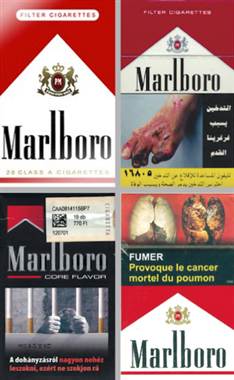
Marlboro, the world’s top-selling brand, packaged under labeling laws of (clockwise) the U.S., Egypt, Djibouti, Hungary/Photos of non-U.S. packs, Canadian Cancer Society
Countries have been emboldened to pass more stringent measures by the Framework Convention on Tobacco Control. In effect since 2005, the treaty has committed about 175 nations to pursue such measures as higher cigarette taxes, public smoking bans, prohibitions on tobacco advertising, and graphic warning labels with grisly images such as diseased lungs and rotting teeth (The U.S. has signed the treaty, but the Senate has not ratified it. The U.S. Food and Drug Administration has ordered graphic warnings for cigarette packs, but an industry court challenge on 1st Amendment grounds has stalled the rule.)
Cigarette makers say they acknowledge the hazards and the need for regulations. “We actually support the vast majority of them,” said Peter Nixon, vice president of communications for Philip Morris International, which has its headquarters in New York, its operations center in Switzerland, and is the biggest multinational cigarette maker with 16 percent of global sales.
But the industry has watched with growing concern as more than 35 countries have adopted total or near-total bans on cigarette advertising. Its big profits depend on consumer recognition of its brands. Yet in many countries, the once-ubiquitous logos and imagery are receding, leaving the cigarette pack as a last refuge against invisibility.
Now the pack, too, is under attack. Along with plain packaging laws such as Australia’s, countries are weighing retail display bans that keep cigarette packs out of view of consumers, and laws requiring graphic health warnings so large that there is barely any room for trademarks. Tobacco companies contend that countries enforcing such rules are effectively confiscating their intellectual property and must pay damages.
The industry also claims that measures like plain packaging are counterproductive. “We see no evidence — none at all — that this will be effective in reducing smoking,” Nixon of Philip Morris International said in an interview. In fact, he said, generic packaging likely will increase sales of cheap, untaxed counterfeit smokes, thus increasing consumption (my emphasis added).
Comment: And for me this is the bottom line. Governments are happy to collect the ‘sin tax’ every year, most increasing it annually under the pretext of curbing the use of alcohol or tobacco products. Forcing draconian law will only increase the contraband ‘underground’ which these same governments have little control over. The worldwide push under the WHO banner appears to have more of a ‘social conditioning’ connotation than a health one.
Related articles
- Aussie Ciggies In Brown Paper Wrappers From Today. What Next, Pink Hearses? (stirringtrouble.wordpress.com)
- Plain packs for Australia smokers (bbc.co.uk)
- Australians Face Gangrene Photos as Tobacco Brands Vanish – Bloomberg (bloomberg.com)
- These are the cigarette packs Big Tobacco is afraid of (qz.com)

 What Happened to the Portcullis?
You must be logged in to post a comment.