Data is King!

Two recent articles reaching my desk reiterate the importance of clean and standardised Customs data. Without this, any real benefits to be derived from the latest and future technologies will not be fully achieved. Downstream, a country’s economy depends on this data for accurate analysis, forecasting and policy-making. Similarly, the business community relies on accurate information to assist in better business and investment decisions.

During the 15th PICARD Conference held during 23-26 November 2020, ‘World Customs Journal Special Edition’ was introduced. The first paper of the special edition is based on the keynote speech which was given at the 14th PICARD Conference in October 2019 titled “Data Science: Policy Implications for Customs”.

The paper referred to is titled –

“If algorithms dream of Customs, do customs of cialsdreamofalgorithms?A manifesto for data mobilisation in Customs

The Abstract of the document reads as follows –

“Governance by data is a growing global trend, supported by strong national public policies whose foundation is open data, artificial intelligence and decision-making supported by algorithms. Despite this trend and some technical advances, Customs face obstacles in deploying ambitious data use policies. This article describes these challenges through recent experience in some Customs administrations and considers the technical and ethical issues speci c to all law enforcement agencies in the context of customs missions, to open paths for research and propose policy recommendations for a better use of customs data.”

The second matter is perhaps more directed towards Africa. TRALAC Newsletter, of October 2002 titled “Trade and Related Matters discusses the importance of data, specifically now with the introduction of the African Continental Free Trade Area (AfCFTA) in January 2021.

The article considers more than just Customs trade data relating to goods. It envisages trade in services data as just as important to ensure a holistic approach –

“Trade-related data includes not only recorded values and volumes of goods trade among countries, but also data on services trade, non-tariff measures and barriers, tariffs, informal trade, trade restrictiveness, macro-economic conditions (like gross domestic product), micro-economic data (industry/firm-level data including employment, sales, profits and prices) and investment. This data is utilised by governments to make public policy decisions including the formulation of industrial, agriculture, trade and economic growth policies, strategies and regulations; trade negotiations strategies; merger and acquisition reviews; assessments of anti-competitive practices and determinations in trade remedy cases and applications for changes in tariffs. Businesses use trade information, such as tariffs in destination markets, applicable non-tariff measures, transportation costs and trade restrictiveness in combination with macro-economic indicators, firm-level data and market information to make investment, trade and market development decisions, and also to lodge trade remedy and tariff review applications and to inform their participation in public-private forums.”

The Newsletter continues to explain the notable improvements in data and reporting oer the last decade –

“Although trade and trade-related data has various uses, it needs to be useful, reliable and accurate information which is publicly available (except in the case of confidential information). This is the area where most African countries have historically fallen short although there has been some significant progress over the last decade. Initially, African trade data was only available on subscription databases and only for a select number of countries (like South Africa, Kenya and Egypt) and limited to trade in goods. There was a lack in published tariff schedules and data pertaining to non-tariff measures, investment, informal trade and services. In recent years, the availability of some data has improved significantly, especially for goods trade.

  • African countries are now increasingly publishing their statistics on websites of national statistics authorities and notifying their national data to the United Nations (UN). This data includes data on formal goods trade, aggregate services trade, non-tariff measures, tariffs, investment and some market information. The quality of the data has also improved as most countries now extensively verify the data prior to publication and submission. Increased access enables organisations like the World Bank, the World Trade Organisation (WTO) and International Trade Centre (ITC) to obtain, collate and publish trade data in databases like the ITC TradeMap and MacMap and the WTO trade portal.
  • As part of the implementation of the WTO Trade Facilitation Agreement, many countries are establishing trade portals. Southern and eastern African countries that already have functioning portals include Seychelles, Eswatini, Kenya, Rwanda and Uganda. Some portals contain detailed information on import and export requirements by specified product, sanitary and phytosanitary requirements, port of entry and applicable tariffs. The trade portals of countries in east Africa, including Uganda and Rwanda provide details of import or export processes including the trade costs such as inspection charges, and indicate the waiting time to complete the different steps.
  • Once fully operational, the African Trade Observatory (ATO) will contribute significantly to the availability of African trade data and capacity building. The ATO will collect and analyse trade and trade-related qualitative and quantitative data and information, establish a database for African trade; monitor implementation and evaluate the implementation process and impact of the AfCFTA and the Action Plan for Boosting Intra-Africa Trade (BIAT); and equip national governments and businesses to analyse and use of trade and related data.
  • There is increasing awareness of the effect of non-tariff barriers (NTBs) on intra-Africa trade. More information is available in the public domain through industry/product/sector studies, the trade cost database of the World Bank and the online non-tariff barrier mechanisms of the COMESA-EAC-SADC Tripartite Free Trade Area, the Borderless Alliance (west Africa) and the new AfCFTA mechanism.
  • Informal trade is recognised as a major component of intra-Africa trade and this is not captured in formal trade statistics. There are a number of initiatives to gather data on informal cross-border trade (ICBT), including studies by UNECAand ongoing work by the Bank of Uganda which has been conducting surveys and reporting ICBT data since 2005.

Although there have been improvements in intra-Africa trade data, there is room for improvement.”
WCO Publishes HS 2022 Correlation Tables

The WCO has released the HS 2022 Correlation Tables.

The Harmonized System Committee (HSC) completed its examination of the correlations prepared by the Secretariat at its 66th Session in October 2020. Upon the adoption of the HSC/66 Report on 13 November 2020, the Correlation Tables were cleared by the HSC for release on the WCO website.

While not legal instruments, the Correlation Tables have become essential tools for Members and the wider trade community in preparing for the introduction of a new edition of the HS. These tables provide guidance on the correlations between the Seventh Edition of the Harmonized System (HS), which comes into force on 1 January 2022 and the current HS 2017 (Sixth Edition) of the HS. There are two tables released.

Table І establishes the correlation between the 2022 version and the 2017 version of the HS. It also includes remarks against many of the correlations, briefly specifying the nature of the goods transferred and, where appropriate, referencing other relevant amended legal provisions in the HS.

Table ІІ establishes the correlation starting from the 2017 version to the 2022 version. As a simple mechanical transposition of Table І, it does not include a reproduction of the remarks.

Access the Correlation Tables here!

Source: World Customs Organisation, 13 November 2020

WCO News – October 2020

The WCO has published the 93rdedition of WCO News, the Organization’s flagship magazine aimed at the global Customs community, which provides a selection of informative articles that touch the international Customs and trade landscape.

This issue looks more specifically at Customs valuation, a technical but fundamental subject. Since its inception, the WCO has always been closely associated with the different multilateral systems used to value imported goods. As the Technical Committee on Customs Valuation established by the WTO Agreement on Customs Valuation has just celebrated its 50th Session, we thought it appropriate to retrace the history of the rules used to determine the value of imports, the challenges raised by their implementation and existing opportunities for Customs to enrich their knowledge and improve their practices in this area.

The “Panorama” section covers various topics such as the development of electronic tariff platforms in Africa, the improvement of the food clearance process in India, the construction of an advanced digital platform for trade and logistics in the United Arab Emirates, enhanced collaboration between Australia and Korea through officer placement, and, finally, the perspective of Customs experts on issues deemed important in their own country or area of work.

Following on from the previous edition of the magazine, we have compiled articles related to the COVID-19 pandemic in the “Focus” section. The WCO Secretariat presents, in particular, the new procedures and new tools adopted to ensure continuity of activities by the Organization’s working bodies. As for capacity building, it is discussed in an article describing the remote delivery of Mercator Programme Stocktaking and Forward Planning missions by the WCO team overseeing the HMRC-WCO-UNCTAD Programme.

The “Flash info” section includes a long article on the new approaches to measuring corruption and integrity which have been adopted by the WCO Secretariat team in charge of the Anti-Corruption and Integrity Promotion (A-CIP) Programme, and what lessons can be learned from their experience so far.

Finally, this issue’s “Point of view” article highlights the benefits of using systematic non-intrusive screening equipment and automatic detection to screen baggage upon arrival at airports.

It has been our great pleasure to produce another edition of WCO News and we trust that you will enjoy reading this issue, whether it be the paper version or the new mobile-friendly digital one.

Source: WCO, 28 October 2020

WCO holds its first Accreditation Workshop on E-Commerce

A Global On-line Accreditation Workshop for English-speaking experts on E-Commerce was held from 31 August to 7 September 2020 via the CLiKC! platform of the World Customs Organization (WCO). 

Due to the increasing needs of WCO Members for Capacity Building support for a harmonized and efficient implementation of the WCO Framework of Standards on Cross-border E-Commerce and other supporting tools, the Secretariat organized this first Accreditation Workshop in the area of E-Commerce as a pilot virtual accreditation initiative.

The event was organized with the objective of setting up a pool of English-speaking Technical and Operational Advisors capable of independently leading, on behalf of the WCO for its Members, Capacity Building missions in the field of Cross-border E-Commerce.

Twelve selected candidates representing five of the WCO regions took part in the Workshop. Mr. Mike Leahy of the Canada Border Services Agency (CBSA), former Customs Co-Chairperson of the WCO Working Group on E-Commerce, joined the workshop as a co-facilitator. Participants from Australia, Belgium, Brazil, Canada, China, Ireland, Japan, Mauritius, the Netherlands, Nigeria, Pakistan and the United Kingdom worked intensively and demonstrated their knowledge and skills to deliver Capacity Building activities in the area of Cross-border E-Commerce. Moreover, the Workshop served as a forum for sharing knowledge and experience, as well as discussing challenges and solutions. 

The participants that successfully completed the Accreditation Workshop will be invited to the next stage of the WCO expert accreditation process, an in-field mission with a qualified WCO expert in the area of E-Commerce. Fully accredited experts will be expected to conduct future WCO Capacity Building activities.

Also read – Facilitating E-Commerce (WCO Article)

Source: WCO, 8 September 2020

WCO 2019 Illicit Trade Report

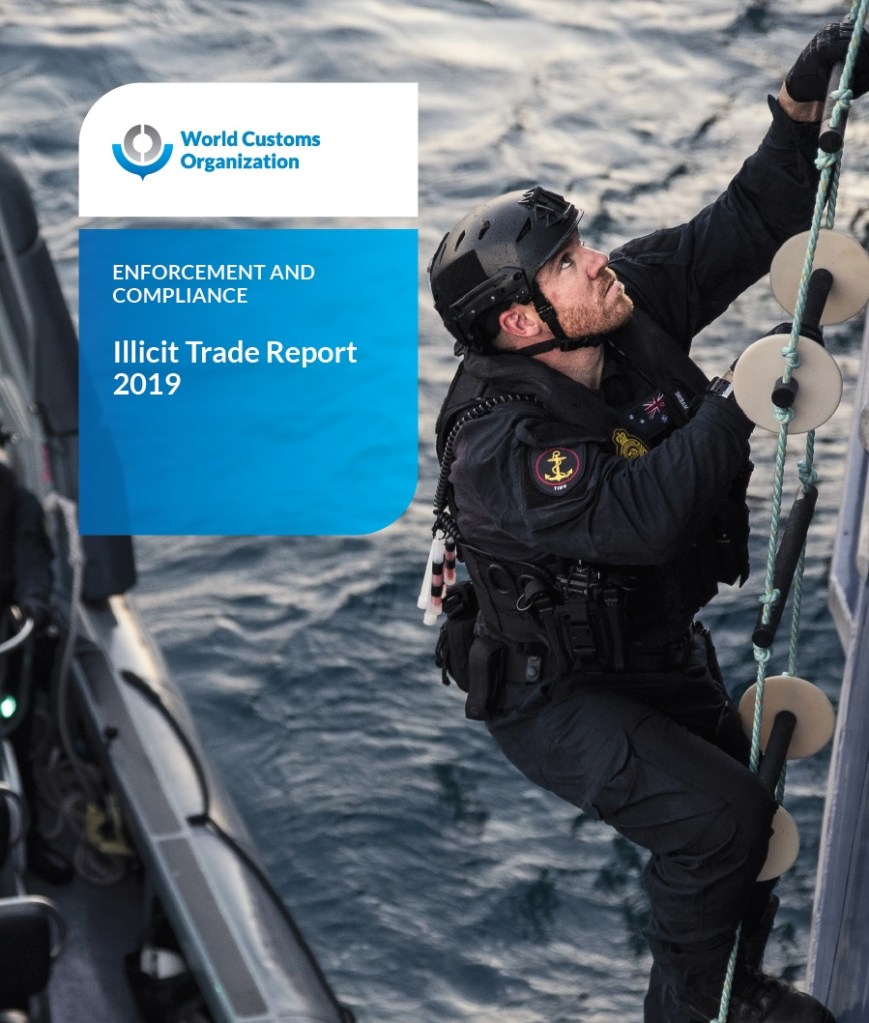
The WCO has issued its 2019 Illicit Trade Report (ITR), an annual publication which offers a comprehensive study of illicit trade flows through an in-depth analysis of seizure data and case studies voluntarily submitted by Member Customs administrations worldwide. 

The information captured in the ITR provides essential insight into the occurrences of illicit trade, thereby assisting Customs administrations in understanding trends and patters and making enlightened decisions to secure cross-border trade. The importance of comprehensive data analysis is indisputably a key component to support effective and efficient Customs enforcement activities. 

This year, the analysis provided in this Report is based on data collected from 137 Member administrations and the report consists of six sections: Cultural Heritage; Drugs; Environment; IPR, Health and Safety; Revenue and Security. 

For the fourth year in a row, the WCO has partnered with the Center for Advanced Defense Studies (C4ADS), a Washington, D.C.-based non-profit organization dedicated to providing data-driven analysis and evidence-based reporting, thereby enriching readers’ experience with advanced data visualization technologies and enhanced data analysis.  

Access the 2019 Illicit Trade Report here! (45MB)

Source: World Customs Organisation

Kazakhstan, “My Faithful Friend” wins the 2020 WCO Photo Competition

A photo submitted by Kazakhstan Customs, as part of the annual WCO Photo Competition, has been voted as the winner of the competition 2020 edition. The aim of the competition is to provide the WCO Members with a means to showcase their Administration’s history, activities and successes.

The winning photo shows a Customs officer in uniform alongside his faithful friend, ready to start the day despite the risks posed by the spread of COVID-19. 

The WCO Secretariat wishes to congratulate the winner and thank all 58 Customs administrations which took part in the Competition this year, as well as the 76 Members having voted for their favorite photos.

See all the entries for 2020 here!

Source: World Customs Organisation

Brazil launches first ever nation-wide Time Release Study

On 30 June 2020 the Secretariat of the Federal Revenue of Brazil (Receita Federal do Brasil), launched its first ever nation-wide Time Release Study (TRS) during an online live broadcasted event attended by over 4000 participants – including border agencies and the private sector, as well as Customs administrations from across the globe. The TRS, which follows the World Customs Organizations (WCO) TRS Methodology, constitutes a milestone for the Brazilian Customs Administration as it enhances transparency while providing an opportunity for an evidence based dialogue between all key stakeholders to tackle the identified bottlenecks and improve the effectiveness and efficiency of border procedures.

The TRS report was validated by the WCO in collaboration with the World Bank Group and with support of the UK’s Prosperity Fund. Speaking at the Opening Session of the launch event, WCO Deputy Secretary-General, Ricardo Treviño Chapa said: “This is a big step forward towards increased trade facilitation and provides a baseline to measure the impact of actions and reforms”. He also underlined that the Brazilian experience would be valuable to share with the wider Customs community and added that “the current health emergency shows that it is key to keep the flow of goods going”. Throughout the event the importance of the WCO’s TRS methodology was highlighted by various speakers as a vital tool for strategic planning and the implementation of the WTO’s Trade Facilitation Agreement. 

The study shows an average time measured of 7.5 days considering air, sea and road modes of transport. The Customs clearance stage accounts for less than 10% of the total time measured, while those actions under the responsibility of private agents represent more than half of the total time spent in all flows analysed. 

To further increase transparency for importers and exporters, the Secretariat of the Federal Revenue of Brazil also intends to publish the raw data of the TRS.

The recording of the full launch event with Portuguese/English translation can be watched here (YouTube).

The TRS report and its Executive Summary are available here.

Source: World Customs Organisation

Guide to the WCO E-Commerce Framework of Standards

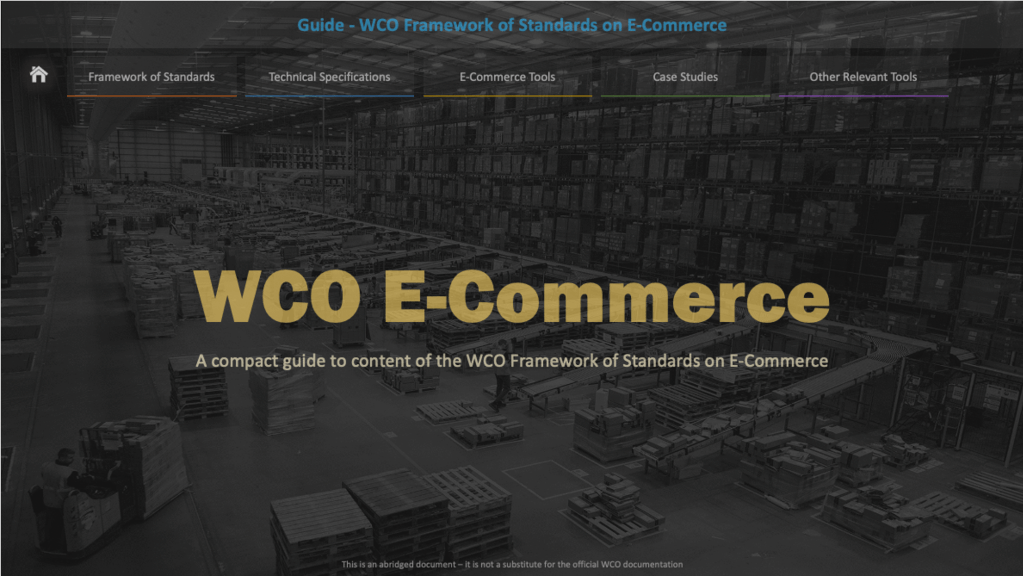
It is often difficult to navigate and assimilate the myriad of documentation and annexes associated with significant initiatives such as WCO’s ‘framework of standards’. True, the documentation is detailed and technical. There are, however, online training courses available on the WCO website for users wishing to attain a level of proficiency on a particular subject. Furthermore, member states can request technical assistance from WCO in the establishment of capacity for the implementation of specific Customs initiatives.

However, sometimes one requires a synopsis or insight as to what a particular initiative aims to achieve. This is important so as to establish the nature and extent of change and capacity required in one’s own domestic situation. In my area of operation, MS PowerPointTM plays an important role in uniformly conveying key information to a multitude of people across different disciplines in the organisation. Im happy to share a ‘guide’ which consolidates most of the ‘official’ WCO documentation that comprise the Framework of Standards on E-Commerce. When viewed as a PowerPoint Show, all hyperlinks to the official WCO E-Commerce documentation are available for download or display. Below are versions for both standard PowerPoint or PowerPoint Show. I hope it will serve some useful purpose.

Guide – WCO Framework of Standards on E-Commerce [PPTX, 3MB]

Guide – WCO Framework of Standards on E-Commerce [PPSX, 3MB]

WCO launches COVID-19 Trade Facilitation Repository

In the wake of the ongoing COVID-19 outbreak, characterized by the World Health Organization (WHO) as a pandemic on 11 March 2020, countries around the world have been adopting a series of trade and border protection measures to try to contain the spread of the disease across borders. Such measures have had immediate and severe impacts on economic activities and caused major disruptions in supply chains. Given that trade facilitation is a key policy tool that can help countries mitigate some of the impacts of the COVID-19 pandemic, the WCO has partnered with the WTO, UNCTAD, the CSSO, the GATF, IATA and ITC to develop a COVID-19 Trade Facilitation Repository in which all these actions are consolidated.

The repository acts as a platform that consolidates the initiatives on trade facilitation adopted by organizations and stakeholders, seeking to provide access to these resources in a unique and user-friendly database. It contains a useful listing of all such initiatives broken down by organization, type of measure and subject matter. As the situation evolves and further actions are taken, the platform will be expanded to include other key actors working in the area of trade facilitation.

Since the beginning of the COVID-19 pandemic and its unprecedented sanitary and economic effects, the WCO and other international organizations, NGOs, business associations and other representative entities have redeployed resources to develop new instruments, tools and guidance materials on trade facilitation measures. These documents can be a useful source of information for countries to learn from each other, share best practices and experiences and provide inspiration to design targeted policy responses. However, these resources were scattered throughout a multitude of platforms. This initiative will assist in ensuring that the seamless flow of safe cross-border trade continues, especially with regard to essential goods which are crucial for fighting the COVID-19 pandemic.

The COVID19 Trade Facilitation Repository can be accessed via the following link and will be updated regularly to reflect new guidance material developed.

The WCO thanks its partners, the World Trade Organization (WTO), the United Nations Conference on Trade and Development (UNCTAD), the Commonwealth Small States Office (CSSO) in Geneva, the Global Alliance for Trade Facilitation (GATF), the International Air Transport Association (IATA) and the International Trade Centre (ITC) for this initiative and reiterates its commitment to assist its Members in securing, protecting and facilitating legitimate global trade.

Source: World Customs Organisation, 9 May 2020

WCO-IMO Partnership for maritime digitalization to support flow of trade by ship

The WCO and the International Maritime Organization (IMO) strengthened their partnership recently to further facilitate the exchange of information in a harmonized way by updating the IMO Compendium on Facilitation and Electronic Business and mapping it to the WCO Data Model. The updated Compendium, which is a set of standards on the submission of maritime related data, will enable the integration of Maritime and Customs Single Windows and allow closer coordination between Customs administrations and Maritime authorities. 

It is known that when ships enter and leave ports, vital information concerning cargo, dangerous goods, crews, vessel details and other pieces of information have to be exchanged with the authorities ashore. However, under the International Maritime Organization (IMO) Convention on Facilitation of International Maritime Traffic (FAL), public authorities are now required to set up systems for this all to happen digitally. 

With a view to sustaining the maintenance work of the Compendium and to allow more involvement of different stakeholders in the maritime supply chain, within the framework of existing partnerships, the IMO, the WCO, the United Nations Economic Commission for Europe (UN/ECE) and the International Standards Organization (ISO) have come together to support this increased maritime digitalization. 

The renewed partnership paves the way for updating the IMO Reference Data Model and for its further development towards the harmonization of data standards in other areas, beyond the FAL Convention, such as exchanging operational data that could help facilitate the just-in-time operation of ships. Just-in-time operations allow ships to optimise their speed, so they arrive at their destination port when their berth is ready for them, thereby saving energy and cutting costs and emissions. 

The partners involved have been cooperating to develop the IMO Reference Data Model, which is a key element of the IMO Compendium on Facilitation and Electronic Business and covers the reporting requirements defined in the FAL Convention to support transmission, receipt, and response of information required for the arrival, stay, and departure of ships, persons, and cargo via electronic data exchange.  This work ensures interoperability between the respective standards of each organization, such as the WCO Data Model.

Source: WCO, 14 May 2020

WCO issues updated joint WCO/WHO HS classification list for COVID-19 medical supplies

The WCO continues its close cooperation with the World Health Organization (WHO) to contribute to the rapid cross-border movement of medical supplies and medicines needed urgently during the current COVID-19 global pandemic. Following the coordinated response adopted by the two organizations, a WHO/WCO List of Priority Medicines was released and the Joint WCO/WHO HS Classification List for COVID-19 Medical Supplies was further updated. 

The clinical characteristics of the COVID-19 and its evolution makes it challenging for the health system of many countries and shortage of medicines can worsen the situation. Potential supply chain disruptions may jeopardize the timely supply of all essential medicines, including those not directly related to COVID-19. 

The List of WHO/WCO Priority Medicines for Customs Used during COVID-19 aims at assisting Customs and economic operators in classifying these medicines. The list contains the suggested HS codes for medicines used in the general medical care administered to hospitalized patients; as part of the direct treatment of the COVID-19 disease; and for which interrupted supply could result in serious health consequences. 

The new list, which will now be continuously updated, is the result of an efficient collaboration between the WHO and the WCO. The medicines and active substances were compiled by the WHO taking into account various information published by National Health Authorities, scientific societies or pharmacology experts, and with suggested HS codes provided by the WCO Secretariat. 

The List of WHO/WCO priority medicines used during COVID-19 can be found on the WCO COVID-19 dedicated webpage.

HS classification reference for Covid-19 medical supplies 2.1 Edition

Taking into consideration the suggestions received from Members and other stakeholders, the WCO/WHO HS Classification Reference for Covid-19 Medical Supplies was once more updated with additional items that could be used during this pandemic situation. COVID-19 medical supplies list update:

Future initiative foreseen by the WCO for COVID-19 medical supplies list

The WCO is aware that some countries have used the WCO list as a reference when making their own national lists of medical supplies. In order to further facilitate trade in medical supplies and present information in a coordinated manner, the WCO is considering, for the next edition of the medical supplies list, to include links to specific national classification lists of medical supplies.  Members wishing to include information on their national classification lists of medical supplies can send their links to: hs@wcoomd.org

Further assistance in identifying essential items can be found on the website of WHO. The COVID-19 Critical Items List from the WHO can be found at:

https://www.who.int/emergencies/diseases/novel-coronavirus-2019/technical-guidance/covid-19-critical-items

Source: World Customs Organisation, 30 April 2020

WCO issues 2nd Edition HS classification list for COVID-19 medical supplies

To respond to the unprecedented demand in medical supplies amid the current global COVID-19 pandemic around the world, and in order to help countries speed up the cross-border movement of these critical products,  the WCO and the World Health Organization (WHO) joined hands to strengthen their cooperation by establishing a coordinated approach in their response to the pandemic. 

As a result of this joint effort of the two organizations, the HS Classification Reference for COVID-19 Medical Supplies was updated, in a more structured and user-friendly format, to reflect more of the products that would be required in the professional opinion and experience of the WHO in public health. The first HS classification reference for COVID-19 medical supplies, published by the WCO at the dedicated section of its website two weeks ago, was an initial response of the Secretariat to help countries in their fight against the spread of COVID-19.  The initial list contained the classification of essential products needed such as COVID-19 diagnostic test kits and masks, certain protective personal equipment and medical devices such as ventilators and ECMO (extracorporeal membrane oxygenation), consumables and disinfectant products that may be used for the prevention and treatment of the disease.  The latest edition expands this list to cover a greater range of medical equipment and supplies that are required as critical items by the WHO, such as oxygen concentrators and sample collection sets.

The list of HS-coded medical supplies was widely appreciated by stakeholders and taken into consideration by governments when preparing their responses to secure and facilitate trade in these supplies. It serves as the basis for identifying the cross-border movement of the products needed during the pandemic, applying contingent tariff and non-tariff relief policies, monitoring and combating falsified supplies, and even for taking responsive actions to address shortages.

The updated list is provided as an indicative list with a view to facilitating the classification of COVID-19 medical supplies at the international level (6 digit of the HS). Economic operators are kindly advised to consult with the relevant Customs administrations in relation to classification at domestic levels (7 or more digits) or in the event of any discrepancy between their practices and this list. 

The Second Edition of the HS Classification reference list for COVID-19 medical supplies can be found in the WCO COVID-19 dedicated page.

Source: WCO, 9 April 2020

COVID-19 Reference page for Customs and Trade users

A dedicated COVID-19 page has been added to this blog to provide Customs and Trade users a reference and insight into a variety of international and South African weblinks and documents concerning guidelines under COVID-19. This page will be updated regularly to include additional links and updates to any relevant document or website referenced. Please bookmark this page to be kept abreast of updates.

WCO – COVID-19 Update

Counterfeit medical supplies and introduction of export controls on personal protective equipment

The WCO reminds the general public to exercise extreme caution when purchasing critical medical supplies from unknown sources, particularly online. The use of these goods may cost lives. 

While the world is gripped by the fight against COVID-19, criminals have turned this into an opportunity for fraudulent activity. There have been an alarming number of reports quoting seizures of counterfeit critical medical supplies, such as face masks and hand sanitizers in particular. 

Customs and law enforcement agencies in China, Germany, Indonesia, Uganda, Ukraine, United Kingdom, United States and Vietnam, to name but a few, have reported such seizures in the past three weeks. 

Moreover, there was a significant increase in seizures of counterfeit and unauthorized face masks and hand sanitizers during Operation Pangea XIII, a collaborative enforcement effort by the WCO, Interpol, Europol, Customs administrations, Police forces and other law enforcement agencies. This Operation, held from 3 to 10 March 2020, resulted in the seizure of 37,258 counterfeit medical devices, of which 34,137 were surgical masks. 

Online retailers have also announced a surge in sales of counterfeit goods. In particular, a US company reported the removal from its marketplace of a million products claiming to cure or prevent COVID-19. Tens of thousands of listings were removed because of price hiking, particularly for products in high demand such as masks. In one operation, US Customs and Border Protection seized counterfeit COVID-19 test kitswhich had arrived at Los Angeles International Airport (LAX) by mail from the United Kingdom. This seizure triggered a joint investigation by the City of London Police’s Intellectual Property Crimes Unit (PIPCO), the Medicines and Healthcare products Regulatory Agency (MHRA) and the United States Food and Drug Administration (FDA), resulting in one arrest and the seizure of 300 more kits and 20 litres of chemicals for the production of such kits. 

Given the shortages and the activities of market speculators, another important trend is the introduction of export licences for certain categories of critical medical supplies, such as face masks, gloves and protective gear. In particular, on 11 March 2020 Vietnam adopted Decision 868/QD-BYT by the Ministry of Health, introducing export permits for medical masks. The European Union (EU) introduced a temporary export licensing scheme for personal protective equipment as of 14 March 2020 (see Commission implementing Regulation 2020/402). Other countries, such as Brazil, India, Russia, Serbia and Ukraine, have also followed suit. 

The EU’s dual-use export control regime will also continue to be applied to more sophisticated items such as full face masks, protective gear, gloves and shoes, specifically designed for dealing with ‘biological agents’. The full list of such items can be found in Annex I to EU Regulation 428/2009, as amended.  

The WCO urges its Member Customs administrations to remain vigilant in these difficult times.

Please consult the relevant section of the WCO’s website regarding COVID-19 information, including changes in legislation, new trends and patterns, and initiatives by partners and Member administrations. 

The WCO stands ready to continue working with all its partners to disrupt the supply chains of counterfeit products that put the lives of millions of people at risk.

Source: WCO Website, 23 March 2020

WCO – Global Customs community mobilizes efforts to mitigate the effects of the COVID-19

Following previous communications from the WCO in relation to the Coronavirus disease (COVID-19), the WCO Secretariat has published a dedicated webpage to update Members and the general public about WCO’s tools, instruments, recommendations, as well as an HS Classification reference document for COVID-19 medical supplies among others. WCO Secretary General Dr. Kunio Mikuriya also communicated with all WCO Members to provide guidance and extend a request for strong coordinated action during these challenging times. 

“During this time of crisis, the global Customs community is invited to continue advocating for and realize the facilitation of not just relief supplies but of all goods being traded in order to minimize the impact of the COVID-19 pandemic,” said Dr. Mikuriya. He further added that “We are witnessing an unprecedented situation, but I am confident that by acting together, in a spirit of solidarity, we can mitigate the effects of the COVID-19 pandemic on our societies and economies.”

The dedicated webpage will be updated regularly with further guidance material, Members’ best practices and a database of Customs administrations’ contact points, the latter accessible for Members only

In his communication to Members on 17 March 2020, Dr. Mikuriya reiterated the appeal to facilitate the smooth movement of relief consignments, as well as relief personnel and their possessions, while applying appropriate risk management. Members were also invited to share challenges and best practices to prevent and/or fight the spread of the infection, as well as to nominate contact persons who can handle inquiries regarding the applicable procedures for the import, export and transit of relief consignments and equipment for humanitarian purposes via air, land and sea modes of transport.

In less than 48 hours, the Secretariat received an overwhelming number of replies from Customs administrations around the world. 

The WCO will continue to proactively communicate with its Members and partners, not only on measures to facilitate the movement of relief consignments, but on action to safeguard supply chain continuity.

Source: WCO, 20 March 2020