Inclusiveness Through Information Technologies – Launch of the 14th IT Conference & Exhibition

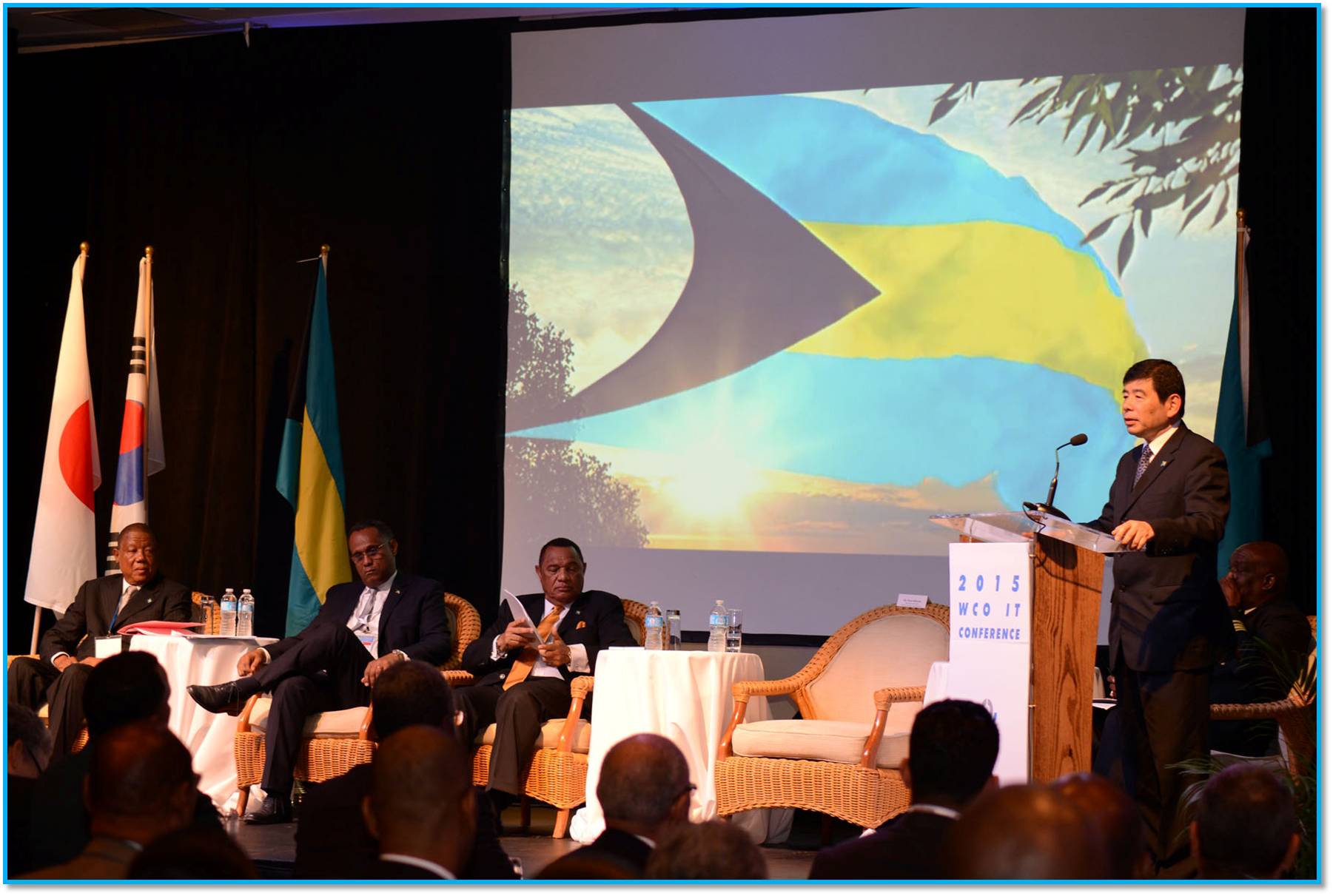
Secretary General of the WCO, Mr. Kunio Mikuriya, welcomes  delegates to what is now one of WCO’s premium external events bringing together representatives of the software industry and Customs policy makers.

Secretary General of the WCO, Mr. Kunio Mikuriya, welcomes delegates to what is now one of WCO’s premium external events bringing together representatives of the software industry and Customs policy makers.

The 14th annual WCO IT Conference & Exhibition was officially opened on 6 May 2015 in Freeport (Bahamas). Senior Government representatives of The Bahamas Government opened the 3-day Conference in the presence of over 400 participants from 75 countries.

The Right Honorouble Perry Gladstone Christie, Prime Minister and Minister of Finance of the Commonwealth of The Bahamas thanked the WCO for choosing The Bahamas for this very important global Conference. The hosting of this WCO event is an example of the government’s commitment to bring business opportunities to Grand Bahama!

The Prime Minister further continued by reminding the delegates that the WTO concluded negotiations on a Trade Facilitation Agreement at the Bali Ministerial Conference in December 2013 and about its potential of reducing international trade costs of approximately 12%. He underlined that the WTO Trade Facilitation Agreement owes much to the technical work that had already been carried out at the World Customs Organization.

In his speech, the Prime Minister stressed: “Our efforts are very much consistent with the theme of this Conference “Inclusiveness Through Information Technology”. It is in our interest here in The Bahamas to pursue an inclusive approach to the introduction of the new IT systems. These new systems must bring benefits, not only to government, but also to commercial operators and to the general public who will use these services. We recognize that with the introduction of these IT systems we must adopt a more client focused and customer orientated approach to make it easier to conduct business.”

The Secretary General of the WCO, Mr. Kunio Mikuriya, welcomed the delegates to what is now one of WCO’s premium external events bringing together representatives of the software industry and Customs policy makers. The Secretary General emphasized the theme of this year’s Conference “Inclusiveness Through Information Technologies”, adding that it addresses three key priorities of the WCO Members – Implementation of the WTO Trade Facilitation Agreement, Regional Economic Integration and Coordinated Border Management.

Mr. Charles Turner, Comptroller of Customs and Excise Department of the Commonwealth of The Bahamas, stressed that the IT Conference & Exhibition comes at an important juncture for The Bahamas as the Customs Department implements the Trade Sector Support Program. Having such a broad range of exhibitors and international delegates provides a rare opportunity to share ideas and learn from the experiences of others. Source: WCO

WCO publishes the Correlation Tables between the 2012 version and the 2017 version of the Harmonized System

OMD_7760The Correlation Tables between the 2012 version and the 2017 version of the Harmonized System (HS) are an essential device for preparation of new national Customs tariffs and a trade statistical classification based upon the HS Nomenclature 2017 Edition; modification of HS-based international Nomenclatures such as the Standard International Trade Classification (SITC) and the Central Product Classification (CPC); and preparations for possible WTO negotiations.

At its 55th Session in March 2015, the HS Committee examined and approved the Correlation Tables correlating the 2017 and 2012 versions of the HS.

Table І establishes the correlation between the 2017 version and the 2012 version of the HS. It contains remarks opposite certain correlations briefly specifying the nature of the goods transferred. In many cases, reference has also been made to the amended legal provisions.

Table ІІ establishes the correlation starting from the 2012 version to the 2017 version. It is simply a mechanical transposition of Table І and therefore includes no remarks. Source: WCO

WCO – Sub-Saharan Africa Customs Modernization Programme Newsletter

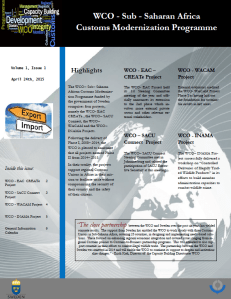
WCO Sub-Saharan Customs Modernisation Programme NewsletterHerewith a new newsletter informing about developments of Capacity Building Projects in Sub- Saharan African Customs Unions as sponsored by the government of Sweden. The project includes the WCO- EAC CREATE Project, the WCO- WACAM Project, The SACU Connect Project and the WCO INAMA Project.

With this newsletter we share with you updates about ongoing activities as well as an outlook for the events of the upcoming months. Click this hyperlink to download the newsletter.

Whilst this newsletter can only provide a snapshot of key developments, it may raise your awareness and encourage you to address us for more detailed publications or to contact us. Source: WCO

Feature – Côte d’Ivoire Single Electronic Window for Trade

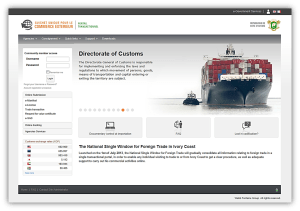
Ivory Coast SEW2As Customs and Border regulatory authorities ramp up their commitment to international agreements, such as the WCO Revised Kyoto Convention, SAFE Framework of Standards and the more recent WTO Trade Facilitation Agreement, more countries will offer a single point of entry through which traders, international carriers and logistics providers can access and comply with the resident customs and other government regulatory regimes.
The concept of a Single Window is borne out of the fact that traditional import/export and related regulatory requirements pose a barrier to market entry for international goods. There are many derivatives of Single Window in operation globally. Perhaps the best resource for this can be found on the UNECE’s interactive Trade Facilitation Implementation Guide webpage. One can navigate to the case studies page to read up on a country-by-country experience on various trade reforms including Single Window developments.

Côte d’Ivoire (Ivory Coast) is one of many African countries who have introduced Single Window as a facilitation measure whereby international trade can interface with Customs in a number of ways. It consists of a web-based trade portal (operated by Webb Fontaine) which interfaces with AsycudaWorld (AW), Côte d’Ivoire Customs’ management system. The portal allows traders to key-in advance import/export information within an electronic document called TVF (Trade Virtual Folder). Customs declarations are then subjected to tariff classification  and valuation, thereafter routed for commercial/risk assessment and revenue accounting on AsycudaWorld, or Sydam World as it is known in Côte d’Ivoire.

Commercial banks use the TVF within the Single Window to endorse the settlement of each import; the Ministry of Commerce subsequently authorizes the overall transaction through the system.

The Single Window provides an entry point for traders and supply chain operators to accomplish various Customs formalities such as –

  • Customs Declaration processing – allowing importers and exporters to electronically file clearances.
  • Manifest operations – used by all carriers to upload their XML manifests and register the same through the trade portal directly into AsycudaWorld. The facility also allows the amendments of waybills (e.g. excess and shortages) and automatically synchronizes the operations with the AW system. The Port Authority IT systems, including the Port of Abidjan and the Port of San Pedro, automatically receive and integrate the manifests submitted by carriers.
  • License module – allows traders to request import/export licenses (regulatory permits) that are later on approved online by the relevant ministries. Each license comprises a list of regulated products, quota allowable amount based on a predefined scheme (gross mass, net mass, FOB, Unit of measurement or unlimited quota). Further developments will include the automatic write-off of license quota by declarations using the Declaration module.

Source: Webb Fontaine

WCO News – February 2015 Edition

WCO News - Coordinated Border Management Feb 2015Check out the latest WCO News – per usual a wealth of interesting customs and supply chain information:

  • WCO launches IRIS, an application exploiting open source information
  • Harmonized System amendments effective from 1 January 2017
  • Beginning the CBM process: the Botswana experience
  • Inter-institutionality – a distinctive feature of the Colombian AEO model
  • WCO Data Model: the bridgehead to connectivity in international trade
  • Implementing New Zealand’s Joint Border Management System

and a whole lot more…

Source: WCO

International Customs Day – 2015

For more information about Co-ordinated Border Management visit the WCO website.

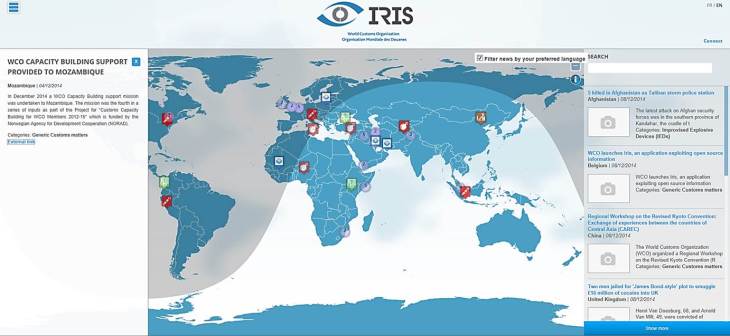
IRIS – WCO launches application to exploit open source information

WCO IRISOpen sources, such as the Internet, include a considerable amount of useful information for Customs purposes. For instance, such information can benefit Customs risk management through improved analysis and by enabling sounder decisions to be made on the basis of solid information, thereby providing decision-makers with better situational awareness.

The exploitation of this vast repository of data has become easier and markets are full of different tools that allow Customs officers to keep track of issues that impact on their daily work. Although many WCO Members already use such tools at the national level, no international tool exists that collects all this Customs related information together and makes it available in one location.

To fill this void, WCO Secretary General announced the launch of the Iris application during the Policy Commission meeting in Brazil on 8 December. Iris is a new and innovative tool which acts as an “aggregator” for all types of open source Customs information, and as such falls within the framework of the of theme of the year 2014, “Communication”.

The application utilizes Web-crawlers to search the Internet for news items and presents this information in a graphic-style world map in real-time. The system also allows for the storing of the “hits” on a specific database where they will be available for intelligence experts and other operational front-line Customs staff for further analysis.

Iris also allows the WCO to push out information about major Customs seizures which have been reported to the WCO Customs Enforcement Network (CEN) database or to the Global Shield application (seizure information itself will not be reported, but a notice about a seizure will be displayed).

“Iris is a ground-breaking initiative and will allow the WCO, for the first time, to monitor open source information on a 24/7/365 basis and to provide its Members with enhanced intelligence support”, declared Secretary General Mikuriya.

“The application also promotes CEN and Global Shield application and we hope it will encourage Members to increasingly report their seizures to both of these existing enforcement tools”, he added.

All WCO Members, Regional Intelligence Liaison Offices (RILOs), and WCO staff will benefit from Iris. Its benefits extend beyond these specific user groups, as the application is aimed at a broader audience. Some of the Iris functionality will be made available to WCO’s private sector partners, the academic community, and the public.

Iris works in all different types of devices including smart phones and tablets. The system is hosted at https://iris.wcoomd.org and can also be accessed through the WCO’s website. Source: WCO

WCO supports Capacity Building in Mozambique

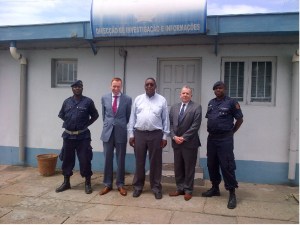
Mozambique: Maputo, Mozambique Revenue Authority, Customs Division, Risk Management Unit

Mozambique: Maputo, Mozambique Revenue Authority, Customs Division, Risk Management Unit

In December 2014 a WCO Capacity Building support mission was undertaken to Mozambique. The mission was the fourth in a series of inputs as part of the Project for “Customs Capacity Building for WCO Members 2012-15” which is funded by the Norwegian Agency for Development Cooperation (NORAD). The aim of the project is to deliver technical assistance to seven countries in specific areas of Customs operations. As one of the countries participating in the project the assistance provided to Mozambique has been designed to strengthen their capacity in the areas of Risk Management and Human Resources/Training Policy Management.

The mission commenced with a meeting between the WCO delegation and Mr. Guilherme Mambo Director General, Customs. Progress with the project was discussed and specific plans for the introduction of new risk management procedures.

The mission focused on the delivery of a high-level strategic Risk Management workshop. The workshop was designed to support the implementation of a new Risk Management Framework and was attended by several members of the MRA Senior Management Team.

Together with the workshop, the WCO experts also conducted a Risk Management organizational review and prepared a report summarizing key findings and recommendations. Work also continued on supporting the MRA with the development of their new Strategic Plan and specifically with a review of existing risk profiles to ensure that they are aligned with the organization’s strategic objectives.

The opportunity was taken to also discuss establishing procedures for access to the WCO e-learning modules so that the MRA can make best use of the wide range of training modules that are available for their use, particularly in the areas of Risk Management, CBM, PCA and the Revised Kyoto Convention. Source and picture: WCO

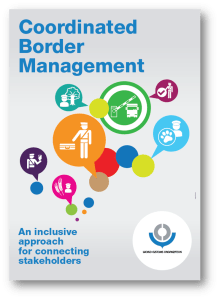
Coordinated Border Management – An inclusive approach for connecting stakeholders

WCO Customs Theme 2015The WCO is dedicating 2015 to promoting Coordinated Border Management (CBM) under the slogan “Coordinated Border Management – An inclusive approach for connecting stakeholders”.
WCO Members will have the opportunity to promote the enhanced coordination practices and mechanisms that they have implemented within their administrations and with other Customs administrations and government agencies, as well as with economic operators involved in cross-border trade.

The term Coordinated Border Management (CBM) refers to a coordinated approach by border control agencies, both at the national and international level, in the context of seeking greater efficiencies over managing trade and travel flows, while maintaining a balance with compliance requirements.

CBM can result in more effective service delivery, less duplication, cost-savings through economies of scale, enhanced risk management with fewer but better targeted interventions, cheaper transport costs, less waiting times, lower infrastructure improvement costs, more wider sharing of information and intelligence, and strengthened connections among all border stakeholders. Source: WCO


WCO addresses the United Nations Conference on Landlocked Developing Countries

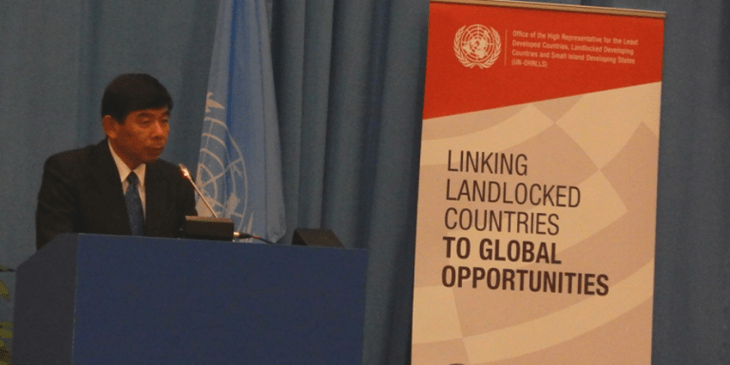
WCO Secretary General Kunio Mikuriya addressing delegates at the high-level opening ceremony of the ConferenceWCO Secretary General Kunio Mikuriya addressed delegates at the high-level opening ceremony of the United Nations Conference in Vienna on 3 November 2014.
The Conference aimed to seek a renewed political commitment to address the special needs of landlocked developing countries (LLDCs) and identify priorities, ways, and means to address them. This was the second Conference after the first one held in Almaty, Kazakhstan in 2003. The Conference takes place only once a decade and is an important milestone for formulating a focused, forward-looking and action-oriented development agenda for LLDCs for the next decade.

Secretary General Mikuriya made a statement together with other heads of international organizations, including Mr. Ban Ki-moon, Secretary-General of the United Nations, and Mr. Roberto Azevêdo, Director General of the World Trade Organization, and several heads of state, including President Heinz Fischer of Austria. In his remarks, he highlighted the importance for Customs administrations to establish an effective and efficient transit regime which is an essential element to promote regional economic integration and ensure economic growth of LLDCs.

He also used his speech to launch the WCO Transit Handbook that the Permanent Technical Committee finalized last week. Secretary General Mikuriya announced that the Transit Handbook would be formally published shortly after further editing and incorporating the outcomes of the Conference. He also described other WCO instruments that facilitate transit, including the Revised Kyoto Convention and the Time Release Study. He gave an assurance of enhanced delivery of technical assistance and capacity building for LLDCs through the Mercator Programme, a tailor-made assistance programme supported by a wealth of instruments and best practices, a network of accredited experts and a comprehensive donor engagement mechanism. Source: WCO

Related links

nCEN goes live in Botswana

nCEN goes live in BotswanaThe WCO launched its national Customs Enforcement Network (nCEN) application in Botswana in October 2014. Following the pilot projects in Mauritius and Kenya, the nCEN is already operational in Namibia, Swaziland, and the Seychelles, providing these countries crucial opportunities for regional cooperation in the enforcement field.
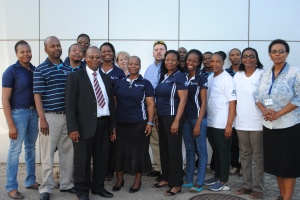
After an official meeting in Gaborone with the Executive Management Committee as well as with the General Managers of Botswana Unified Revenue Service, the WCO delegation conducted an eight-day nCEN Workshop intended to provide local officers with the necessary knowhow about the nCEN application, with an ultimate goal of improving the operational efficiency and analytical possibilities of their Administration. The workshop also touched upon the other WCO applications, giving valuable insight on the additional data mining and information exchange potential of the CEN suite.

The launch of the nCEN application in the region is financially supported by the Finish government as a component of the WCO project “Building Trade Capacity through Customs Modernization in the East and Southern Africa Region”, aiming at providing Customs Administrations with the necessary hardware and software as well as related knowledge and skills to implement simplified and improved customs procedures with modern customs operational techniques.

The nCEN application consists of three independent databases (a seizure database, a suspect database, and a company database), as well as a communication component. The core database of national seizures and offences comprises data required for analysis, including means of conveyance, routes, and the possibility to view photos depicting exceptional concealment methods. Two supplementary databases contain information on suspected persons and offending business entities, facilitating a structured investigation process.

The nCEN software is a free application for all WCO Members. The costs of the hardware needed to run the nCEN application, the costs associated with the training, and possible costs for modifications to the local IT infrastructure (if applicable), are however the responsibility of the implementing Customs Administration. Source: WCO

France – Customs in High School Education

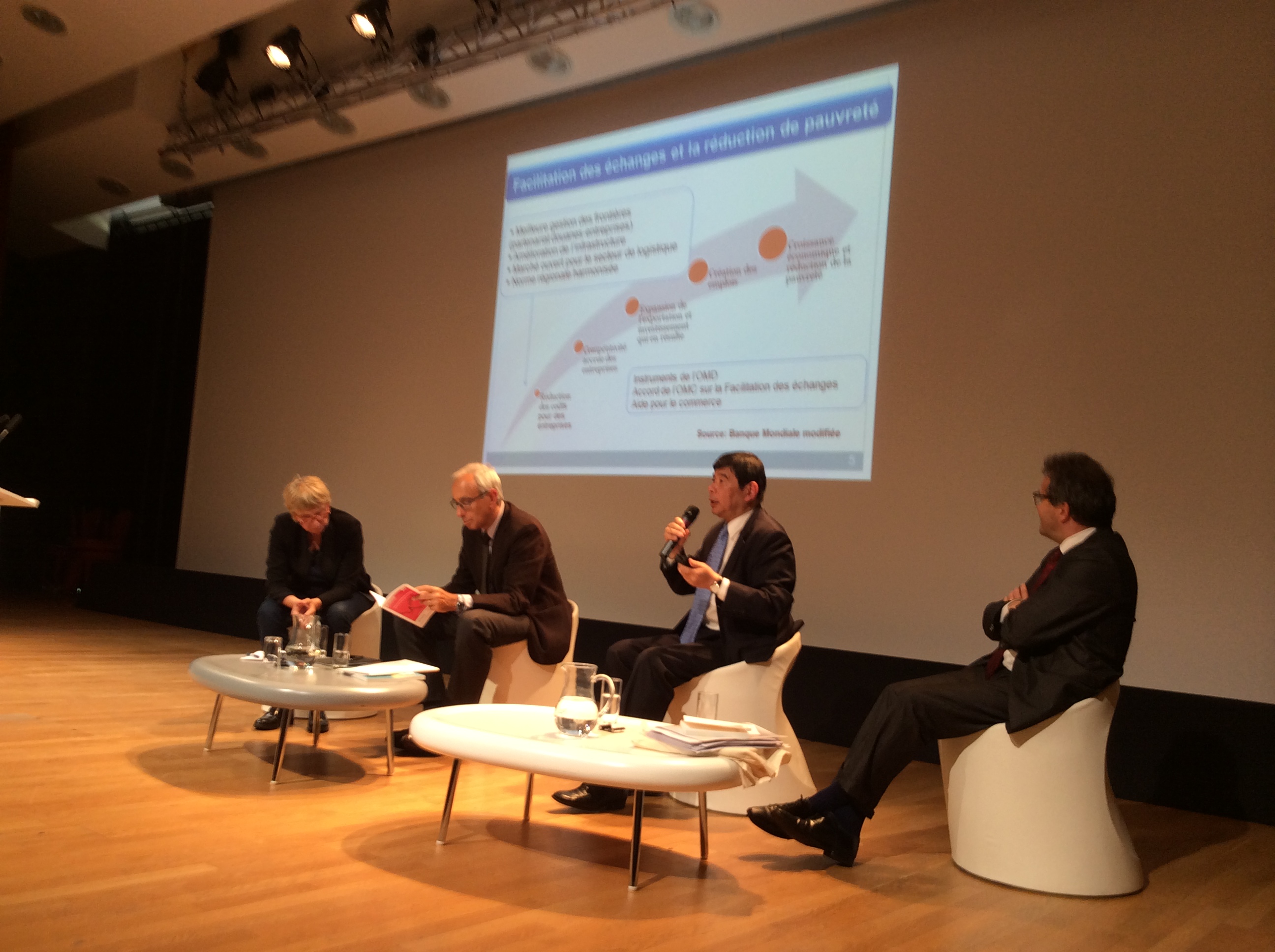
20140827%20154452At the invitation of the “Institut de l’Entreprise” in the framework of its programme “Entretiens Enseignants-Entreprises”, WCO Secretary General Kunio Mikuriya spoke at the Summer University’s conference entitled “La croissance en question(s)” (growth into question(s)) in the Veolia Campus, Jouy-le-Moutier, France on 27 August 2014.

Supported by the French ministry of Education and the Council of Economic Analysis, this forum gives the opportunity to high school teachers in economics and social sciences to exchange views with the business world. It also provides them with an opportunity to update their knowledge on current economic issues benefiting from the attendance of renowned economists and prominent business leaders.

260 High school teachers participated in the event and listened to a panel session on poverty reduction during which Secretary General Mikuriya explained the contribution of Customs through enhancing connectivity at the borders to secure and facilitate global supply chain. They were eager to understand how the WCO and Customs could play a significant role in trade facilitation to convey the messages to their classrooms. Source: WCO

New WCO HS standards coming into force on 1 January 2017

OMD_7760The WCO Council, at its 123rd/124th Sessions in June 2014, adopted a Recommendation that lists recommended amendments to the Harmonized System (HS) nomenclature which will enter into force on 1 January 2017 (HS 2017).

This Recommendation is being promulgated under the provisions of Article 16 of the HS Convention, which implies that HS Contracting Parties now have six months to notify the WCO Secretariat of an objection to a recommended amendment.

Since the entry into force of the current version of the HS (HS 2012), the HS Committee has been revising this version of the HS nomenclature for almost five years. HS 2017 will be the sixth version of the HS since the Convention entered into force in 1983. HS 2017 will enter into force for all HS Contracting Parties, but will exclude any amendments objected to during the six month timeframe.

The new version of the HS includes 234 sets of amendments. Environmental and social issues are a major feature of these amendments, due to the importance of the HS as a global tool for collecting trade statistics and monitoring trade. This is borne out by the fact that the HS Convention currently has 150 Contracting Parties, making it the WCO’s most successful international instrument to date.

The majority of the recommended amendments were broached by the Food and Agriculture Organization of the United Nations (FAO):

  • Amendments relating to fish and fishery products are aimed at further enhancing the coverage of species and product forms which need to be monitored for food security purposes, and the better management of resources.
  • Amendments relating to crustaceans, molluscs and other invertebrates are motivated by the importance of the trade in and consumption of these species in their various product forms.
  • Amendments relating to cuttlefish and squid enlarge the coverage of the present HS codes for these species, in order to have all these species grouped together.

The classification of forestry products has also been modified, in order to enhance the coverage of wood species and get a better picture of trade patterns. The modification will enable trade data on tropical wood to be identified, resulting in better statistics on the trade in tropical wood and better data on the use of non-tropical hardwoods. In addition, the amendments include new subheadings for the monitoring and control of certain bamboo and rattan products.

Furthermore, HS 2017 amendments aim to provide detailed information on several categories of products that are used as antimalarial commodities. This will facilitate classification work, and the trade in these life-saving products.

The amendments also introduce specific subheadings to facilitate the collection and comparison of data on the international movement of certain substances controlled under the Chemical Weapons Convention.

New subheadings have also been created for a number of hazardous chemicals controlled under the Rotterdam Convention and for certain persistent organic pollutants (POPs) controlled under the Stockholm Convention. In some cases, there is a confluence of control regimes for chemicals by both the Rotterdam and Stockholm Conventions.

In addition, new subheadings have been created for the monitoring and control of pharmaceutical preparations containing ephedrine, pseudoephedrine or norephedrine, and for alpha-phenylacetoacetonitrile (APAAN), a pre-precursor for drugs.

Other amendments resulted from changes in international trade patterns. Headings 69.07 (unglazed ceramic products) and 69.08 (glazed ceramic products) were merged to take account of the fact that the main subheadings within these headings concern products which are essentially no longer manufactured, and the industry and trade no longer make a distinction between unglazed and glazed ceramic products, whilst new products with a very high trade volume are classified under subheadings 6907.90 and 6908.90 (“Other”).

Furthermore, for purposes of adapting the HS to current trade practices, certain important products will be separately identified in either existing or new subheadings.

Advances in technology are also reflected in the amendments, inter alia, the size criteria for newsprint, light-emitting diode (LED) lamps, multi-component integrated circuits (MCOs), and hybrid, plug-in hybrid and all-electric vehicles.

Finally, the HS 2017 Recommendation includes amendments to clarify texts to ensure uniform application of the nomenclature. For example, the regrouping of monopods, bipods, tripods and similar articles in a new heading, namely 96.20. Source: The WCO

WCO 2014 Photo and Poster Competition

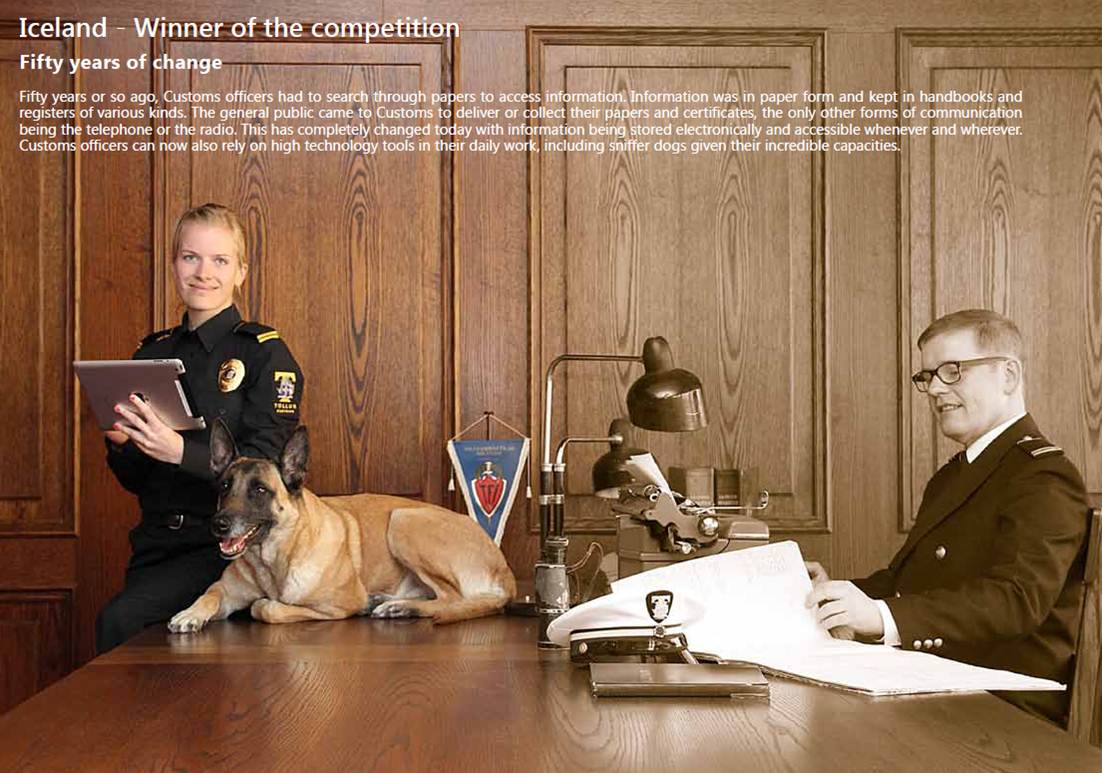
Winning Entry 2014 - Iceland Customs - Fifty Years of Change (WCO)

Winning Entry 2014 – Iceland Customs – Fifty Years of Change (WCO)

This years entries are a combination of photography and poster themes. Please click this link to view an e-book of all the entries. Congratulations to Customs Iceland for their winning entry titled -“Fifty Years of Change”. Source: WCO

Mexico – Recognising WCO Policies and Standards in the wake of Organised Crime

Port of Lazaro Cardenas Mexico [www.puertolazarocardenas.com.mx]

Port of Lazaro Cardenas Mexico [www.puertolazarocardenas.com.mx]

At the beginning of May the Mexican authorities detained the 73,700 dwt Jian Hua with this following on from the earlier seizure of 119,000 tonnes of iron ore in storage at the port.

At the end of April the Mayor of Lazaro Cardenas was arrested and accused of kidnapping, extortion and links to organised crime and in November last year federal troops took over the security and customs functions at the port of Lazaro Cardenas and remain in charge today.

The main aim of these measures is to eradicate the influence of the violent criminal organisation the Knights Templar, whose base of operations is the south western state of Michoacan where the port of Lazaro Cardenas is located.

Knights Templar, through the corruption of customs and other officials, has been using the port of Lazaro Cardenas for the extensive import and export of illegal drugs. The iron cargoes are one of many ‘business diversifications’ by the cartel but as the Jian Hua shipment proves are illegal in that the documentation associated with this cargo showed production at a mine that is not yet authorised for legal operation.

For years the state of Michoacan has basically been lawless and the area around the port of Lazaro Cardenas has been a battleground between the various drug gangs with the Knights Templar being in ascendancy since 2010.

Since, however, the entry of federal agencies into the state, and notably the Mexican navy into the port of Lazaro Cardenas, the influence of Knights Templar has gone into severe decline. The cartel has basically lost control of its biggest business. They have also felt the wrath of a public uprising, the sharp end of which are armed vigilantes backed by federal forces.

The optimistic view is that the port of Lazaro Cardenas will become ‘clean’ again with the demise of Knights Templar and the arrangements it had with other drug cartels. The negative view is that another cartel will step into Knight Templar’s shoes and the port will again find itself under external control and home to illegal activities.

Short steps

The lesson here, as independent organisations such as Control Risks emphasise, is that it is a few relatively short steps before a major port gateway can be comprehensively penetrated by criminal organisations. The conditions that created an opening for Knights Templar are not unusual in Latin America in Control Risks’ view.

For these reasons, and many others associated with port efficiency, it is very important to have secure and professional agencies active in ports that are specialists in security and border management. It is also important to realise in this context that considerable assistance is available from external agencies such as the World Customs Organisation (WCO) to establish the proper controls and security checks. Further, that it is often only by the use of independent agencies or organisations that comprehensive experience and know-how can be deployed to achieve this – the arms’ length approach which can circumvent internal corruption.

If corrupt elements are in place there will inevitably be resistance to change but an external agency forcing the pace of change, based on global experience, will play a major part in overcoming such elements.

Taking the WCO as an example, among other things it functions as a forum for dialogue and exchange of experiences between national Customs delegates. The WCO offers its members a range of conventions and other international instruments, as well as technical assistance and training services provided either directly by the secretariat, or with its participation. The secretariat also actively supports its members in their endeavours to modernise and build capacity within their respective national Customs administrations.

The WCO’s efforts to combat fraudulent activities are also recognised internationally. The partnership approach championed by the WCO is one of the keys to building bridges between Customs administrations and all the stakeholders in the transport chain. Source: Port Strategy