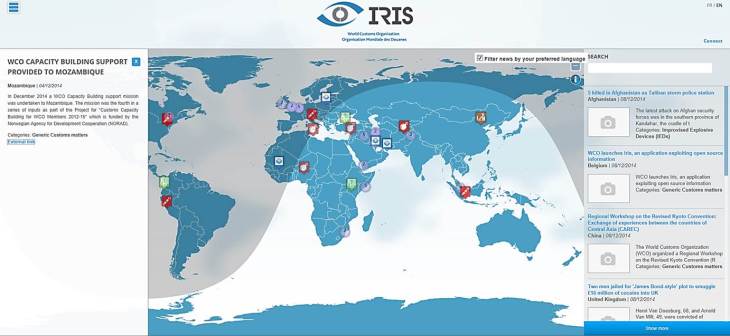
 Open sources, such as the Internet, include a considerable amount of useful information for Customs purposes. For instance, such information can benefit Customs risk management through improved analysis and by enabling sounder decisions to be made on the basis of solid information, thereby providing decision-makers with better situational awareness.
The exploitation of this vast repository of data has become easier and markets are full of different tools that allow Customs officers to keep track of issues that impact on their daily work. Although many WCO Members already use such tools at the national level, no international tool exists that collects all this Customs related information together and makes it available in one location.
To fill this void, WCO Secretary General announced the launch of the Iris application during the Policy Commission meeting in Brazil on 8 December. Iris is a new and innovative tool which acts as an “aggregator” for all types of open source Customs information, and as such falls within the framework of the of theme of the year 2014, “Communication”.
The application utilizes Web-crawlers to search the Internet for news items and presents this information in a graphic-style world map in real-time. The system also allows for the storing of the “hits” on a specific database where they will be available for intelligence experts and other operational front-line Customs staff for further analysis.
Iris also allows the WCO to push out information about major Customs seizures which have been reported to the WCO Customs Enforcement Network (CEN) database or to the Global Shield application (seizure information itself will not be reported, but a notice about a seizure will be displayed).
“Iris is a ground-breaking initiative and will allow the WCO, for the first time, to monitor open source information on a 24/7/365 basis and to provide its Members with enhanced intelligence support”, declared Secretary General Mikuriya.
“The application also promotes CEN and Global Shield application and we hope it will encourage Members to increasingly report their seizures to both of these existing enforcement tools”, he added.
All WCO Members, Regional Intelligence Liaison Offices (RILOs), and WCO staff will benefit from Iris. Its benefits extend beyond these specific user groups, as the application is aimed at a broader audience. Some of the Iris functionality will be made available to WCO’s private sector partners, the academic community, and the public.
Iris works in all different types of devices including smart phones and tablets. The system is hosted at https://iris.wcoomd.org and can also be accessed through the WCO’s website. Source: WCO

 What Happened to the Portcullis?
You must be logged in to post a comment.