Government SEZ Bill will support economic growth and opportunities

sez.jpgThe Special Economic Zones (SEZ) Bill 2013, according to the government will support a broader-based industrialisation growth part and be a significant milestone in pursuit of the aspirations of the National Development Plan (NDP).

Rob Davies, Department of Trade and Industry Minister says, “The bill aims to support a balanced regional industrial growth path, along with the development of more competitive and productive regional economies.”

SEZs are defined as geographically designated areas of a country set aside for specifically targeted economic activities, supported through special arrangements and systems that are often different from those that apply to the rest of the country.

Says Davies, “The aim of the SEZ Bill seeks to boost private investment (domestic and foreign) to labour-intensive areas to increase job creation, competitiveness, skills and technology transfer along with exports of beneficiated products.”

The Bill introduces a variation of SEZ’s to cater for the various spheres of government at local, provincial and national level.

It also provides for the designation of the following types of SEZs:

  • Free Ports: duty-free areas adjacent to a port of entry where imported goods may be unloaded for value-adding activities, repackaging, storage and subsequent re-export, subject to special customs procedures.
  • Free Trade Zones: a duty-free area offering storage and distribution facilities for value adding activities within the SEZ.
  • Industrial Development Zone: a purpose-built industrial estate that leverages domestic and foreign fixed direct investment in value-added and export-oriented manufacturing industries and services. (To date there are five Industrial Development Zones (IDZs) – Coega, East London, Richards Bay, OR Tambo and Saldanha Bay).
  • Sector Development / Specialised Zones: a zone focused on the development of a specific sector or industry through the facilitation of general or specific industrial infrastructure, incentives, technical and business services primarily for the export market.

Source: Transport World Africa
Special Economic Zones – how special?

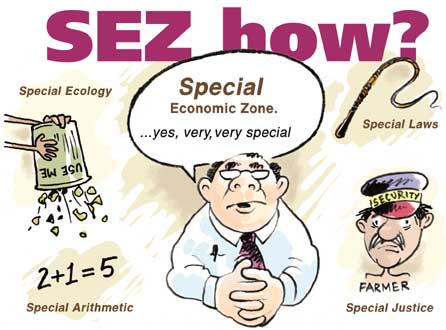
Despite having burned its fingers with Industrial Development Zones (IDZs), which involved a few fiscal benefits (shrouded in legalese) and billions in infrastructure, Trade and Industry has gone into overdrive to push its new policy on special economic zones (SEZs). It has relaxed ‘locality’ for one, i.e. such zones need not be located in close proximity to an international port or airport. Moreover, SEZs are now being promoted to ‘compliment’ existing IDZs and not replace them as was erroneously suggested in an earlier post.

While the South African Department of Trade and Industry (the dti) is conducting public hearings on the matter, it is perhaps relevant to consider what the Free Market Foundation (FMF) – a think-tank on limited government and economic freedom – has to say on the matter. The content of the report might well attract support from some in the business community involved with manufacturing, distribution and logistics. Read the FMF’s evaluation of the dti’s SEZ Policy here!

While there are not many trade remedies available to local business many prospective requests have over the last decade been presented to establish so-called distribution centres/hubs and ‘virtual bonded warehouses’, which have not borne much fruit mainly due to the lack of a legal framework for their operation. Moreover, in government there is always a cautious resistance to liberalisation in customs and trade laws (they directly impact the fiscus) in the absence of viable risk mitigation strategies or remedies. Perhaps it has something to do with the dwindling public sector skills and experience levels available to conduct effective audits; although, the big audit firms would readily contest this and advocate the outsourcing of such function to the private sector. As the development of more sophisticated systems in SARS come on stream, ICT will no longer be an obstacle. Through increased automation comes the availability of additional human resources who can be up-skilled to perform audit work. Both Tax and Customs Modernisation programmes bare testimony to this.

The establishment of the IDZ programme (circa 2000) was fraught with inter-departmental tensions around the so-called benefits and concessions to be made available to foreign investors. The lack of a clear framework did not allow for much ‘liberalisation’ of controls and fiscal benefits. In fact the customs dispensation offered procedures and facilities to IDZs identical to that available in the national customs territory. Tax holidays and relaxed red tape are characteristic of some of the more successful SEZs around the world, as the article will attest. The dti’s latest SEZ Bill and Policy do not hint to any great length how things will be different this time round. There is however some firm calls within government to consider relaxed labour regulations – the test however lies in whether the policy makers have the appetite (or vision) to permit liberalisation in this area. I have a simple view on this matter – (i) create a favourable economic environment focusing development on SMMEs and entrepreneurship, and (ii) get the standard customs procedures and controls right through modernisation and there will be no need for ‘tax holidays’ and economic zones in this country!