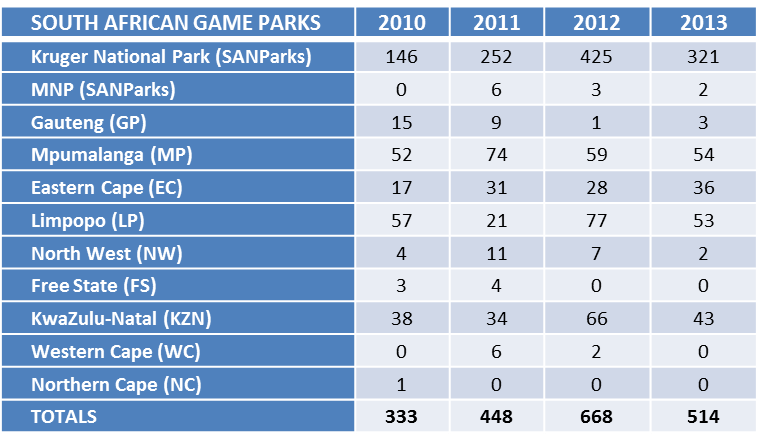
514 rhinos poached in South Africa so far in 2013

Rhino poaching statistics (Department of Environmental Affairs)

Rhino poaching statistics (Department of Environmental Affairs)

The Department of Environmental Affairs today, 24 July 2013 released the Rhino Issue Management (RIM) Report which emanated from the national consultation process to facilitate a common understanding of the key issues related to the protection and conservation of South Africa’s rhino population. The release of the RIM report comes as the number of rhino poached in South Africa increased to 514. To access the report, Click Here!

The Kruger National Park continues to bear the brunt of poaching with 321 rhino poached since 1 January 2013, while 54 have been killed for their horns in Limpopo, 53 in North West and 43 in KwaZulu-Natal. A total of 143 alleged poachers have been arrested this year.

The final report submitted to the Minister and Department of Environmental Affairs in January 2013 has greatly assisted the department in reviewing and updating its rhino response strategy outlined in the National Strategy for the Safety and Security of the Rhinoceros Population of South Africa (NSSSRPSA).

The RIM report incorporates current thinking on sustainable rhino conservation by acknowledged rhino specialists, ecologists and a range of other experts. It encapsulates viewpoints from Non-Government Organisations (NGO’s) both specialised and community based, civil society, and from traders, professional hunters, resource economists and ordinary citizens with a deep concern for the ethical and humane treatment of animals.

The consultation process resulted in clear agreement that the country’s rhinos should be conserved for the good of all humanity, and that every effort should be made to protect the threatened species from the sustained poaching onslaught by international syndicates earning huge profits from the sale of rhino horn.

The RIM report does, however, state that there is support to include commercial international trade in rhino horn as an integral part of South Africa’s comprehensive response strategy to address the continued illegal killing of rhinos. Source: Department of Environmental Affairs (South Africa) 

Want to help? Shut up and listen!

The subject of “Aid” is perhaps the hottest topic on the African continent, but for a variety of reasons. I came across the following video clip which I believe hits the nail on the head when it comes to international donor aid. No doubt there will be many out there who will denounce the presenter, Ernest Sirolli’s message, but as an African myself I can attest to the many examples of wasted opportunity and bullying which has occurred and continues (till this day) by NGO’s who believe they know better than any what is good for this continent. Thanks to the egotism of most politicians it is easy for such NGO’s to bulldoze their way into lucrative contracts which in most instances never see the light of day, or are so poorly implemented by outsiders, that the target country inevitably has to start all over again at its own cost. Anglo-Saxon involvement and meddling is a particular case in point … brazenly advancing the argument of ‘saving Africa from the Africans!’ I have experienced this several times in the last 15 years. Africa to donors has become little more than a box of Lego – where handpicked consultants experiment – upending all the coloured blocks and after 5 years or more leave a pile of blocks in no better arrangement than what they found when they first arrived. Sadly, the ‘developed nations’ have gotten the whole world into a financial mess and, now more than ever, will apply pressure on African governments into newer and more lucrative deals, because there are no more opportunities in their own back yards. The methods are the same, even the players are the same, just the stakes are now higher. Why, because China and the East are now the new ‘trading partners’ with a bit more bargaining power. Enjoy the video!

About the speaker

Ernesto Sirolli is a noted authority in the field of sustainable economic development and is the Founder of the Sirolli Institute, an international non-profit organization that teaches community leaders how to establish and maintain Enterprise Facilitation projects in their community. The Institute is now training communities in the USA, Canada, Australia, England and Scotland.

In 1985, he pioneered in Esperance, a small rural community in Western Australia, a unique economic development approach based on harnessing the passion, determination, intelligence, and resourcefulness of the local people. The striking results of “The Esperance Experience” have prompted more than 250 communities around the world to adopt responsive, person-centered approaches to local economic development similar to the Enterprise Facilitation® model pioneered in Esperance. Source: TED.com

Related Article