How much bigger can container ships get?

Check out this superb article – click here – featured on BBC News Magazine‘s website –

What is blue, a quarter of a mile long, and taller than London’s Olympic stadium? The answer – this year’s new class of container ship, the Triple E. When it goes into service this June, it will be the largest vessel ploughing the sea. Each will contain as much steel as eight Eiffel Towers and have a capacity equivalent to 18,000 20-foot containers (TEU). If those containers were placed in Times Square in New York, they would rise above billboards, streetlights and some buildings. Or, to put it another way, they would fill more than 30 trains, each a mile long and stacked two containers high. Inside those containers, you could fit 36,000 cars or 863 million tins of baked beans.

The Triple E will not be the largest ship ever built. That accolade goes to an “ultra-large crude carrier” (ULCC) built in the 1970s, but all supertankers more than 400m (440 yards) long were scrapped years ago, some after less than a decade of service. Only a couple of shorter ULCCs are still in use. But giant container ships are still being built in large numbers – and they are still growing.

It’s 25 years since the biggest became too wide for the Panama Canal. These first “post-Panamax” ships, carrying 4,300 TEU, had roughly quarter of the capacity of the current record holder – the 16,020 TEU Marco Polo, launched in November by CMA CGM.

In the shipping industry there is already talk of a class of ship that would run aground in the Suez canal, but would just pass through another bottleneck of international trade – the Strait of Malacca, between Malaysia and Indonesia. The “Malaccamax” would carry 30,000 containers.

There are currently 163 ships on the world’s seas with a capacity over 10,000 TEU – but 120 more are on order, including Maersk’s fleet of 20 Triple Es. Source: BBC News Magazine

Grindrod – coastwise feeder expansion to extend services between Durban and Angola

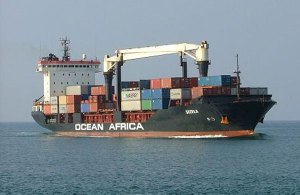
South African logistics and shipping firm Grindrod has continued its expansion programme, with the purchase of Safmarine’s 51% stake in Ocean Africa Container Lines. Grinrdod gave no details of the price paid for Safmarine’s stake in Ocean Africa Container Lines (OACL), but Grindrod now fully owns the company, which operates a feeder service with four vessels between Durban and Angola, calling at several ports in between, including in Namibia and Angola.

OACL’s former COO, Mahmood Simjee, has now been appointed CEO. Grindrod hopes that OACL can continue to benefit from close ties with Safmarine and the latter’s parent company, Maersk. OACL could take advantage of Ngqura’s growing role as a transhipment port, particularly with Angolan ports. The shipping line previously operated between Durban and Mozambican ports and could again resume this role.

Röhlig-Grindrod, a joint venture between Grindrod Limited and Röhlig International, has also acquired Sturrock Group’s clearing and freight forwarding division in exchange for a 15% stake in Röhlig-Grindrod, leaving the founding partners with 42.5% equity each in the venture. The inclusion of black empowerment partners in Sturrock Group helps Röhlig-Grindrod to fulfil its empowerment requirements.

Hylton Gray, the CEO of Grindrod Logistics, said: “We are very pleased with the merger of the businesses and the introduction of the empowerment partners. Calulo, a partner in the Sturrock Group, already has a stake in Grindrod’s South African operations and has contributed significantly by way of existing relationships and experience in niche markets.” Source: worldcargonews.com

Maersk pays US government $32m

Logo of A.P. Moller – Maersk Group

Maersk Line has agreed to pay an out of court settlement of US$31.9 million to the US government to resolve allegations that it submitted false claims for inflated shipping costs incurred during the transport of containerised cargo to support US troops in Afghanistan and Iraq.

The government claimed Maersk was allegedly billing in excess of the contractual rate to maintain the operation of refrigerated containers holding perishable cargo at a terminal in Karachi, Pakistan, and at US military bases in Afghanistan; billing excessive detention charges (or late fees) by failing to account for cargo transit times and a contractual grace period; billing for container delivery delays improperly attributed to the US government; billing for container GPS tracking and security services that were not provided, or only partially provided; and failing to credit the US government for rebates of container storage fees received by Maersk’s subcontractor at a Kuwaiti port.

Tony West, Assistant Attorney General for the Civil Division of the US Department of Justice said: “Our men and women in uniform overseas deserve the highest level of support provided by fair and honest contractors. As the Justice Department’s continuing efforts to fight procurement fraud demonstrate, those who put profits over the welfare of members of our military will pay a hefty price.”

In 2009, APL was fined $26.3 million by the US Department of Justice, and Agility is still fighting a claim for overcharging in 2010.

Makes you wonder – did they declare the correct cargo information on their manifest? I guess it really does not matter since the cargo was destined for Afghanistan and Pakistan in any event. Don’t believe these countries require advance manifest reporting just yet.

Source: ifw-net.com