WCO News – October 2013 Edition

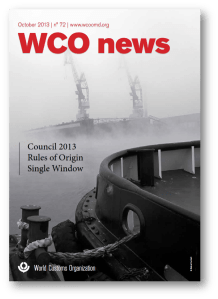
wco news 2013The latest edition of WCO News reflects on the Secretary General’s thoughts on what the WCO has done, what it will be doing, and what will impact on its work in the coming months. The WCO will actively focus its energies on it’s four strategic packages concentrating on revenue, compliance and enforcement, economic competitiveness and organizational development. Together, these packages support the adoption and application of modern Customs practices and raise awareness on the vital role of Customs in international trade.

Featured articles include –

  • From borders to boundless: the digital dilemma in Customs – it discusses two questions – How does an industry traditionally focused on physical borders remake itself for digital commerce, which inherently circumvents such borders? and, Why must Customs agencies transform to address the rise in digital goods and services?
  • Intercepting next generation threats

    For those responsible for the security of our borders, transit networks, VIPs and high-profile sites, the threat posed by more creative adversaries is compounded by the increasing frustrations of passengers and visitors, when subjected to existing security checks. The article discusses a range of ingenuity which technology nowadays provides to these adversaries, and the elements of new Terahertz imaging equipment to assist border agencies in the combat thereof.

  • Beyond the Single 

    Window (SW) – In the 20-plus years since they first opened in Singapore and Sweden, SWs have remained a central focus of border clearance strategies, even though the majority of Customs administrations have not implemented them. Although design plans vary considerably, most SW systems support an electronic data exchange model which allows for (i) Single submission of data and information; (ii) Single and synchronous processing; and (iii) Single decision-making for release and clearance. This article considers 4 best practices which governments should consider when implementing Single Window programs.

The publication also includes country case study’s on Single Window featuring Nigeria and New Zealand, Sri Lanka Customs 20 years of dedication towards conservation, a feature on Argentine Customs and many other interesting articles. To access the publication – click here! Source: WCO

Customs and Nigeria’s Trade Hub Portal

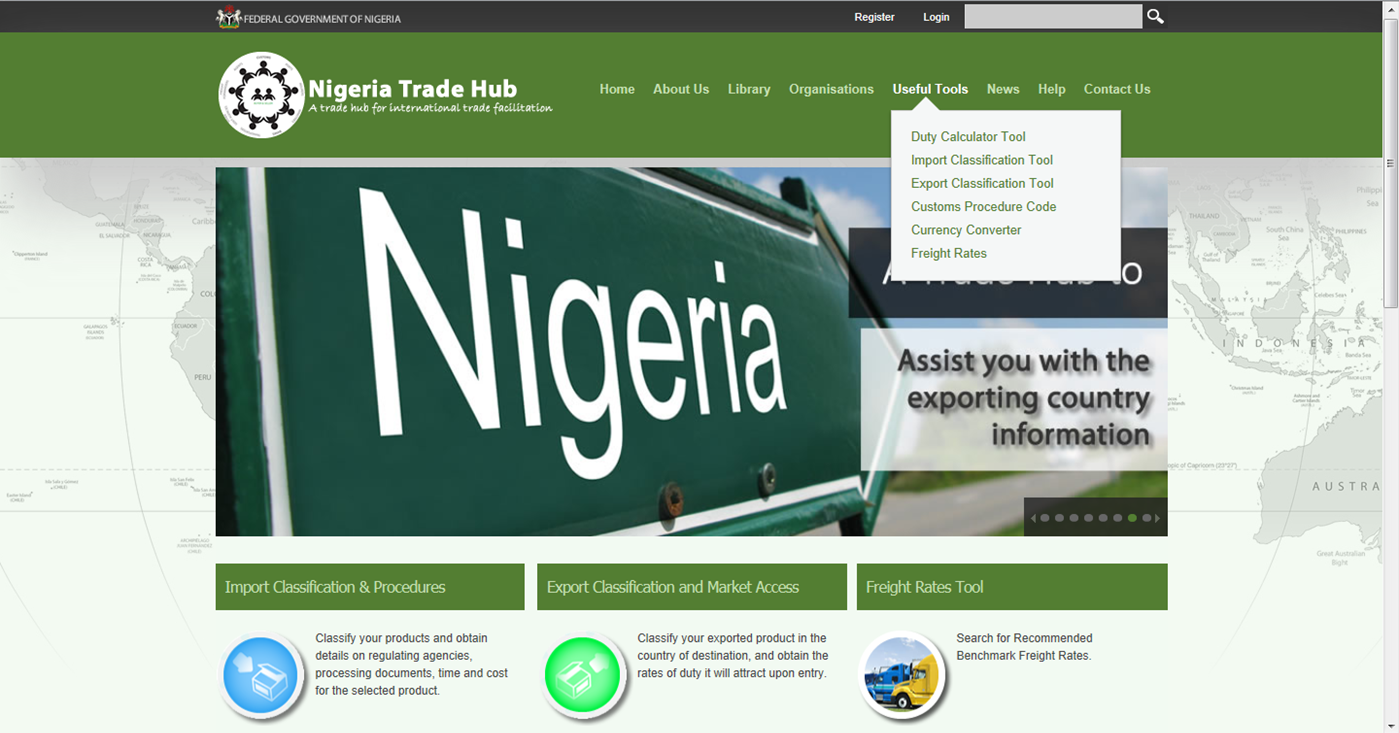
Nigeria Trade Hub 2Anyone familiar with the import and export business in Nigeria will recall how tedious the process used to be. It could take days or even weeks to complete due to ceaseless documentation that importers, exporters and their agents had to endure with the various regulatory agencies. Now, the Nigeria Customs Service (NCS) has developed a web-based application known as the Nigeria Trade Hub Portal, simplifying the entire process and providing information and guidance for international trade business processors in the areas of import, export and transit trade.

The www.nigeriatradehub.gov.ng portal, a non-restrictive and is an intuitive and interactive platform for classifying goods. Through it, trade processors are enabled to find exact Harmonised System Codes (HS Codes) required for related tariffs and duties.

This latest technology is expected to enhance compliance by traders and avail them the required information on tariff in areas like the prohibited items and taxes/levies due for payment upon importation. The application is also designed to touch on the aspect of trade facilitation such that trade processors can access information from all related government agencies. Guidelines and procedures for obtaining permits, licences and certificates of specified commodity and country of origin that a trade will require for business processing are also available on the portal.

The Nigeria Trade Hub portal allows traders to convert currencies to exchange rates set by the Central Bank of Nigeria (CBN) on a monthly basis, make payments, simulate tax and access the CPC Code. The application goes further to provide the tax and duties payable on any particular item, whilst presenting the user with the documents, i.e., the named permits or certificates required for the product, the issuing agency, the processing cost as well as the duration (no of days) for processing. This empowers the trader and provides them with sound information to assist them in competing on the international market.

A mobile Android App is also available on the Google Play store, and other platforms are to be rolled out soon. Source: Nigeria Trade Hub, Suleiman Uba Gaya and Valentina Minta (West Blue Consulting).

Best SA Exporters

best_sa_logoBest SA Exporters is an online based business, created in order to promote export-ready Southern African goods and services to the international marketplace. In essence, Best SA Exporters role is to assist in growing your international trade, resulting in foreign direct investment and national job creation. Clients are advertised and promoted through a highly visible Best SA Exporters website, as well as through popular social networking presence on Facebook, Twitter and LinkedIn. Adding on to these services, Best SA Exporters now offers an international trade related company the opportunity to promote its goods / services to the Best SA Exporters database of approximately 8000 online subscribers. Trade leads received for each campaign will then be collated and supplied exclusively to you as an advertiser. Something worthwhile for exporters to look into?

Exports – Dispelling a fallacy

Following my previous post on ’empty container depots’, its time to dispel a long time myth basically perpetuated to safeguard the cargo handler’s imagined responsibility that goods delivered to be packed for export must be first cleared through Customs. There is no current law, rule or policy which supports this notion, and neither is there any liability on stuffers, consolidators, container depot, transit shed operators, empty container depot operators to ensure that goods they receive under instruction to pack for export have been pre-cleared with Customs.

Let’s first consider what a Customs export declaration implies. Generally, a declaration for export is lodged with Customs subsequent to the conclusion of a sales agreement between a local supplier and a foreign buyer via the commercial bank. The forwarding agent will arrange foreign shipment with a carrier, obtain commercial documents (pro forma invoice, required regulatory permits/certificates, etc.) and prepare a declaration for submission to Customs on behalf of the exporter.

The acceptance, by Customs, of an export declaration is no more than a formal notification of an exporter’s intention to exportnothing more. It is therefore untrue that an ‘approval to export’ or ‘release for export’ notification is the last word from Customs. Moreover, it is also incorrect to reason that Customs has no right to intervene in a ‘transaction’ subsequent to clearance. In essence the notion of an export ‘consignment’ only materialises once the goods are packed, sealed and ready for delivery to the point of international cartage ; or, more accurately, when the ‘secured goods’ are reported for delivery to the place/port of export. Only at this point can risk be evaluated in all its dimensions and a final decision by Customs (load/no-load) be pronounced.

The advent of advance information, post 9/11 and subsequent proliferation of ‘secure export’ initiatives means that ‘risk’ in relation to international cargo movements encompasses three key areas – information, conveyance and cargo. To merely accept whats declared on the export is insufficient for Customs. Other potential risks involving a multitude of people with a lesser liability, little appreciation for accuracy, and little or no sensitivity towards the safety and security of goods in their custody may compromise the ‘compliant’ intent of the exporter and clearance broker at time of initial customs clearance.

It is therefore plain to see why SARS Customs is modernising not only its procedures and systems, but also its enabling legislation.  A new export clearance and cargo reporting dispensation is envisaged, to be accompanied by the licensing of cargo handlers and their premises and the implementation of a seal integrity programme.