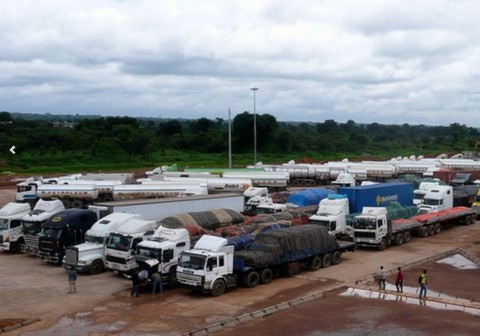
 Democratic Republic of Congo’s (DRC) border post with Zambia, one of Africa’s busiest land frontiers, went high-tech, with a web-based customs system that was meant to improve efficiency and eradicate corruption. It’s not quite working to plan. As officials struggle to get to grips with the new system and DRC’s decrepit phone network groans under the weight of data, the Kasumbalesa border post 300 km (200 miles) north of Lusaka has almost ground to a halt, according to drivers and freight operators. The result is a tailback of trucks stretching at least 20 km into Zambia and a spike in prices in Lubumbashi, impoverished DRC’s second city, which has lost its one proper road link to the outside. The bottleneck is bad even by African standards but it throws into stark relief the problems governments face as they try to remove the numerous bureaucratic and physical barriers to intra-regional trade across the poorest continent.
The Kasumbalesa blockage is being felt 100 km away in Lubumbashi, a bustling mining city of several million who rely on the 450 trucks a day that normally pass through the border laden with everything from biscuits to cement to paraffin. Shop owners are stockpiling and prices of staples such as casava powder – known locally as fufu – have gone up 50 percent in three weeks. “This has already had a big effect. It is causing lots of problems for the population,” Lubumbashi resident Charles Pitchou said.
Kasumbalesa – at the heart of the relatively prosperous and developed Copperbelt – was meant to be an example of how to do it properly, a frontier handed over to a private firm to make customs run like clockwork.
In one of the first public-private partnerships on African borders, an Israeli-run firm called Baran Trade and Investments won a 20-year concession in 2009 to build a “one-stop” customs post and operate it for 20 years. (Makes one wonder why the countries have a Customs authority in the first place?) With $5 million of Baran’s own money and a $20 million loan from the Development Bank of Southern Africa, the Zambia Border Crossing Company (ZBCC), as the subsidiary was known, had a streamlined Kasumbalesa up and running in 2011. Local media reports suggested much-reduced crossing times. However, Lusaka canceled ZBCC’s contract in late 2011 when President Rupiah Banda lost an election and his successor, Michael Sata, ordered investigations into a slew of state deals struck by his predecessor. TheBaran deal never went out to public tender and the fees charged to trucks – $19 per axle – were too high. It also said giving control of the border to an outside concessionaire was a threat to national security and that the reduction in waiting times was not as dramatic as the firm said. Baran’s chief executive, contacted via ZBCC’s website, did not respond to requests for comment.
With Baran gone, the state-run border posts muddled through until September, when DRC upgraded its systems from ‘Sydonia++’, a set-up widely used in the 1990s, to a web-based successor called ‘Sydonia World’, freight operators and regional trade experts said. Although UNCTAD was pushing use of ‘Sydonia World’ as far back as 2002, the data burden was too much for DRC’s computer networks, which crashed.
“The system is very good but if you don’t have a decent Internet connection, it doesn’t work,” said Mike Fitzmaurice, a South African logistics consultant and editor of online trade journal Freight Into Africa. National government spokesman Lambert Mende said a vice finance minister had been despatched from Kinshasa, 1,500 km away, to resolve the problem.
Zambia too is pulling out the stops to get the border moving again in a region important to its economy. “We need to have a normal flow of goods and services because this affects the entire region,” deputy trade minister Miles Sampa told Reuters. One stop-gap solution has been to scan documents in low-resolution black-and-white, rather than full color, to ease the data burden. But even if the two sides iron out the immediate snafu, the fiasco has provided another example of the dream of a seamless, integrated African border crossing falling short of reality.
Zimbabwe and Zambia upgraded their Chirundu border to a one-stop frontier in 2009 but crossing times have only dropped from 38 hours before to 35 now, according to Fitzmaurice, who compiles weekly records on delays. By contrast, customs clearance within the 114-year-old Southern African Customs Union (SACU) – South Africa, Botswana, Namibia, Lesotho and Swaziland – can be as little as 30 minutes. “Once you go north of SACU, into Zimbabwe, Zambia, wherever, there’s no such thing as a ‘good’ border post,” Fitzmaurice said. “The concept behind all these systems is good but the implementation just falls down every time.” Source: Lusaka Voice

 What Happened to the Portcullis?
You must be logged in to post a comment.