Serbia – History of Customs Law & Customs Tariffs

The following comes from the Serbian Customs website – darn interesting! I would indeed like to learn of any other Customs administrations who have preserved “with diginity” their relics of the past.

The Customs profession, one of the oldest trades (emerging immediately after the clerical, ruling and military professions – lets not forget prostitution) withstood many turbulences and assaults, but it persevered, survived and developed. The number of customs officers and customs houses reflects the greatness of a state. And there lies also the greatness of the customs profession.”  These words end a text written on his profession by Veljko Velikić, a customs officer from Vršac, published in the magazine “Carinik” (Customs Officer) in November 1926.
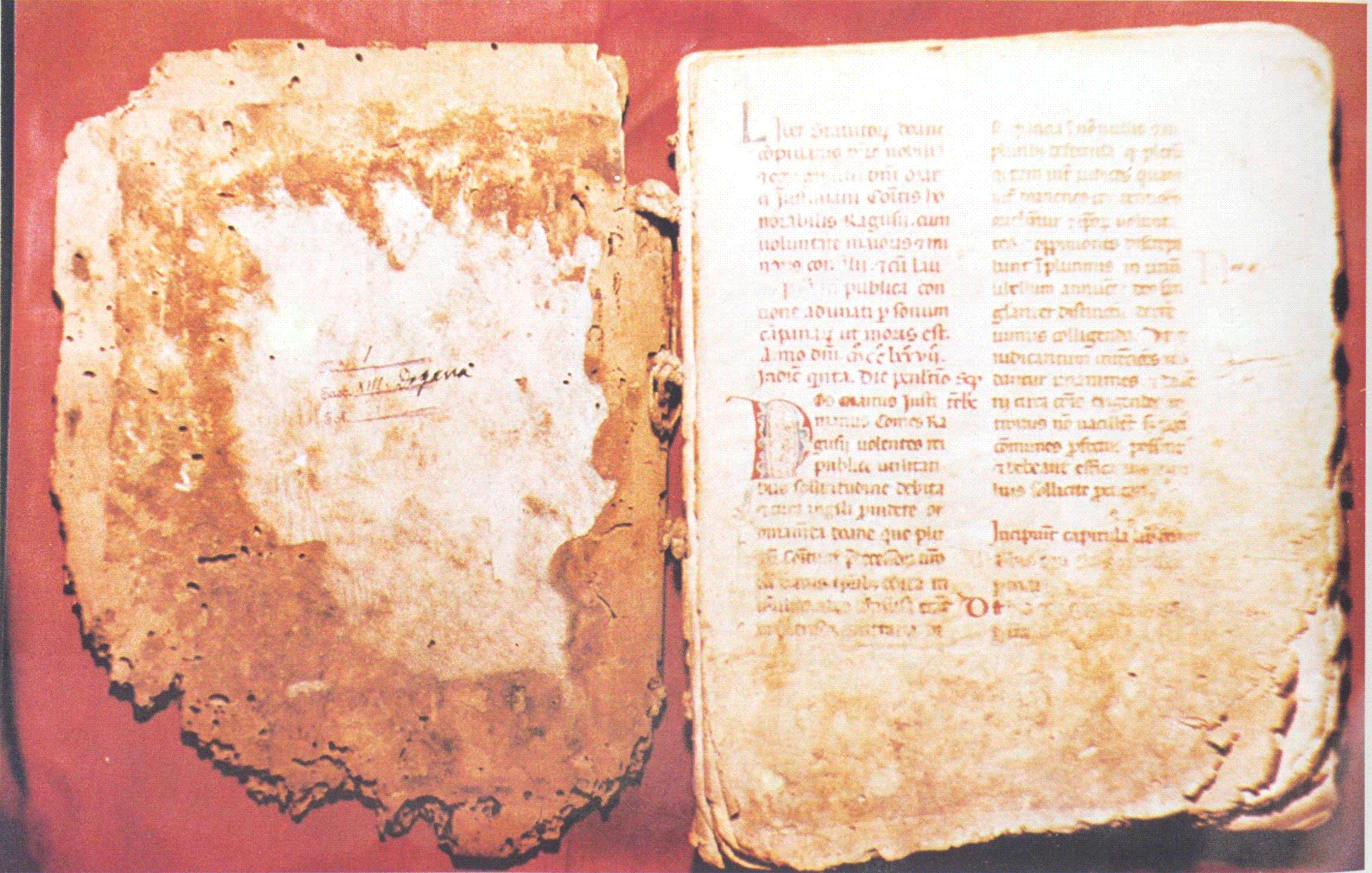
The oldest preserved customs law related to our region was the Dubrovnik customs statute – Liber Statutorum Doane – from 1277 A.D. in Serbia, in addition to case law and national written legal sources, as early back as 13th century the first written legal source of Byzantine origin was applied. Sava Nemanjić, Saint Sava, on declaration of autocephaly of Serbian Orthodox Church in 1219, issued the Nomokanon, a collection of ecclesiastical and civil law regulations.

The oldest preserved customs law related to our region was the Dubrovnik customs statute – Liber Statutorum Doane – from 1277 A.D. in Serbia, in addition to case law and national written legal sources, as early back as 13th century the first written legal source of Byzantine origin was applied. Sava Nemanjić, Saint Sava, on declaration of autocephaly of Serbian Orthodox Church in 1219, issued the Nomokanon, a collection of ecclesiastical and civil law regulations.

This view of our colleague from early XX century was based on historical facts, since customs duties, in the form of tolls or taxes, were known back in the Old Ages.  They were levied by the state or individual cities.  The Old Greeks in Athens imposed a duty of 2% on imports and exports over the Pierian Mountains. The Romans also used to levy such duties as state and provincial or city taxes.  As early back as the Roman times customs duties made up a significant part of public revenues for the state treasury. At certain communication points in the provinces there were customs stations (stationes) where the duties were charged for the goods passing such points. The amount of duties was 2.5% (quadrogesimo) of the value of imported goods. The collection of customs duties was also farmed out, at the beginning granted even to farmers from the ranks of domiciled population, and later on, from mid-2nd century on, duties were collected by officials that in our territory were called publicum portarii Illyrici et ripae Thraciae. In the Middle Ages, in addition to import and export duties, the so-called transit duties were also levied. 

It was the basis for Dušan’s Code, drawn up at the times of developed feudal state in 1349, and amended in 1354, and this Code provided rules for the largest number of social relations.  Medieval Serbian rulers usually farmed out the collection of customs duties, most often to Dubrovnik citizens. After the arrival of Ottoman Turks in the Balkans the structure of revenues was changed entirely. The most important tax was the one paid in money, the so-called desetak (tithe), and also in “fruit of the land” and in labour; also levied were a district surcharge (nahijski prirez), fines, and revenues were also collected from customs duties, transportation and fishing taxes. On liberation from Ottoman Turks, the revenues from customs duties and charges on ferry transportation started to be collected for the first time in May of 1804, when Karadjordje established a customs house with a ferry at Ostružnica. Similar to the rate during the Ottoman rule, the customs duties stood at 3%. The vassal Serbia had to establish its customs tariffs in line with the then applicable provisions of agreements with the Holy See, and Prince Miloš fully complied with the Holy See’s instructions in that area.
Continue reading →

TRALAC – What has happened since customs duties on 124 clothing tariff lines were increased in 2009?

I really enjoy TRALAC’s Newsletter – their analysis is always concise and down-to-earth. This Hot Seat Comment is no exception. One often wonders about the impact and nett result of tariff changes and trade remedies. Here we get some insight.

The clothing and textile industry has a long history in South Africa and is still a very important source of employment, especially for women and in poorer communities. The industry is geographically bound to specific provinces, including the Western Cape, KwaZulu-Natal, the Free State and Gauteng. In many rural areas the clothing and textile sector is often the only source of formal employment. Since about 2002 the Rand appreciated substantially and South African exports became less competitive in the global market. Coupled with the trade liberalisation, in terms of South Africa’s WTO offer, the clothing and textile industry has experienced sustained import competition due mostly from Asian imports. In order to try and remedy large-scale factory closures and employment losses in the industry the Southern Africa Clothing and Textile Workers Union (SACTWU) applied for an increase in the import tariffs of 124 clothing tariff lines to the WTO bound rates of 45 percent in 2009. These clothing tariff lines are classified under Chapter 61 and 62 of the South African Tariff Book and include various clothing items, including men’s woven and knitted shirts, jackets and trousers; babies’ garments; and women’s woven and knitted jackets, skirts, dresses and trousers. Although the retailers objected to an increase in import duties the International Trade Administration Commission (ITAC) granted the application and general customs duties on 121 clothing tariff lines were increased from 40 percent to 45 percent, while the general customs duties on three tariff lines (hosiery) was increased from 20 percent to 45 percent.

imagesIn its application SACTWU stated three reasons for the application: there has been a significant increase in imports under these 124 tariff lines flowing into South Africa; market disruptions in the SACU industry which have resulted in factory closures and retrenchments warranted increased protection for the domestic industry; and increased tariffs will provide both relief and show increased confidence in the industry. The retail industry objected to the application on the following grounds: the loss of business in the manufacturing industry can not only be attributed to price competition, but also inefficiency in the local industry; increased duties will have an inflationary effect impacting the ability of consumers to buy clothing at competitive prices; and increased duties will have a punitive effect on the rail sector and the end consumers. In its decision the Commission found the declining rate of investment and employment in the clothing sector coupled with increased imports a disturbing trend. The Commission decided that an increase in customs duties will enable manufacturers to protect existing jobs, increase market penetration and price competition and growth the domestic manufacturing sector in the export market. However, the question of whether the increase in these customs duties have been successful in reaching its goal of decreased imports and increased domestic production, sales and exports still remain.

Import and export data sourced from the World Trade Atlas (2013) and production and sales data sourced from Statistics South Africa (2013) show the following patterns in the clothing industry between 2009 and 2012:

  • Over the time period imports of the 124 clothing tariff lines increased by 15 percent, from approximately US$ 834 million in 2009 to approximately US$ 1.2 billion in 2012.
  • The top five importing countries were China, Mauritius, India, Madagascar and Bangladesh, accounting for 89 percent of the total imports of these clothing articles into South Africa over the time period.
  • China mainly exported men’s, boy’s, women’s and girl’s cotton trousers; knitted sweaters and pullovers; cotton and knitted t-shirts; and knitted babies’ garments to South Africa between 2009 and 2012.
  • South Africa’s exports of these clothing tariff lines increased by 6 percent, from approximately US$ 71 million in 2009 to approximately US$ 84 million in 2012.
  • These clothing articles were mainly exported to African countries, including Zambia, Mozambique and Zimbabwe.
  • The production index of the physical volume of production (base year is 2005) show there has been a significant decrease in the volume of production of knitted and crocheted articles and wearing apparel in South Africa. The index decreased from an average of 108.11 in 2009 to an average of 79.82 in 2012.
  • The sales of knitted and crocheted articles and wearing apparel also declined over the time period. Actual value of sales declined by 3 percent, from approximately US$ 18 billion in 2009 to approximately US$ 16 billion in 2012.

Although there has not been a significant lapse of time since the increase of import tariffs the data gives the short term response of imports, exports, and production to the change in import duties in November 2009. Immediately after the increase in tariffs there was an initial decrease in exports, production and sales.  However, exports recovered by the end of 2012, while production and sales are still significant lower than pre-2009 levels. SACTWU has also recently indicated that employment in the clothing, textiles and leather sector seems to be more stable over the last two years. However, one of the main objectives of the increase in import duties, to deter lower priced imports mainly from Asia, has not been accomplished. Source and content credit – Willemien Viljoen, TRALAC Researcher.

WCO receives gift of historical significance to Customs from Egypt

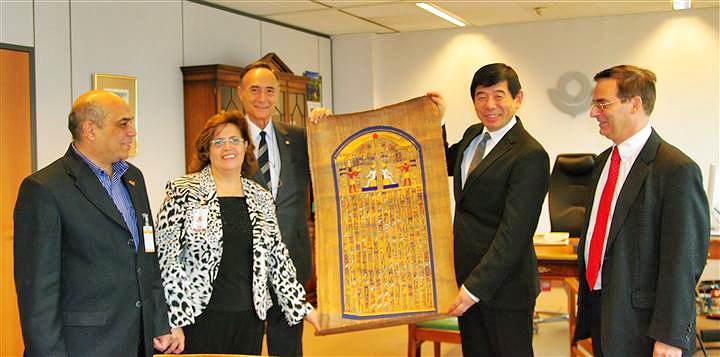
An Egyptian delegation to the WCO Harmonized System Committee, on behalf of the Director General of Egyptian Customs, Mohamed Elalhawy, presented the Secretary General of the WCO, Kunio Mikuriya, with a colour papyrus copy of the Customs tariff applied in Egypt during the time of the Pharaohs some 2000 years B.C. The original tablet is to be found in a museum in Egypt. You can view a photograph of the Egyptian tablet by clicking here!

The Secretary General thanked Egyptian Customs for this impressive gift full of significance which clearly illustrated the historic nature of Customs tariffs dating back more than 4000 years. He expressed the hope that one day he would be able to see the original stone tablet in Egypt. The papyrus will be displayed at WCO Headquarters. Source: http://www.wcoomd.org

Customs Core Skills – in danger of extinction or a casualty of progress?

The recent death of a close friend and colleague – Lester Millar – brings to mind, once again, the dire situation of a dwindling ‘knowledge base’ in the area of Customs’ core competency. In an era where most customs or border management authorities are happy to employ people with a variety of tertiary qualifications – with the idea that this alone will be sufficient to ‘arm and support’ them in the field of customs/border control and management – what happened to the skills of yesteryear which allowed both government and trade practitioners to exercise their technical abilities to agree or disagree amicably on a customs tariff or valuation interpretation that could result in thousands of rands (ZAR) going to state coffers or the retailer’s bank account?

Many would argue that with the extent of automation and modern techniques, customs core skills are no longer valid or even necessary. Indeed the extent and design of systems goes so far as removing the relevance of human intuition and decision-making. Today we have automated risk management, automated duty calculation and declaration processing, automated cargo and goods accounting, any even a call centre – so is there really a role for a Customs specialist in the 21st century? Customs Managers today have their reports and other so-called ‘empirical data’ to rely on for decision-making and strategizing. The year-end revenue rush, it-self, relies on such computer generated reports negating the need for an internal ‘think-tank’ to devise means of collecting the hidden revenue before the deadline.

For those in the trade, a similar situation exists, with some difference however. The traditional customs clearance and cargo reporting process is highly mechanised these days and if your systems are up to the task, you can rest assured staff can remain glued to their seats and screens without having to venture to the Customs House. Here too, lies a significant change. The traditional Custom House no longer exists and is basically home to the ‘Customs Frontline’ which deals with ‘physical’ intervention and other trade services. Tariff, Valuation and Origin are now confined to back-office functions accessible via a call centre or tiered response mechanisms embedded in Customs’ new automated workflow; that is, if physical or telephonic access to regional customs specialists have been removed.

Few can dispute the advantages of technology supported processes. Yet, when things go array, even the knowledgeable people have difficulty in resolving an issue. Some suggest that human discretion is dangerous and counter-productive, which perhaps is true if left to an uncouth, power-crazy customs or border control official. Yet, ‘discretion’ is a tenet most necessary for interpretative and cognitive skills which once most Customs Officials used to have.

So what is this core competency to which I refer? First of all Customs competency requires an officer to reason, interpret and apply the customs law in the “fairest” possible way based on the facts at his/her disposal. So it means the officer must have an ability to discern; importantly between right and wrong. Discernment must also take into account an acute understanding of previous/historical evidence relating to a case. For a customs official, it will be important to comprehend the rights and legal obligations of the parties concerned, as well as the documentation relating to the case/transaction. Moreover, where a case/transaction deals with a matter of ‘tariff’, or ‘valuation’ or ‘origin’ the officer must at least have the basic knowledge and skills of the internationally defined rules of interpretation in these disciplines. I say ‘at least’, because in any of the mentioned areas, it may require an expert opinion to further conclude the outcome of a matter.

While automation will take care of validation and computation to the n’th degree, storing and retrieving vast amounts of data in milliseconds, the fact remains that a competent ‘human being’ is still required to preside over a complex decision. Good systems are built on ‘rules’, not exceptions. It is the latter therefore that requires ‘customs core competency’ to resolve.

Our dear friend and colleague Lester was gifted with a phenomenal ability to distill and comprehend information. This knowledge made him one of our finest, and sadly virtually last remaining tariff experts. Add to this, a wonderful and helpful nature and willingness to serve the public – a not too common trait nowadays. Adios Lester…..since we did not fully profit from your time with us, may we at least profit from our loss!

World Customs Tariffs – post World War 1

I came across a document prepared by the Canadian Reconstruction Association titled – Tariff Policies Throughout the World – published in 1921. It comprises a survey of tariff legislation since the armistice (end of WW1), which shows that every important country in the world was protecting its own industries and striving to reduce its dependence upon outside sources of supply, and that “Protection” is established and accepted as the fiscal policy of the nations of the world more generally and firmly than ever before.

The story told by these tariff developments is absolutely one-sided, a world-wide resort to tariff protection, recognition of the value of industrial development and of the home market, and a general strengthening of protective systems.

Two significant statements by the governments of the day bear testimony to this fact. The Spanish Government summarized cogently the world tariff situation at the time: “Many countries have taken and are taking measures to prevent the invasion of their markets by foreign goods; tariff barriers are being raised and other restrictive measures adopted on all sides; the situation is developing towards a worldwide tariff war. The new customs tariff is an instrument prepared for use in a tariff war, if necessary.” Not less worthy of heeding is a statement issued by the Australian government: “customs duties which are not high enough to be effective are worse than useless.”

What a strange contrast to today’s circumstances where the WTO seeks at all costs to ensure the dismantling of all barriers – tariff and otherwise. Now read what things were like in our own backyard.

SOUTH AFRICA

Conditions during the war were, in effect, such as would have obtained under an almost prohibitive tariff and as a result the industries of South Africa experienced a tremendous development. The Minister of Finance in his budget speech in 1920, stated that no less than 2,000 new factories had been established in that Dominion since the fiscal year 1915-16, that in the past four years industrial production had increased 50% and that the country was advancing rapidly in the direction of becoming self-supporting in respect of all the necessaries of life. Protectionist sentiment in the Union is strong.

The budget introduced into the Union Parliament on April 15, 1921, provided for an increase of various customs duties, and the Government has announced its decision to appoint an Advisory Customs Tariff Board which will be called upon, among its other functions, to report on “what steps may be necessary to assist and develop the industries of the Union.”

Two recent developments indicate the attitude of South Africa in regard to protection and encouragement of domestic industries. In the Spring of 1921, in order to protect the shoe manufacturing industry of South Africa, principally against competition from the United Kingdom, the Government prohibited the importation of leather footwear, except under license, with the provision that licenses should be issued only for the importation of such shoes as the South African manufacturers were unable to produce. By a proclamation of May 11, 1921, the Government brought certain goods within the scope of the “dumping” clause of the Union customs tariff and the “dumping” duty has now been made applicable to wheat, flour, and wheat meal imported from Australia, the amount of such duty to equal the difference between the price at which these products are sold for home consumption in Australia and the price for which they were sold for export to South Africa, except that, as under the Canadian Customs Act, the special or dumping duty must not exceed 15 %.

The policy of the present South African Government (circa 1921) is frankly to enable South African industries to continue in operation, to encourage new manufacturing industries and the utilization of the resources of the Dominion, and to prevent the Union from becoming a dumping ground for other countries. While the question of revenue is being kept in mind, the maintenance of South African industries is regarded as still more important in the interests of the country as a whole. Source: Internet Archive