SARS clampdown nets R40.8m in illegal vehicles

For some, particularly government enforcement agencies and the motor industry will laud such a headline. Read the full article on FTWOnline .

The real question is why South Africa allows the importation and storage of these vehicles for subsequent re-exportation? This also implies the continued operation of licensed warehousing facilities for a commodity which seemingly is impossible to monitor and control. If the illegal importation of second-hand motor vehicles was outlawed we wouldn’t have to print such a headline, nor would enforcement agencies have to waste scarce resources and taxpayers money in counteracting such a threat. There is an argument that political and social conditions in our neighbouring BLNS states necessitate the ‘exportation’ of cheap vehicles to the people in these countries. Yet, this implies full customs controls at the internal land border posts between South Africa and the SACU states. Unfortunately, SARS provides little more than domestic VAT control at these borders which beckons the question why this practice is allowed.

Freight Forwarders and Brokers – a US perspective

Of all supply chain operators, the brokers and freight forwarders undoubtedly have the most challenging business – highly competitive and so dependant on the activities and integrity of all other logistics players. For an interesting analysis of the US environment you will find the following white paper both interesting and thought-provoking.

10 Best Practices and Recommendations for customs brokerage and freight forwarding

Customs Day – let’s not forget the heroes!

While the world’s customs administrations prepare to celebrate International Customs Day, the grim reality of the fight against crime stares back at us right here in our own back yard. Just a few days ago, customs officers and investigators learnt of the sudden and tragic death of their colleague Johan Nortje, who was gunned down in his driveway in Durban. Johan was a counterfeit investigator.

It is ironic that while customs administrations spend a lot of time in developing electronic systems in the fight against crime, little thought is in fact given to the ‘risks’ facing the official on the ground. In this age of data systems, proactive risk assessment, and frontline scanning it still remains the responsibility of a ‘human’ officer to make the ‘judgement calls’ and ‘physical intervention’ where necessary. Let’s hope this incident does not go unheeded. It helps little if a lot of time and money is spent on ‘capacity building’ and there is not a plan to retain and safeguard these ‘intellectual’ interests.

Something for Solution Developers

Herewith a link for service providers: http://www.tradefacilitate.com/ . You can read the case study at the following link: Microsoft Case Study: Microsoft Visual Studio 2010 Ultimate – TradeFacilitate

Paper Free Trade

This is the latest ‘buzz-word’ in international trade circles…….it reinforces the view (and fact) that trade is moving further away from the notion of physical documents. Paperfreetrade.eu provides a concise and holistic view of European and American circles. For many, most of the content is not exactly new. South African traders will indeed be familiar with most of the principles but is is all the same interetsing to note how these are being packaged and implemented internationally. SARS, has a number of unique technological offerings planned for forthcoming phases of the Customs Modernisation Programme which will augment the very same ‘paperfree’ principles – watch this space.

SA Reserve Bank scraps Form F1.78

The Financial Surveillance Department of the South African Reserve Bank has announced that the electronic export monitoring system will be implemented on 3 January 2011 and that the Forms F178 will be withdrawn from that date.

Consequently, exporters will be exempted from the provisions of Exchange Control Regulation 6(10)(a) and Authorised Dealers will no longer be required to confirm the receipt of export proceeds, unless directed to do so by the Financial Surveillance Department.

As a further administration relief to Authorised Dealers, all attested Forms F178 not acquitted by 3 January 2011, may be disregarded. Exchange Control Regulations 6(10)(a), (b) and (c) will, in due course, be amended and the reference to the Form F178 withdrawn.

The electronic export monitoring system is dependent on the correct capturing and reporting of the mandatory Exporter Code and the Unique Consignment Reference (UCR).

The introduction of the electronic export monitoring system will necessitate a number of changes to the Exchange Control Rulings, which amendments will be made in due course.

AEO software tool for US companies

Learn how Trusted Trade Alliance and CUSTOMS Info give U.S. companies a unique opportunity to access a full-featured AEO software tool to ensure AEO profiles are kept up-to-date.

http://www.prweb.com/releases/customs-info/trade/prweb4785514.htm 

Why traditional Customs’ document / information reporting standards are ‘out-dated’

Commencing with the US Container Security Initiative (CSI) in 2002, it became clear that traditional cargo and conveyance reporting was a thing of the past. Let’s face it without the events of 9/11, none of the security advances in the customs space would have been possible. Many customs administrations did not even have a formal cargo manifest reporting system. Some relied on 3rd party terminal access to carrier and airline manifest data, others interfaced with cargo community systems, but only a few placed any real relevance on a dedicated cargo management and reporting facility. Most electronic messaging formats today still rely on an electronic ‘derivative’ of some document/form or another. This perhaps is a logical departure point. However, recent developments under the banner of the WCO SAFE Framework of Standards indicate a departure from the traditional form of customs information reporting. Let’s see, the framework itself appears to delineate cargo and clearance security data elements for exports and imports. But, at the same time we see the release of version 3 of the WCO Data Model clearly advocating a single overarching electronic messaging architecture which portends to accommodate not only current EDI reporting requirements but future ‘all-of-government’ messaging in so far as it relates to the transactional clearance of import and export goods. Moving ahead into the current environment, the impending EU advance cargo reporting requirements are very similar to that of the US 24 Hour Rule. What is more interesting is the fact that the EU – through its Entry Summary Declaration (ENS) – has created a new information exchange requirement which effectively applies a combination of both clearance and cargo information. This clearly indicates that traditional forms of cargo manifest and conveyance reports/exchanges no longer fulfil customs information and risk assessment requirements. I think it is important for all shippers and operators to realise that in today’s rapidly changing environment, we can no longer speak strictly in terms of pre-arrival notifications, carrier’s manifests, house manifests, discharge lists, or customs clearances. Customs requires ‘DATA’ (not forms/documents) in order to achieve its security, fiscal and enforcement obligations; and it needs this information way in advance of what shippers and operators have become accustomed to over the last 50 years – this is in effect the ‘change’ which international supply chain operators need to embrace. Unfortunately, the developments on automated processing and risk management are not taking place uniformly across all customs administrations; hence the envisaged benefits of so-called ‘paperless clearance’ are still a pipe dream in many respects. Before the 2005 security amendment, EU Customs legislation required that goods be presented to customs authorities on arrival to the customs territory, but how that was done was left to each individual EU member state; and, there was no emphasis on safety and security or requirement of sharing of risk data among EU members. Another factor, it would seem, is that the EU (comprising 27 members), has opted for the introduction of the ENS, realising the so-called disparity and complications related to coordinating controls and sharing information between independent customs administrations. A ‘single’ country does not have to deal with this – only its own domestic requirements. For example, under the new dispensation, where a flight is destined for two EU airports, and the carrier submits the ENS to the first, Customs needs to make provision for pushing the risk information and results of control to the second country, or allowing that second country to pull the control results and ENS data from the first. Also, such a system depends on mutual recognition across all EU members of an AEO granted in one member state. Bottom line, EU traders must prepare for some chaos to occur on 1 January 2011. The new requirements will be a true litmus test of what is possible in the supply chain, as it will surely become the defacto standard in other regions in the globe. At the same time the WCO will undoubtedly observe the first wide scale application of its SAFE Framework of Standards with keen interest.

WCO DMV3 followup notice

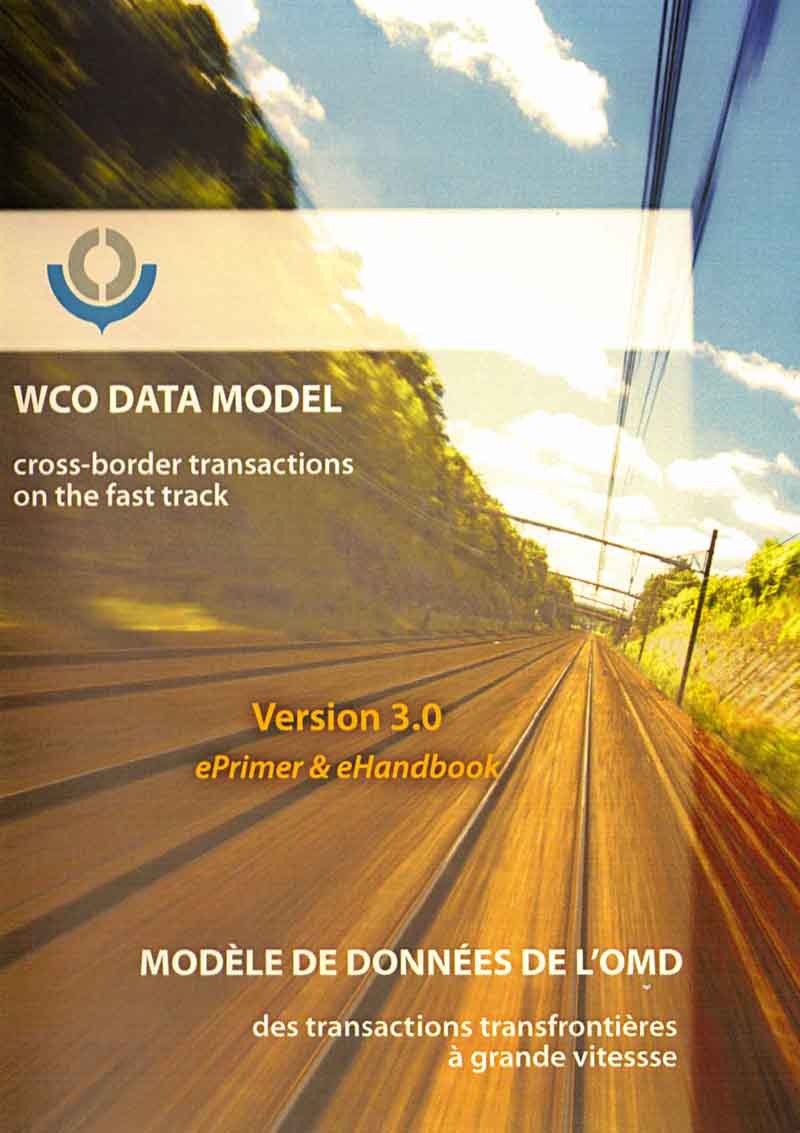
WCO3 Data ModelI have received numerous enquiries concerning the availability of the the WCO DMV3.

The WCO has since clarified that DMV3 will not be available in DVD format. The intitial release on DVD was merely to commemorate the launch, where each member customs administration received a  copy. 

Members of the private sector seeking access to this service will be able to view the contents of the data model exactly as it is presented in the DVD. The content will be updated from time to time. The cost of such service is Euro 980.00.

Admittedly this is quite an exhorbitant amount, but content includes eHandbook and ePrimer but also eSupport, a page that allows the user to provide feedback, ask queries and consult with the experts at the WCO. Trust this clarifies the situation.

WCO Data Model V.3 available online!

The WCO Data Model 3 is a maximum set of carefully combined and harmonized data requirements derived from cross-border regulation. These requirements are mutually supportive and are updated on a regular basis to meet the procedural and legal needs of cross-border regulatory agencies such as customs, controlling export, import and transit transactions. The WCO Data Model 3 is only available online, by the means of an annual subscription which will enable you to – (a) Have access to a database of knowledge through a FAQ module, and (b) Ask any question directly to the WCO Data Model 3’s Project Managers.

Please visit: http://wcoomdpublications.org/data-model-3.html for pricing and conditions.

The Supply Chain is a Scary Place – World Trade Magazine

The Supply Chain is a Scary Place – THIS MONTH’S ISSUE – World Trade.

Downloads

Please visit the new “Downloads” tab for available documents. In the coming weeks, more specific information in support of the Customs Modernisation Programme will be provided. Please feel free to use this content in a respectable manner, i.e. for training and research purposes.

The Dynamics of Electronic Trading – Issues for Customs, Forwarders and Traders (and service providers)

Ever since the inception of automation in Customs (circa 1981) it has offered time-saving benefits and obviated several mundane tasks. Like all things new, improvements are lauded and soon forgotten as quickly as the novelty wears off. With each improvement more ‘operational knowledge’ is translated into software code, aiding the user, but unwittingly depriving future users of fully understanding the logic behind it all.

Let me provide an analogy –

20 years ago most broker’s classified supplier’s invoices for appropriate tariff, computed currency conversion, value for duty purposes and duty calculation all manually. Similarly, Customs officers verified each declaration according to the supporting documents presented. True this was resource intensive and time-consuming, and hopelessly inefficient by today’s standards and expectations. On the plus side, the brokers and customs officials had a greater appreciation for the detail and technicalities involved in clearance processing. Another benefit of the past was the accessibility of the customs officer.

After 2 decades of computerised enhancements the technicalities around customs clearance have been made easier through significant automation of workflows and communication. Most brokers nowadays offer transport and logistics services and have clearly evolved into international freight forwarders. The introduction of the Customs duty deferment scheme has also long been recognised by most brokers and forwarders as a critical component of the financial viability of their business.

In fact, the nature and focus of the trade and customs business have themselves shifted drastically in the last 10 years. Company boardrooms are more about strategy and tactics, and the IT division plays more and more an operational role rather than purely a support function. This is often the bain for the operations division which fails to realise that ICT is an ally not and enemy. This short-sightedness is also the cause by which the system is often blamed for operational shortcomings.

It is therefore clear that procedural enhancements, revised business practices along with computerisation have all lead to a conglomeration of miscellaneous ‘detail’ which seemingly daunts the user. The computer is able to process millions of lines of code and perform instructions across the physical boundaries which make up the different organisational divisions and data stores. In the past human intervention gave effect to physical processes through manual activities with hand-offs from one division to another; today, thousand’s of instructions are triggered by a few swift keystrokes by an operator, where sophisticated algorithms filter and distribute data, perform calculations, risk assessment and account management. Computerisation also enables activities to occur in parallel, whereas a manual process normally follows sequentially. Because the eye does not see these things the user/operator is unaware of the sequence or complexity of the processes being accomplished. Because there is perhaps more idle time today, the expectation is that things need to happen in seconds, not hours or days. And so, service levels are defined with these expectations in mind with onerous penalties for non-delivery. (Okay, Customs is indemnified against the latter!)

In the light of the above and a review of the recent weeks of activities leading up to the implementation of the first phase of the Customs Modernisation Programme, it is abundantly apparent that the state of preparedness needs to look at a variety of areas, not just those which affect the computer operator (customs officer or trader).
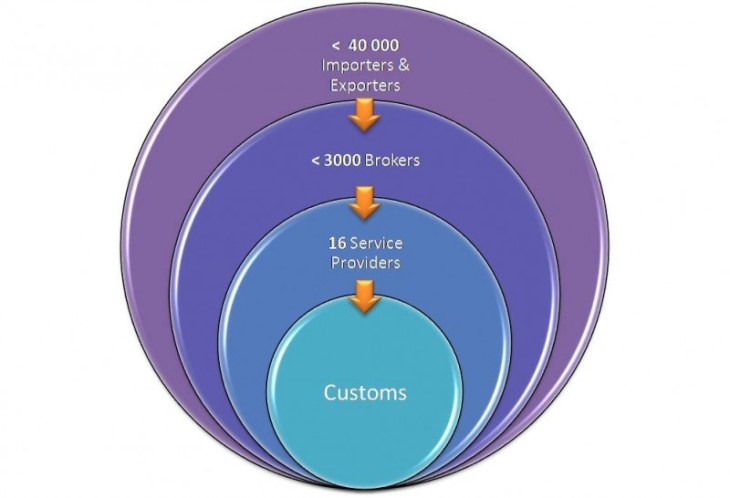
The diagram is intended to illustrate the effect of Customs Modernisation on the local trade community. In terms of technical ICT developments, Customs need only interact with the 16 service providers. These in turn have the responsibility to provide systems and systems support for their 3000 or so brokers and freight forwarders. However this obligation can only impart systems knowledge. The brokers/freight forwarders must, over and above the systems enhancements, be able to articulate and understand these changes in a tangible manner. Why, because these affect not only their legal obligations under the law but their service offerings to their clients – the importers and exporters. This is where I perceive there is some gap or lack of capacity rather. There are indeed excellent thinkers in this industry, but alas too few, and these few have fulltime day jobs as well. A change of the current magnitude requires a dedicated team of knowledgeable practitioners who (on a fulltime basis) should not only challenge the law makers but make constructive alternatives. It is difficult to maintain focus on this if the participants are all volunteers.

Lastly, those thousands of importers and exporters are soon to realise that the impending new Customs Act has a whole bag of goodies for them too! While the umbrella organisations have always had the intent to provide training, this requires capacity as well. The recent joint training initiative between SARS and Stakeholders was undoubtedly a first, but must not be the last. Moving forward it is imperative that similar joint ventures occur, with increasing frequency and more detailed training content and materials. There is more than enough room for all of us (SARS and Trade) to make an impact. This is the bigger picture!

Modernisation Release 1 – stepping stone to success!

On Sunday morning, 31 October 2010 (just after 05h00) the culmination of 11 months hard work resulted in a successful rollover of the old customs procedures to the new. All current transactional clearance systems, information systems and the EDI gateway were successfully implemented. Thus the path to compliance of the Revised Kyoto Convention has been set in motion with several more planned enhacements in the pipeline.

The Customs operational support centre, together with all the call centres supporting industry service providers (ICT providers to the shippers and brokers) – some 20 in total I believe – kicked into place to support the customs user through the new customs clearance process.

I heard a comment that Monday (1 Nov) was too late to issue a report on the Customs implementation – evidently from a reporter’s perspective, news must be pre-emptive or current. I obviously differ and believe that a few weeks of operation need to pass by in order to accurately assess and gauge the effectiveness and efficiency of the upgraded systems and procedures.

Weeks of preparation covering the new customs procedures, implementation and fall-back plans, were supported by a contingent of willing volunteers in both SARS and industry to foster knowledge and user readiness. Almost 11 months of weekly technical sessions were avidly attended by service providers and a few shipping experts. Regular health checks were conducted to gauge trade readiness and developments. The original implementation date of 1 October 2010, was timeously postponed to afford SARS and trade additional time to satisfactorily accomplish a state of ‘joint’ readiness. While this created some initial setbacks for some providers, hindsight proves that the additional month was both very necessary and warranted for all parties.

After almost a week’s operation of the new process, it can be unequivocally stated that the implementation was a success. However, while this view is held by most, it is vigorously opposed by others. More about this in a followup post.


Countdown to D-Day

In little over 2 weeks from now, the South African Revenue Service together with its business partners in South African commercial trade will usher in a new customs clearance dispensation. Notwithstanding many trials and tribulations on both sides, there is a steady commitment and determination to successfully introduce the single biggest change to impact the country’s import / export community. It is only right that there should be anxiety, trepidation, and cautious optimism. Modernisation in the Customs domain is not new, internationally, and most definitely not in South Africa. Obvious too are those who wish to detract from the hard work already accomplished, to the point of seeking any fracture, shortcoming or delay as reason to doubt the ability of this country to implement a modern electronic trading environment.

True, there is a lot of reputation at stake…surely all the more reason to toil tirelessly over the last remaining weeks to best prepare ourselves for this event. In reality it is my wish that this event be a ‘non-event’ – to the extent that it provide as seamless as possible a transition for internal and external users. However, that is wishful thinking since the sheer scope of this programme necessitates ‘challenges’ to both 3rd party service provider, trader, trade practitioner, and customs policy makers alike. Over the last 2 months, not a day has gone by without one or other procedure, policy or IT technical issue being raised which necessitates a rethink or alternative consideration.

Modernisation programmes have a transitional element which poses difficulties in terms of timing and coordination. In the South African context the first phase is about putting Customs and the trading community in the right space to migrate from dated legacy clearance practices to principles of a new customs legal dispensation – to be introduced sometime in 2011. Information Technology is undoubtedly the key enabler here, which is the reason SARS chose the migration from clearance by ‘purpose code’ to ‘customs procedure code’ as the catalyst to kickstart its longer term modernisation strategy. Phase 1 is the most critical delivery in that its outcome not only determines the collective ability of Customs and Trade to modernise, but the ‘apetite’ to continue the journey over the next phases of this programme to bring into being a true fully automated end-to-end supply chain.