A photo submitted by Kazakhstan Customs, as part of the annual WCO Photo Competition, has been voted as the winner of the competition 2020 edition. The aim of the competition is to provide the WCO Members with a means to showcase their Administration’s history, activities and successes.
The winning photo shows a Customs officer in uniform alongside his faithful friend, ready to start the day despite the risks posed by the spread of COVID-19.
The WCO Secretariat wishes to congratulate the winner and thank all 58 Customs administrations which took part in the Competition this year, as well as the 76 Members having voted for their favorite photos.
THE use of Electronic Tax Stamps (ETS) for excisable goods have contributed to a 34 percent increase in revenue collected on branded products.
Due to the increase, the Tanzania Revenue Authority (TRA) has already rolled out the second phase which saw ETS being stamped on soft and carbonated drink plus bottled water.
TRA Deputy Commissioner General, Mr Msafiri Mbibo made the remarks during the on-going 44th Dar es Salaam International Trade Fair (DITF).
Mr Mbibo said since the system was introduced it has proven success showing improvement in revenue collections in which there is an increase of 34 percent.
ETS replaces the former paper stamp system, which was cumbersome and prone to human error, allowing certain tax-related malpractices to slip through the cracks.
This is one of the government’s moves geared towards improving tax administration in the country.
“We are glad that ETS shows improvement in the collection of excise duty and Value-added Tax (VAT), in the first quarter of the 2019/20 financial year the collection rose to 35.3 per cent on domestic spirits and wines compared to the corresponding period of last year,” he noted.
The taxman garnered 25.8bn/-as excise duty and VAT from domestic spirits and wines during the first quarter of the 2018/19 fiscal year, but the amount rose to 34.96bn/- during the first quarter of the 2019/2020 financial year.
Excise duty and VAT on cigarettes rose by 5.6 percent during the first quarter of the 2019/2020 financial year compared to a similar period last year.
TRA collected 56.7bn/-as excise duty and VAT on cigarettes from July to September 2019, a 3bn/-increase from a similar period of the previous financial year.
For the soft drinks, the amount collected as excise duty and VAT during the two months of August and September 2019 was 18 percent, higher than what was garnered during a similar period in 2018.
TRA collected 16.155bn/-in excise duty and VAT on soft drinks in August and September 2018, but the amount rose to 19.05bn/-during the period between August and September 2019.
Mr Mbibo said ETS has helped to eliminate counterfeit products from the market. It is, nonetheless, a promising move by the Government, and manufacturers and intellectual property owners should have reason to smile.
Commenting on how TRA is planning to ensure the surge the tax base, Mbibo said they will continue to develop friendly tax collection mechanisms so that everyone can enjoy voluntary taxation.
ETS first phase commenced on 15 January 2019 and affected cigarettes, wines, spirits, beer and all other alcoholic beverages.
The second phase began on 1 August 2019 and applied to products such as sweetened or flavoured water and other non-alcoholic beverages, except for fruit or vegetable juice.
The Regulations require each manufacturer to install an electronic tax stamp management system.
A Swiss-based firm SICPA has been contracted by the Tanzania Revenue Authority (TRA) to install and enroll all manufacturers, producers and importers onto the system.
A.P. Moller – Maersk will acquire Sweden-based KGH Customs Services for 2.6 billion Swedish crowns ($281 million), the company announced Monday.
KGH specializes in trade and customs management services in Europe across multiple freight modes. The deal adds to Maersk’s service offerings as the carrier looks to expand beyond ocean shipping and position itself as a full-service supply chain solutions provider.
“There are no end-to-end solutions without customs clearance,” Vincent Clerc, CEO of ocean and logistics at A.P. Moller – Maersk, said in a statement. “With KGH, we will not only be able to strengthen our capabilities within customs services and related consultancy, but also reach more of our customers in Europe through a larger geographical footprint and digital solutions that will enhance our ability to meet our customers´ end-to-end supply chain needs.”
Maersk has been open about its ambitions to expand its business into other parts of the supply chain, positing its logistics sector growth as a main business objective.
“Focus remains on developing our end-to-end offering through an even stronger Ocean product while expanding and scaling our logistics and services portfolio,” Maersk wrote in its latest annual report.
Maersk began outlining its end-to-end ambitions in 2016 and has taken multiple steps toward realizing its goal in the form of deals and reorganization. Last year, Maersk closed a deal to acquire the New Jersey-based customs broker Vandegrift. And in 2018, it announced plans to merge its operations with Damco.
Maersk sees its ocean business as the “strong foundation” for the rest of its logistics offerings, and new products will be important in adding to its end-to-end logistics offerings, the company explained in its latest annual report.
“The next phase in the strategy is about growing the business by innovating existing products combined with selling landside logistics products to our existing customers – as well as growth in our Terminals & Towage business,” the annual report reads.
Maersk has specifically said M&A would be one tool it would use to achieve its end-to-end initiative, highlighting landside logistics as one space where deals could happen in its annual report. And when the company brought on a new CFO, Patrick Jany, earlier this year, it specifically highlighted his experience with M&A.
Last year, Maersk became the first ocean carrier to offer digital ocean customs clearance, according to a press release. The offering allows shippers to upload declaration paperwork and the carrier can send a notification when the shipment clears customs, according to a video explaining the offering.
Like with most businessecosystems, the functioning of global trade relies on efficient exchanges of information, especially of documents. While industries and ecosystems around the world are now digitizing associated processes and automating the bottlenecks, the business ecosystem of global shipping has been slower to realize innovation and digitization.
Supply chain processes require close coordination among many parties and a major choke point in this process is the requesting and finalizing of bills of lading with ocean carriers. There are many situations which cause even the most straight-forward flows to be disrupted and require multiple versions of documents to be created, reviewed and exchanged until final approval and the final bill of lading submission.
TradeLens Workflows utilize blockchain smart contracts to automate and digitize multi-party interactions — this helps drive efficiencies across supply chains. Let’s take a look at each major element to understand what digitizing document workflows looks like for the shipping industry.
Blockchain as the foundation
The foundation of TradeLens Workflows is a permissioned blockchain which guarantees the immutability and traceability of shipping documents and their processes on the platform. This is a very important building block in providing the trust needed to scale.
The permissioned blockchain transforms some of the basic concepts around business networks — contracts, ledgers, transactions, the flow of assets and identity of participants — and introduces the following:
Consensus. Transactions in a blockchain network are first proposed, then consented to by the group, and only then committed to the ledger.
Shared ledger. Trust anchors have an exact copy of the ledger.
Immutability. When a block is committed it is cryptographically secured with previous blocks in the ledger forming an audit log that becomes the foundation of trust.
Accountability: All participants are digitally identifiable, and each blockchain transaction is signed with a permissioned user digital certificate.
Document sharing
TradeLens Document sharing provides a framework for organizing and sharing trade documents related to a host of information such as shipments, consignments and transport equipment. This is all done through permissioned access according to the role of different players and includes security, version control and privacy provisions.
Each trade document is stored on a single stack within the blockchain network, under the control of the operator and accessible only to permissioned parties within a channel. Users can upload, download, view and edit documents as allowed by their permissions and access control on that specific type of document for the trade object in question.
It is important to note, only the hash of a given document is stored on the ledger. The document itself is stored securely where access is granted according to the TradeLens Data Sharing Specification. Each time a document is edited or uploaded, a new version is created and added to the document store. Every version can be verified against a hash of its original submitted content in the ledger.
Blockchain ensures the immutability and auditability of all these documents, promoting trust and alignment across trading partners.
Beyond document sharing
The TradeLens Workflow feature takes thedocument sharing capability one step further. It provides a way to interpret structured documents and take actions on them according to well-defined workflows. In other words, by understanding the purpose and contents of documents we can automate certain actions and notifications in the shipment flow.
As documents are submitted through the TradeLens API or UI, they are interpreted by looking at specific attributes that determine which trade object the document is applicable to, and which actions to perform. The actions are checked against defined rules and only specific actions by specific actors are accepted.
When all requirements are fulfilled, the document is saved and the appropriate action gets recorded as a transaction on the blockchain. Smart contracts ensure the state and progression of a TradeLens Workflow — what can be done at each step, and by which organization or actor.
Our workflows also update generated events to help notify subscribers (members of the supply chain) of the actions and results.
An example of TradeLens Workflow: SI-BL Flow
Let’s talk about a specific TradeLens Workflow — the SI-BL. This variation simplifies the process of sending a shipping instruction (SI) to the ocean carrier and receiving back a verified bill of lading (BL). The TradeLens SI-BL Workflow removes the need to manually edit, amend and transfer these critical documents, accelerating end-to-end flow to achieve a final bill of lading.
When a shipper (or their representative) submits a SI to the TradeLens Platform, it is analyzed by its attributes to determine which consignment it’s related to and which ocean carrier should be notified. Once the carrier has it, a draft BL is submitted back to the platform, the shipper can review and make amendments and share back to the carrier and so on, until a final BL is agreed upon. Because this is an automated process between systems at the shipper and carrier, manual tasks are eliminated along with their inherent delays.
There are many other variations of this flow, but the benefits come from the visibility and increased speed in processing these transactions. Also helpful for shippers, this offers a single mechanism and process for interacting with different ocean carriers with an immutable, shared audit trail for all draft BL revisions and approvals — all recorded on the blockchain ledger.
A digital ecosystem to meet old and new challenges
TradeLens Workflows help connect your ecosystem, drive information sharing and foster collaboration and trust by enabling the digitization and automation of how you work with others.
On 30 June 2020 the Secretariat of the Federal Revenue of Brazil (Receita Federal do Brasil), launched its first ever nation-wide Time Release Study (TRS) during an online live broadcasted event attended by over 4000 participants – including border agencies and the private sector, as well as Customs administrations from across the globe. The TRS, which follows the World Customs Organizations (WCO) TRS Methodology, constitutes a milestone for the Brazilian Customs Administration as it enhances transparency while providing an opportunity for an evidence based dialogue between all key stakeholders to tackle the identified bottlenecks and improve the effectiveness and efficiency of border procedures.
The TRS report was validated by the WCO in collaboration with the World Bank Group and with support of the UK’s Prosperity Fund. Speaking at the Opening Session of the launch event, WCO Deputy Secretary-General, Ricardo Treviño Chapa said: “This is a big step forward towards increased trade facilitation and provides a baseline to measure the impact of actions and reforms”. He also underlined that the Brazilian experience would be valuable to share with the wider Customs community and added that “the current health emergency shows that it is key to keep the flow of goods going”. Throughout the event the importance of the WCO’s TRS methodology was highlighted by various speakers as a vital tool for strategic planning and the implementation of the WTO’s Trade Facilitation Agreement.
The study shows an average time measured of 7.5 days considering air, sea and road modes of transport. The Customs clearance stage accounts for less than 10% of the total time measured, while those actions under the responsibility of private agents represent more than half of the total time spent in all flows analysed.
To further increase transparency for importers and exporters, the Secretariat of the Federal Revenue of Brazil also intends to publish the raw data of the TRS.
The recording of the full launch event with Portuguese/English translation can be watched here (YouTube).
The TRS report and its Executive Summary are available here.
The consumption of illicit cigarettes fell below 8 per cent of total cigarette use last year, but was still equivalent to nearly 39bn smokes and €9.5bn in lost tax revenues, says a new report.
Thelatest editionof the annual study – carried out by KPMG on behalf of tobacco giant Philip Morris International – also found that imports of illicit cigarettes from non-EU countries such as Ukraine and Belarus declined in 2019, with law enforcement reports suggesting there are “increasing volumes from illegal factories within the EU.”
Illicit ‘whites’ with no country specific labelling – i.e. legally produced cigarettes that are smuggled and traded illegally, often through free trade zones (FTZs) – remain the largest element of the counterfeit and contraband (C&C) category, representing 23.1 per cent of total EU illicit consumption or 9bn cigarettes.
Counterfeit of brands owned by manufacturers participating in empty pack surveys grew to 7.6bn cigarettes, an increase of more than 38 percent over 2018’s figure, and is the highest level ever recorded by KPMG. Counterfeit consumption was the highest in the UK and Greece.
The overall picture is one of increasing sophistication by the criminal networks behind the illicit trade, with multiple production units to compensate if one is raised, and increasingly high tech manufacturing equipment. New groups are also emerging that are focusing specifically on smuggling raw and fine cut tobacco.
“Illicit manufacturers are producing counterfeit, established and new illicit white brands to order at scale for organisations and smugglers who can arrange distribution of large volumes, either in large shipments or increasingly via high frequency, low volume shipments,” says KPMG.
Criminal groups are exploiting new distribution channels, such as rail, as it is faster than traditional shipping routes, as well as courier packages which are small and hard for law enforcement to detect, according to the report.
“The continued decline of illicit tobacco trade in the EU is a positive development and reinforces the importance of supply chain control measures, strict enforcement, and collaboration in combating this issue,” said Alvise Giustiniani, vice president of Illicit Trade Prevention at PMI.
However, while considerable efforts have taken place to stem contraband cigarettes from flowing into the EU, “we are once again seeing criminal organisations shifting their operations to stay one step ahead of anti-illicit programmes, according to the company.
Kenya is among 15 African States that have agreed to pilot a new project seeking to ease movement of goods within the region’s trading bloc.
The electronic certificate of origin (eCO) System, developed under the Common Market for Eastern and Southern Africa (Comesa) digital free trade area will fast-track movement of goods, enhancing intra-regional trade.
The new plan will do away with registration, application and submission of certificates for post-verification of goods.
Certificates of origin are issued to exporters within the Comesa Free Trade Area (FTA) to confer preferential treatment to goods originating from an FTA member State.
Truckers issued with eCO certificates will no longer stop to undergo an audit of their cargo via a manual verification process.
Comesa trade and customs director Christopher Onyango said the pilot was launched after last week’s meeting where member States agreed to develop national piloting plans to ensure that electronic certificates are implemented as soon as possible.
“The emergence of the Covid-19 pandemic calls for speedy implementation of the Comesa eCO by all member States,” said Dr Onyango, adding that eCO will spur intraregional trade and attract more investments into the region.
Other countries involved in eCO are Burundi, DR Congo, Egypt, Eswatini, Ethiopia, Madagascar, Malawi, Mauritius, Rwanda, Seychelles, Sudan, Tunisia, Zambia and Zimbabwe.
Adoption of eCo that replaces manual certificates follows increased restriction on movement of cargo across borders due to the Covid-19 pandemic.
“It is rather disheartening that despite the preferences offered under the FTA, intraComesa is at eight percent of total trade, compared to Africa’s 15 percent, America’s 47 percent, Asia’s 61 percent and Europe’s 67percent,” Dr Onyango noted.
A technical working group (TWG) on rules of origin (RoO) is engaged on easing rules to facilitate implementation of the Comesa eCO and other trade facilitation instruments.
The director urged the team to consider making the rules simple, transparent and predictable to enable businesses to thrive.
“RoO … are not just the passport for circulating goods under preferential tariffs but are as well the cornerstone behind effective application of preferences towards member States,” said Dr Onyango.
He observed that when the RoO are too costly to be implemented by firms relative to the expected benefits, exporters would rather pay tariffs than comply with strict rules of origin, leading to low utilisation.
According to the Kenya Economic Survey 2020, Kenya’s high appetite for imported goods saw it sink into a trade deficit with Africa for the first time in more than two decades.
Kenya’s import bill from other African countries rose to Sh234 billion last year, an 11 percent increase from the Sh210 billion spent in 2018 while export receipts rose by a paltry three percent to Sh224 billion in the year.
The increased consumption of foreign goods pushed the balance of trade to a deficit position of Sh9 billion.
“Imports from Africa rose by 11.4 percent to account for 13 percent of the total import bill, attributed to increased imports from South Africa,” the survey states.
As the title suggests, the latest edition of WCO Newscontains a variety of articles concerning Customs approach to COVID-19 and even one article relating to Customs Brokers on COVID-19. Other features include C-2-C cooperation and information exchange, Risk Management and the future invisible supply chain and Secure Border . Of interest for Customs Policy are articles on improvements to simplification and harmonisation of components to the Revised Kyoto Convention; WCO’s development of draft “Practical Guidance on Free Zones” as well as Internet domain name ownership data – understanding changes and useful suggestions for Customs. All in all another great read!
Reports such as this should serve as intelligence for any law enforcement entity within the region as well as countries impacted by such illegal activities downstream.
A triangle of vulnerability for illicit trafficking is emerging as a key geographic space along Africa’s eastern seaboard – the Swahili coast. At one apex of this triangle is Zanzibar, a major hub for illicit trade for decades, but one that is currently assuming greater importance. Further south, another apex is northern Mozambique. This area is experiencing significant conflict and instability, and is increasingly a key through route for the illicit trafficking of heroin into the continent and wildlife products from the interior. The final apex of the triangle is out to sea: the Comoros islands, lying 290 kilometres offshore from northern Mozambique and north-east of Madagascar. Comoros is not yet a major trafficking hub, but perennial political instability and its connections into the wider sub-regional trafficking economy make it uniquely vulnerable as illicit trade continues to evolve along the wider Swahili coastal region. These three apexes are linked by illicit economies and trade routes which take little heed of modern political boundaries.
Two main factors underlie the illicit markets that form the primary focus of this study. First, the powerful market demand for illicit wildlife products from Asia (and China in particular), and second, the steady growth in the volumes of heroin moving down the coast, with landings being made further and further south. The Indian Ocean islands themselves have long had serious challenges with heroin trafficking and use, and these are being exacerbated. Developments in Zanzibar, northern Mozambique and Comoros will have a crucial impact on wider patterns of trafficking and trade across the Swahili coast as a whole. For example, as we doc- ument the trade in endangered species from Madagascar which flows to Zanzibar and Comoros, Madagascar is also seen as a potential risk area for an increase in heroin trafficking.
At the time of writing, the impact of COVID-19 in the wider region was just becoming clearer as countries entered lockdown and began to restrict some forms of trade. The effect of these developments on the illicit political economy will still unfold in time to come.
Source: A Triangle of Vulnerability – Illicit Trafficking off the Swahili Coast authored by Alastair Nelson, June 2020
The trend of declining foreign direct investment (FDI) to Africa is set to exacerbate significantly in 2020 amid the dual shock of the coronavirus pandemic and low prices of commodities, especially oil.
FDI flows to the continent are forecast to contract between 25% and 40% based on gross domestic product (GDP) growth projections as well as a range of investment specific factors, according to UNCTAD’s World Investment Report 2020.
“Although all industries are set to be affected, several services industries including aviation, hospitality, tourism and leisure are hit hard, a trend likely to persist for some time in the future,” said UNCTAD’s director of investment and enterprise, James Zhan.
Manufacturing industries intensive in global value chains are also strongly affected, a sign of concern for efforts to promote economic diversification and industrialization in Africa.
Overall, there is a strong downward trend in the first quarter of 2020 for announced greenfield investment projects, although the value of projects (-58%) has dropped more severely than their number (-23%).
Similarly, as of April 2020, the number of cross-border merger and acquisition (M&A) projects targeting Africa had declined 72% from the monthly average of 2019.
Hope for recovery
However, two distinct factors offer hope for the recovery of investment flows to the continent in the medium to long run. The first is the higher value being assigned to ties to the continent by major global economies, promoting investment in infrastructure, resources, but also industrial development.
Investments from these countries, which have varying degrees of political backing, despite being affected by the joint impact of COVID-19 and low commodity prices to some degree, could be relatively more resilient.
The second is deepening regional integration due to the commencement of trade under the African Continental Free Trade Area (AfCFTA) after years of deliberation and the expected finalization of its investment protocol.
In the short term, curtailing the extent of the investment downturn and limiting the economic and human costs of the pandemic is of paramount importance.
Longer term, diversifying investment flows to Africa and harnessing them for structural transformation remains a key objective. Both of these objectives will require a prudent, coordinated and timely response from countries on the continent.
FDI was already on the decline before the crisis
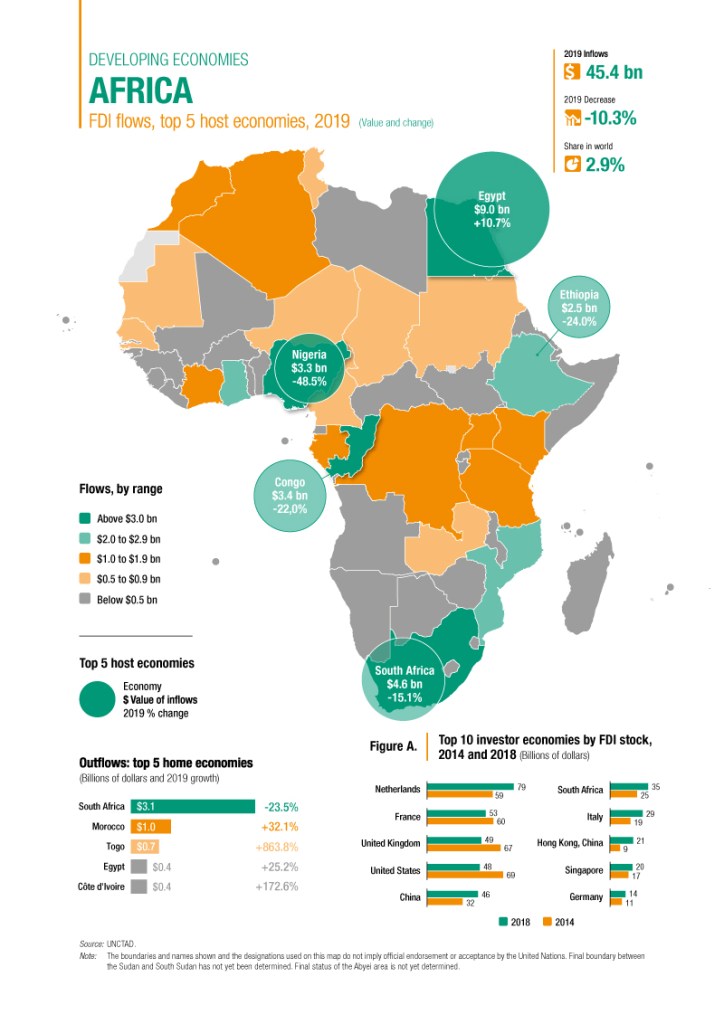
The COVID-19 crisis has arrived at a time when FDI was already in decline, with the continent having experienced a 10% drop in inflows in 2019 to $45 billion.
The negative effects of tepid global and regional GDP growth and dampened demand for commodities inhibited flows to countries with both diversified and natural resource-oriented investment profiles alike, although a few countries received higher inflows from large new projects.
North Africa
FDI inflows to North Africa decreased by 11% to $14 billion, with reduced inflows in all countries except Egypt, which remained the largest FDI recipient in Africa in 2019, with inflows increasing by 11% to $9 billion.
Sub-Saharan and Southern Africa
After a significant increase in 2018, FDI flows to Sub-Saharan Africa decreased by 10% in 2019 to $32 billion.
Southern Africa was the only sub-region to have received higher inflows in 2019 (22% increase to $4.4 billion) but only due to the slowdown in net divestment from Angola.
FDI inflows to South Africa decreased by 15% to $4.6 billion in 2019, despite key investments in mining, manufacturing (automobiles, consumer goods) and services (finance and banking).
West Africa
FDI to West Africa decreased by 21% to $11 billion in 2019. This was largely driven by the steep decline in investment in Nigeria due to new investment regulations for multinational enterprises in the oil and gas industry.
East Africa
FDI flows to East Africa also decreased, by 9% to $7.8 billion. Inflows to Ethiopia contracted by a fourth to $2.5 billion caused to some degree by political tensions in parts of the country.
Similarly, inflows to Kenya dropped by 18% to $1.3 billion despite several new projects in IT and healthcare.
Central Africa
Central Africa received $8.7 billion in FDI, marking a decline of 7%. The key highlight in the sub-region was the decrease in flows to the Democratic Republic of the Congo (9% to $1.5 billion).
The Netherlands overtook France as the largest investor by stock
On the basis of FDI stock data through 2018, the Netherlands overtook France as the largest foreign investor in Africa.
The investment stock held by the United States and France in Africa declined by 15% and 5% respectively, owing to profit repatriation and divestment. Meanwhile, the investment stock of the United Kingdom and China increased by 10% each.
FDI outflows also fell in 2019, by approximately a third
FDI outflows from Africa decreased by 35% to $5.3 billion. South Africa continued to be the largest outward investor despite the reduction in outflows from $4.1 billion to $3.1 billion.
Outflows from Togo increased significantly, from a mere $70 million to $700 million, a tenfold increase. In North Africa, Morocco also increased outward FDI, to approximately $1 billion from $800 million in 2019.
Source: UNCTAD, World Investment Report, 16 June 2020
Botswana is investigating the mysterious deaths of at least 154 elephants over two months in the northwest of the country, a wildlife official said on Monday, although poaching or poisoning have been ruled out.
“We are still awaiting results on the exact cause of death,” Regional Wildlife Coordinator Dimakatso Ntshebe told Reuters.
The carcasses were found intact, suggesting they were not poached. Further investigations have also ruled out poisoning by humans and anthrax, which sometimes hits wildlife in this part of Botswana.
Africa’s overall elephant population is declining due to poaching, but Botswana, home to almost a third of the continent’s elephants, has seen numbers grow to 130,000 from 80,000 in the late 1990s, owing to well managed reserves.
However, they are seen as a growing nuisance by farmers, whose crops have been destroyed by elephants roaming the southern African country.
President Mokgweetsi Masisi last year lifted a five-year ban on big game hunting, imposed by previous president Ian Khama, but the hunting season failed to take off in April as global travel restrictions meant hunters from many coronavirus-hit countries could not enter Botswana.
Meanwhile, the Wildlife Department has undertaken an operation to relocate and dehorn all rhinos to tackle poaching in Botswana – mirroring efforts elsewhere in the region.
The Okavango Delta rhino population has been the hardest hit, with 25 reported poached between December and the beginning of May, government figures show, as poachers take advantage of the absence of safari tourists during the pandemic.
That compares with a total of 31 rhinos poached from October 2018 to December last year.
“Both white rhino and black rhinos have been severely affected, necessitating the … relocation of highly endangered black rhinos (and) intensification of surveillance,” the Department said.
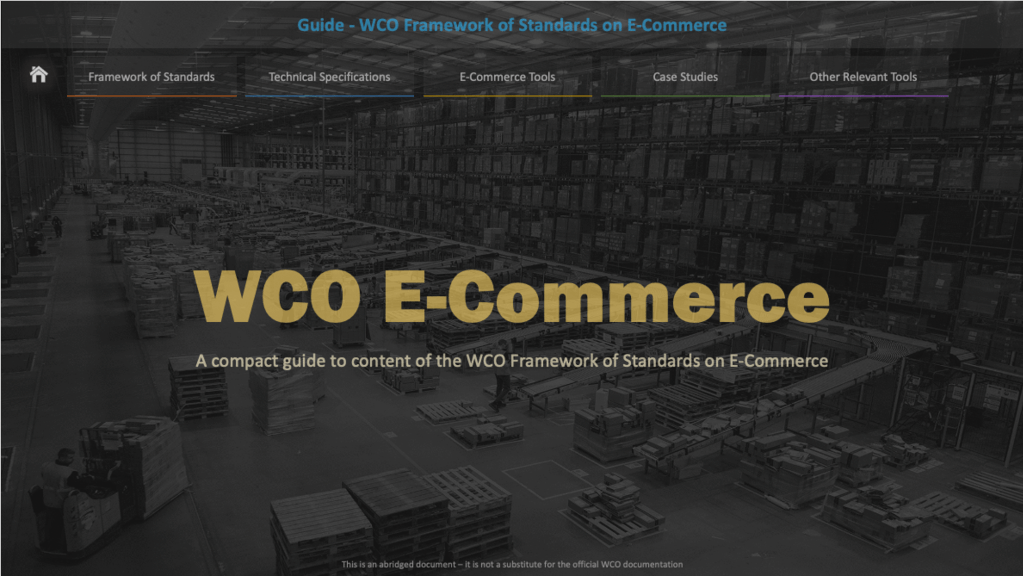
It is often difficult to navigate and assimilate the myriad of documentation and annexes associated with significant initiatives such as WCO’s ‘framework of standards’. True, the documentation is detailed and technical. There are, however, online training courses available on the WCO website for users wishing to attain a level of proficiency on a particular subject. Furthermore, member states can request technical assistance from WCO in the establishment of capacity for the implementation of specific Customs initiatives.
However, sometimes one requires a synopsis or insight as to what a particular initiative aims to achieve. This is important so as to establish the nature and extent of change and capacity required in one’s own domestic situation. In my area of operation, MS PowerPointTM plays an important role in uniformly conveying key information to a multitude of people across different disciplines in the organisation. Im happy to share a ‘guide’ which consolidates most of the ‘official’ WCO documentation that comprise the Framework of Standards on E-Commerce. When viewed as a PowerPoint Show, all hyperlinks to the official WCO E-Commerce documentation are available for download or display. Below are versions for both standard PowerPoint or PowerPoint Show. I hope it will serve some useful purpose.
The following report (Working Paper) was issued in March 2019, a while back, but should not be considered too outdated for analysis and consideration, nevertheless.
A study was conducted to explore how the illicit trade in licit goods supports organized crime, corruption, and erodes state structures. The illicit tobacco trade in southern Africa occupies a prominent place in southern African politics, due to its prominent role in the ‘state capture’ scandals that characterized politics in South Africa between 2013 and 2018. Indeed, the illicit tobacco trade occupies a prominent place in public debate in South Africa, both about crimes that may have been committed in the last five years, and about how the current administration responds to the illicit economy right now.
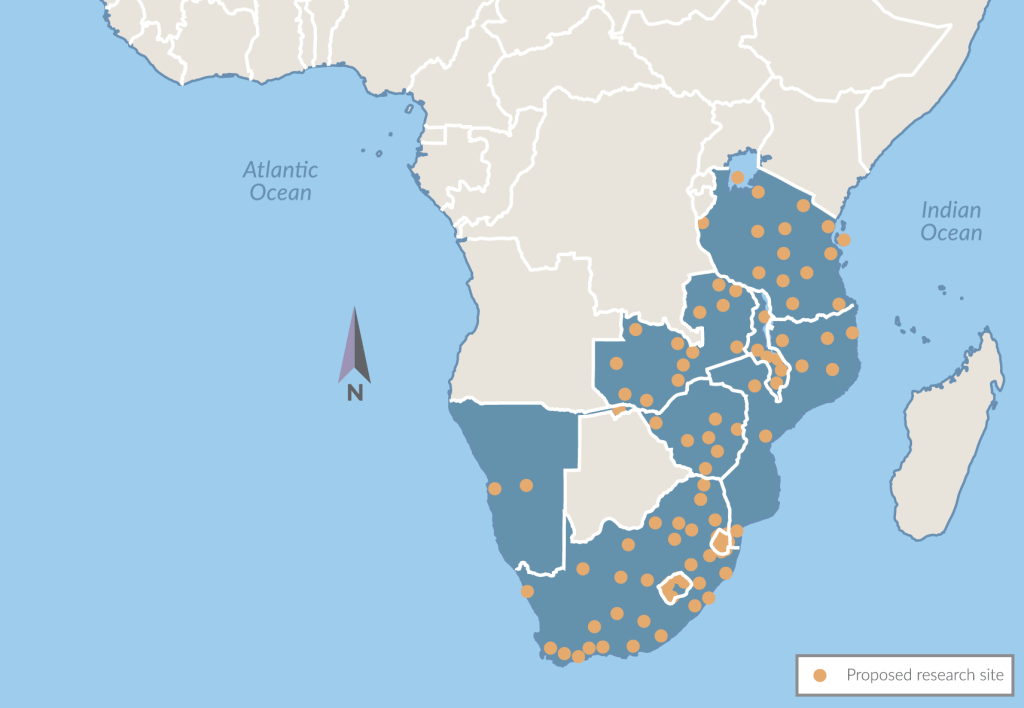
The study maps the key dimensions of the illicit cigarette trade in Zimbabwe and South Africa, including the key actors, the pathways of trade and the accompanying ‘modalities’ of criminality, as well as other important dimensions of the illicit cigarette market in southern Africa. It then identifies ‘good-faith actors,’ primarily in South Africa, whose positions could be strengthened by policy and technical interventions, explores opportunities for such intervention, and assesses the practi- cal solutions that can be applied to combat illicit trade and tax evasion in the tobacco industry. The paper contributes to expanding awareness among policymakers and the public of the nexus between the illicit trade in licit goods, corruption, and organized criminal networks.
This research report “A Shallow Flood: The Diffusion of Heroin in Eastern and Southern Africa” (click hyperlink to access report) draws from and analyzes field data examining three characteristics of the illicit drug economy in a selected number of countries of eastern and southern Africa:
Price. This part of the data identifies the retail price (i.e. street price) for heroin in a given market location, and examines factors that influence retail price variations within a particular market, and between markets.
Distribution system. Identifying the means by which heroin is moved between wholesale and retail vending situations, and how it is moved within and between adjacent and/or distant markets.
Market structure. Identifying core structural components of domestic heroin markets in the region, with particular attention to those features that enable markets to emerge and flourish, as well as factors that disrupt or deteriorate these markets.
The flow of heroin from Asian production points to the coastal shores of eastern and southern Africa is not new. Whereas the first heroin transit routes in the region in the 1970s relied heavily on maritime transport to enter the continent, a number of transport modes and urban centres of the interior have increasingly become important features in the current movement of heroin in this region. Interior transit hubs and networks have developed around air transport nodes that use regular regional and international connections to ship heroin. As regional air routes proliferated and became more efficient, their utility and value for the heroin trade increased as well. Heroin is also consolidated and shipped over a frequently shifting network of overland routes, moving it deeper into the African interior in a south-westerly direction across the continent.
Consequently, a shallow flood of heroin has gradually seeped across the region, and this has had a significant impact on the many secondary towns found along the continent’s transcontinental road networks. These places, in turn, have spawned their own small local heroin markets, and become waypoints in rendering sustainable the now chronic, metered progression of heroin’s resolute geographic diffusion across the region.
The impact of this creeping spread of heroin on regional state development has been significant and, paradoxically, symbiotic. The emerging illicit African drug market environments may represent credible threats to the development and security of the region’s nascent independent state institutions and structures. At the same time, these markets have also presented new and considerable sources of economic livelihood and opportunity for the continent’s ever-expanding population of poor, disenfranchised and vulnerable people. A surrogate ‘drug working class’ has emerged as a socio-economic sequela to more traditional, yet increasingly limited, licit income opportunities.
The purpose of this report is to examine the diffusion of heroin across eastern and southern Africa. This will be achieved through an analysis of retail heroin prices, distribution systems and domestic marketplaces. The report provides an analytical summary of heroin market data collected across the countries of the region, with specific retail price points, commentary on domestic heroin distribution systems and structures, and a discussion of the common structural characteristics evident across the region that enable, embed and sustain these heroin markets.
Quality Assurance Section at Dubai Customs successfully audited a number of departments during the remote working period following the international standards. Auditing covered the Corporate Social Responsibility standard ISO6000, the Development and Training Standard ISO10015, and the Innovation Management European Standard TS16555.
“The successful auditing during this difficult time is the result of our commitment and sustainable efforts in assuring quality in every job we do,” said Samira Abdul Razzak, Senior Manager of Quality Assurance at Dubai Customs. “Thanks to the sophisticated technological infrastructure Dubai Customs has, auditing during working from home was possible. Many procedures are automated and communication has never been easier.”
On his part, Engineer Nizar Bashairah, Regional Partner, TUV Germany said most auditing is carried now from afar as business activities can’t stop even in hard times like the breakout of the virus.
“Dubai Customs covered a number of international standards very effectively despite its big size and the number of departments, activities and services involved.”









 What Happened to the Portcullis?
You must be logged in to post a comment.