Malawi – expresses interest in Single Window

The Southern African Trade Hub (SATH) presented the National Single Window (NSW) concept as one of the most effective tools in trade facilitation to the Ministry of Trade, Malawi Revenue Authority and other public and private sector organizations in Lilongwe and Blantyre respectively during May 2012. The presentation highlighted the great benefits accruing to countries that have implemented the NSW. A case study of Thailand was discussed, indicating how Thailand was ranking position 108 in the Trading Across Border Index by the World Bank in 2007 and remarkably improved to position 10 in 2009 after implementing their NSW. Malawi is currently ranked at 164 out of the 183 countries assessed.

A single window is a facility that allows parties involved in trade and transport to lodge standardized information and documents through a single entry point to fulfill import, export and transit regulatory requirements. The benefits accruing to the NSW include substantial decrease in clearance time, substantial increase in government revenues, clear identification of roles and responsibilities in the clearance process and accurate, consistent and real time statistics. The presentation also highlighted that while there are different models of implementing the single window, the public-private partnership (PPP) model achieved results in a short period of time and was implemented efficiently due to the technical expertise and efficient processes brought in by the private sector. It was also emphasized that it was critical to have all stakeholders’ buy-in for the successful implementation of the NSW.

The Ministry of Industry and Trade and other stakeholders agreed in principle to establish a NSW using the PPP but a cabinet memo to secure formal approval of NSW will only be prepared after SATH has facilitated a more technical and practical presentation by one of the countries already using this tool. Source: SA Trade Hub
Related items

Africa – ready for rich pickings?

While on the theme of African economic and trade emancipation, it is interesting to consider the detailed analysis and evaluation occurring in regard to African continental readiness for information and communication technologies. One such study is the Transformation Ready or eTransform Africa programme, a joint programme of the African Development Bank and the World Bank, in partnership with the African Union. Bear in mind that the WCO and African Development Bank recently signed a cooperation agreement to enhance the capacity of Customs administrations in Africa. 

The study (Click Here!) is a series of  case studies of certain countries. The aim of the programme as a whole, as set out in the terms of reference, is to:

  • Take stock of emerging uses of ICT across sectors and of good practices in Africa and in other continents, including how ICTs are changing business models in strategic sectors.
  • Identify key ICT applications that have had significant impact in Africa or elsewhere and that have the potential of being scaled up, both from the public and private sectors.
  • Identify binding constraints that impact ICT adoption and scaling-up of effective models, such as the need to develop a regional culture of cyber security, and measures to address these constraints, including in relation to the role of different actors and stakeholders (private, public, development community, civil society, etc).
  • Commission a series of country case studies, to formulate a guide for rolling out and scaling up key applications in Africa, in each of the focus sectors, and thereby to identify opportunities for public/private partnership, as well as identifying areas where intervention can be reduced or eliminated.
  • Develop a common framework for providing support in ICT for development to countries that brings together the operations of the two Bank Groups and their respective departments.

The terms of reference for individual sectors were as follows:

  • Within each sector, identify specific opportunities and challenges in Africa that can possibly be addressed with an increased or better use of ICT. Constraints that are hindering ICT uptake and scale-up will be examined within the context of each sector/industry, including human capacity in IT skills and sustainable business models such as for public private partnerships (PPP). Further, the appropriate role of governments in the provision of priority ICT applications and services will be examined in order to maximize private sector development;
  • Undertake a quick scan of ICT applications in the different sectors and identify a few applications that have had significant impact in Africa or elsewhere and that have the potential of being scaled up. The scan should refer to a matrix of selection criteria on which to select case study countries that are considered ripe for the creation of public/private partnerships. On this basis, specific country case studies will be chosen – two to three per sector — on a representative basis, for deep dive analysis. The selection of case studies should be made in consultation with the partners and the other consultants. A workshop should be organized by the coordinator firm at an early stage in the project to finalise this selection.
  • Analyze and understand the barriers to the greater adoption and mainstreaming of ICTs. Barriers may include, for instance, low purchasing power, illiteracy, infrastructure constraints, lack of regulation, poorly functioning mobile ecosystem, power shortages, political instability etc. Identify cases/examples on how these have been dealt with;
  • Analyze and understand the enabling factors of success, including political economy, policy, institutional, human, financial and operational factors;
  • Consider the option of developing multi-country programs or special facilities that would allow fast-tracking specific programs across countries;
  • Provide guidelines on designing appropriate and sustainable ICT components for sector projects (including building effective public and private partnerships) and on evaluating the impact of these interventions; and
  • Propose a course of action on how to include ICT in policy dialogue and planning with country counterparts on sectoral development goals and priorities. Experiences and best practices from other regions will be drawn upon to define the role of the public sector, bearing in mind that government is increasingly positioned as a lead user of ICTs as well as a regulator of the sector.
Related articles

The following article provides a disturbing – some would call it conspiracy theory – on what lies in store for the continent of Africa. Perhaps the colonial days will be viewed as mild should some of the suggested schemes materialise.

Open Borders and Integrated Supply Chains break down Global Trade Barriers

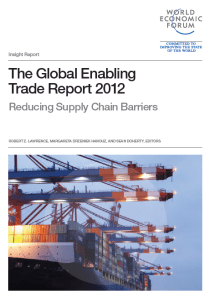
East Asian economies have recorded marked improvements in their ability to enable trade, while traditional frontrunners Singapore and Hong Kong retain a clear lead at the top of the global rankings, according to the Global Enabling Trade Report 2012, released today by the World Economic Forum.

The report, which is published every two years, also confirms strong showings for Europe’s major economies, with Finland and the United Kingdom both advancing six places to 6th and 11th, respectively, and Germany and France remaining stable at 13th and 20. Other large economies fare less well: the US continues its decline to 23rd, as does China (56th) and India (100th). Among emerging economies, Turkey (62nd) and Mexico (65th) remain stable while Chile (14th), Saudi Arabia (27th) and South Africa (63rd) climb in the ranking. ASEAN members Thailand (57th), Indonesia (58th) and the Philippines (72nd) also improve. Perhaps the proponents of OSBPs and a BMA in South Africa have not read this or have deeper insight into the matter.

As well as ranking nations’ trade openness, the report finds that traditional notions of trade are increasingly outdated as global value chains require new measurements, policies and cooperation. The report also finds that security, quality and trade can be mutually reinforcing through supply chain integrity efforts, but a knowledge gap in identifying buyers remains an important barrier. The biennial report, covering 132 economies worldwide, measures the abilities of economies to enable trade and highlights areas where improvements are most needed. A widely used reference, it helps countries integrate global value chains and companies with their investment decisions.

At the core of the report is the Enabling Trade Index, which measures institutions, policies and services facilitating the free flow of goods over borders and to destination. It breaks the enablers into four issue areas: market access, border administration, transport and communications infrastructure, and business environment. The Index uses a combination of data from publicly available sources, as well as the results of the Executive Opinion Survey, a comprehensive annual survey conducted by the World Economic Forum with its network of partner research institutes and business organizations in the countries included in the report. The 2012 results demonstrate that the ASEAN Trade in Goods Agreement has facilitated trade since its entry into force in 2010. This year, the report also directly captures the most important obstacles to exporting and importing in each country, and notes the strong links between import and export success. Source: AllAfrica.com / WEF

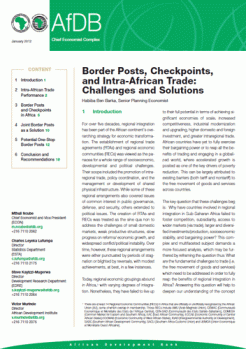
Border Posts, Checkpoints and Intra-African Trade

You may recall earlier this year the African Development Bank and the WCO agreed to a partnership to advance the economic development of African countries by assisting Customs administrations in their reform and modernization efforts.

The AfDB’s regional infrastructure financing and the WCO’s technical Customs expertise will complement each other and improve the efficiency of our efforts to facilitate trade which includes collaboration in identifying, developing and implementing Customs capacity building initiatives by observing internationally agreed best practice and supporting Customs cooperation and regional integration in Africa.

In addition, the partnership will seek to promote a knowledge partnership, including research and knowledge sharing in areas of common interest, as well as close institutional dialogue to ensure a coherent approach and to identify comparative advantages as well as complementarities between the WCO and AfDB. Customs professionals, trans-national transporters and trade practitioners will find the featured article of some interest. It provides a synopsis of the key inhibitors for trade on the continent, and will hopefully mobilise “African expertise” in the provision of solutions and capacity building initiatives.

Who Will Be Africa’s Brazil?

Will there ever be an “African Brazil”? Who will that be? Angola? Congo? Ethiopia? Nigeria? South Africa? Flip that question: what will it take for an African country to become a new Brazil? A lot. First, it will take governments that do not spend or borrow too much, and independent central banks that keep inflation low. That is, the first order of business is a stable “macroeconomic framework.” Brazil managed to do that, but only after decades of rampant inflation and financial crises. Many African countries are making progress in that direction, but none is quite there. Read this objective review by Marcelo Giugale, World Bank’s Director of Economic Policy and Poverty Reduction Programs for Africa. Source: The Huffington Post

Global Preferential Trade Agreement Database (GPTAD)

world-bank-logoThe World Bank International Trade Department has just launched it’s Global Preferential Trade Agreement Database (GPTAD). The GPTAD provides information on preferential trade agreements (PTAs) around the world, including agreements that have not been notified to the World Trade Organization (WTO). It is designed to help trade policy makers, scholars, and business operators better understand and navigate the world of PTAs.

The GPTAD Database contains the original text of PTAs that have been notified to the WTO as well as agreements that have not yet been notified. The database is updated on a regular basis and currently comprises more than 330 PTAs. Agreements in the database have been indexed using a classification consistent with the WTO criteria. The GPTAD is a unique online tool that allows users to search PTAs around the world by provisions or keywords and to compare provisions across multiple agreements. The database can be searched according to the following categories:

  • Duties and charges on imports
  • Quantitative restrictions on imports
  • Rules of origin
  • Sanitary and phytosanitary measures
  • Agriculture
  • Investment
  • Services
  • Dispute settlement procedures
  • Intellectual property
  • Labor
  • Environment

The Library provides the text of all agreements in their original language and archives them by key criteria. It enables users to sort PTAs by membership, date of signature, in-force status, and other key criteria. It also allows users to download and print PDF files of entire agreements.

The GPTAD is designed to be a valuable resource on PTAs for trade policy makers, scholars, and business operators around the world. To that end, the World Bank International Trade Department welcomes your input. If you are aware of bilateral or regional PTAs that are not included in the library or database, please contact us. The GPTAD is work in progress and we actively welcome and solicit your views and suggestions on how the site might be further improved and made more useful. Source: World Bank

Related website: