Australian Customs achieves one million sea cargo x-ray scans

Recently, Australian Customs and Border Protection staff celebrated the one millionth x-Australian Customs CEFray of a sea cargo container arriving in Australia. Staff witnessed the x-ray and unpacking of a recent seizure of 16.8 tonnes of illicit loose tobacco, worth almost $8 million in foregone duties and GST. The sea cargo container arrived from Indonesia and was selected for further examination based on anomalies detected during an x-ray at the Container Examination Facility (CEF) in Melbourne.

Container Examination Facilities across Australia, have been instrumental in many major seizures of illegal or prohibited items. In the last 13 months CEFs have detected:

  • 448 kilograms of heroin and opium
  • 396 kilograms of cocaine
  • 174 kilograms of amphetamines and chemical precursors
  • 82 million cigarette sticks
  • 258 tonnes of tobacco

Since the first Container Examination Facility was opened in November 2002, Customs and Border Protection has x-rayed one million containers at key ports around Australia including Melbourne, Sydney, Brisbane and Fremantle. Prior to the first facility opening, about 4,000 containers were examined each year. Today, Customs officers x-ray more than 101,500 containers each year. That’s a huge increase in physical assessments.

The facilities at Australian ports have container x-ray machines capable of x-raying up to four sea cargo containers at a single time. Source: Ministry of Home Affairs, Australia.

Comment: All I can say is this is an amazing feat! Africa truly has a long way to go.
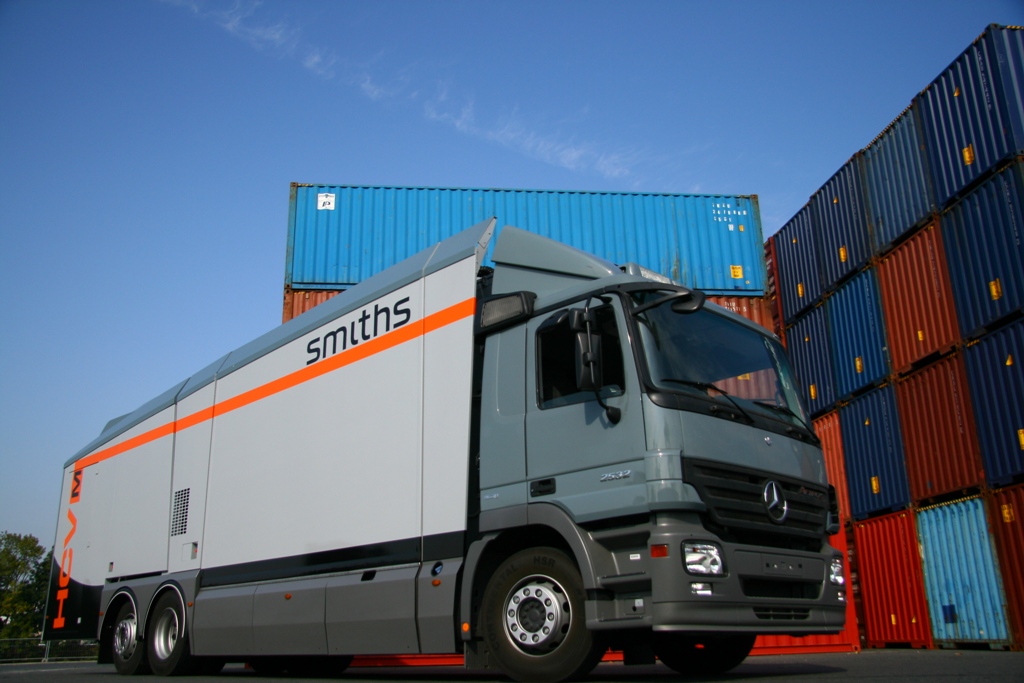
Smiths Detection Wins German Contract for Mobile Cargo Scanners

Smiths Detection has won an order from the German Federal Ministry of Finance (BMF) to provide advanced high-energy [6Mev] X-ray systems for mobile Customs checkpoints to be delivered by the end of 2011. The contract comprises three Heimann Cargo Vision Mobile (HCVM) 3 systems, Smiths’ third generation, mobile high-energy X-ray cargo series, to inspect trucks, containers HCVM-Truckand other vehicles for contraband, weapons, explosives and narcotics. They will be deployed at various locations throughout Germany. Available in truck and trailer versions, which give operators the freedom to use their own towing equipment, the HCVM 3 series improves threat identification through its viZual technology, which uses colour-coded material discrimination to distinguish between organic and inorganic substances. Operational in less than 15 minutes, with a throughput of up to 150 containers per hour, the system offers flexible scanning heights for different vehicle or load dimensions and adjustable scanning angles with a variety of scanning modes. Some of the technical features include:

  • High throughput of up to 25 trucks per hour in scan mode and up to 150 trucks per hour in pass through mode.
  • Steel penetration up to 320mm.
  • viZual technology for real organic/inorganic material discrimination.
  • Up to 6 different Scanning Modes.
  • Automatic Radioactive Material Detection.
  • Space+Cabin for up to 8 Image Analysis Workstations.
  • Automatic Guidance System.

US advised to backtrack on 100% container scanning

U.S. Customs and Border Protection inspectors ...

U.S. Customs and Border Protection inspectors

 A key US government advisory committee has recommended that Washington repeals legislation requiring 100% scanning of maritime containers, suggesting instead risk-based analysis of any threat. A report by the Commercial Operations Advisory Committee (COAC) states: “The mandate for 100% scanning of maritime containers and the 100% screening of air cargo on passenger aircraft contained within the September 11 Commission Recommendations Act should be re-evaluated in favour of risk-based measures that target high-risk shipments for physical inspections. “Further the requirement to scan 100% of maritime containers prior to vessel load should be repealed.” COAC, tasked with providing advice to the Secretary of Homeland Security, the Secretary of the Treasury, and the Commissioner of US Customs and Border Protection, made its comments in reviewing the US government’s National Strategy for Global Supply Chain Security.  This comes in the wake of recent recommendations to have the mandate extended until 2015. The Senate Committee on Commerce, Science, and Transportation was told that the Department of Homeland Security would need “significant resources for greater manpower and technology – technologies that do not currently exist – and the redesign of many ports.

I have updated the page ‘Non-Intrusive Inspection’ substantially – please visit.