Amazon.com China – approved as an NVOCC

Amazon-BoxMarket forces, competition and the desire to be ahead of the competition demonstrate how dynamic the international supply chain is being maneuvered. Amazon’s latest move is not only innovative but demonstrates just how adaptable international trade and Customs Inc. need to be in order to accommodate nuances to traditional accepted norms in global trade. For Customs, it needs to intimately understand the nature of business of its registered or licensed traders so as to properly apply risk and facilitation regimes appropriately. Recent developments in mutual recognition likewise play an important role in awarding real benefits to companies and their supply chains who undertake such global innovations.

According to the U.S. Federal Maritime Commission, Amazon.com Inc’s China arm has registered as an ocean freight forwarder, a move that will give it more control over shipping products from Chinese factories to U.S. shoppers.

The registration is the latest indication that Amazon plans to expand its logistics reach to cut costs for its retail business and potentially provide third-party logistics services to other industries.

It’s new status as a freight forwarder, or “non-vessel operating common carrier,” gives Amazon, the world’s largest online retailer, a foothold in the $350 billion a year ocean freight business. It will not operate ships but subcontract that work.

Amazon is already negotiating a deal to lease 20 jets to start an air-delivery service in the United States, the Seattle Times reported last year. The retailer bought truck trailers to add shipping capacity and started a program last year that uses a fleet of on-demand drivers to deliver packages.

“It has more and more control over the supply chain of their business and it gives them the ability to squeeze (costs) even further,” said Satish Jindel, a logistics consultant and president of SJ Consulting Group.

He added the move gives Amazon an even bigger edge against traditional U.S. retailers in negotiating lower prices for goods.

The Federal Maritime Commission, a U.S. government agency that regulates the U.S.-international ocean transportation system, said on Thursday a business named Beijing Century Joyo Courier Service Co Ltd, with the trade names Amazon China, Amazon.CN and Amazon Global Logistics China, was registered in its database to provide ocean freight services.

Amazon China submitted its registration request on Nov. 9, the commission said Thursday, and it was reviewed and registered on Nov. 13. It is the entity’s first registration.

“Amazon’s ocean freight services will be far more attractive to Chinese sellers than to American buyers. Chinese suppliers would love direct access to Amazon’s vast American customer base,” wrote Ryan Petersen, chief executive officer of Flexport, a San Francisco-based freight forwarder who first wrote about Amazon’s registration on his company blog on Thursday.

Petersen added that Amazon’s third-party merchants were unlikely to use its shipping service because it would expose key data like wholesale pricing and supplier names to a rival. Source: Reuters

Positive future for Electronic Bills of Lading

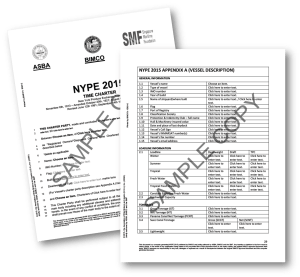
BIMCO E-Bill of LadingPaper bills of lading have been used throughout the world to document and effect international trade for centuries. Yet whilst the world has become increasingly digitalised the paper bill of lading has, on the whole, remained a constant feature of global trade. Its continued use is mainly due to its combination of three legal characteristics that it has developed over time: (i) it is a receipt of the goods carried; (ii) it provides evidence of the terms of the contract of carriage; and (iii) it is a document of title to the goods. It is these characteristics that have, until relatively recently, foiled attempts to replace the paper bill of lading with an electronic equivalent. However, with the inclusion of an electronic bills of lading clause in BIMCO’s NYPE 2015 time charter form, as well as the International Group of P&I Clubs’ approval of the coverage of three electronic trading systems, the dominance of the paper bill of lading may well be coming to an end.

Reed Smith LLP Ship Law blog posts an interesting article in regard to change in law and the impact of e-commerce on bills of lading.

Issues with the paper system
Whilst the paper bill of lading has been used for centuries it is not without its faults, the principal problems being that:

  • Carriers are obliged to discharge the goods carried on production of an original bill of lading: this is particularly problematic today given both the speed of transport and the fact that the cargo may be sold multiple times during carriage. As a result of this the bill of lading is often not delivered to the consignee in time, and the carrier is often required to accept a letter of indemnity. This indemnity does not, however, remove the carriers’ liability under the bill of lading and creates an additional administrative burden and cost to the trade.
  • The paper system is hugely expensive (such cost is estimated to be between 5 – 10% of the value of the goods carried each year).
  • A paper bill of lading may be forged with relative ease and carriers are liable for misdelivery against a forged bill of lading.

Benefits of an electric bill
The electronic bill of lading or e-bill, in theory, addresses many of the flaws of the paper system, bringing with it a number of advantages:

  • It can be sent around the world instantaneously, hugely lowering the administrative burden of trade (especially where cargo is subject to multiple transfers of ownership during carriage).
  • Any amendments or corrections required can be made far more efficiently and cost effectively.
  • Electronic payment systems, and related advances in security, make an electronic system considerably more secure than its paper equivalent. This is obviously subject to cyber issues.

These benefits will cut the administrative costs of trade significantly and reduce, if not eradicate, situations where carriers discharge their cargo against letters of indemnity.

So why so slow on the uptake?
One of the main reasons the widespread use of the e-bill has been slow to proliferate stems from the fact that it is not treated in the same manner, legally, as its paper equivalent. Significantly:

  • A paper bill of lading is a document of title, enabling it to be negotiated and transferred as possession of the bill is evidence of title to the goods. This is not automatically the case at law with an e-bill.
  • The Hague Rules / Hague Visby Rules (HR / HVR) apply to a contract of carriage by reference to the bill of lading, or similar document of title, and it has been less clear whether they would apply to any electronic trading system used. The solution developed to these legal obstacles is essentially a multiparty contract. This takes the form of a set of rules to which users of an electronic trading system are all required to subscribe to use that system. Such rules then set out the specific form of electronic trading documentation to be used and that the consequences of using such documentation shall mirror the position at law as if they were paper bills of lading.

This, however, means that electronic trading systems such as BOLERO, which has been in existence since the 1990s, are only able to function between their members (i.e. those that have agreed to the uniform set of rules and systems that will govern their transactions). Where a member of an electronic trading system enters into a transaction with a non-member, the electronic system cannot be utilised and a paper bill of lading is issued. This feature has limited their growth, as electronic trading systems are only really effective once they have a large number of members, but are not cost-effective for traders to join until they have a large number of members.

The present situation
The benefits of electronic trading systems are particularly tangible to container carriers (as there is often a separate bill of lading for each container carried) and as such have been utilised by liner companies before wider adoption in the industry. However, the efficiencies of electronic trading systems are not confined to the container industry alone and with members of the largest trading companies, trade finance banks, mining companies and oil majors using such systems, it is clear that they are becoming increasingly prevalent in the shipping industry as a whole.

The growth of the use of electronic trading systems in the wider shipping industry is something that BIMCO, by including an e-bills clause in its latest iteration of the NYPE form, has also recognised. In sum the new clause provides that:

  • use of an electronic trading system is at charterers’ option;
  • owners shall subscribe to the system elected by charterers, provided such a system is approved by the International Group of P&I Clubs;
  • charterers shall pay any fees incurred by owners in subscribing to such elected system; and
  • charterers shall indemnify owners for any liabilities incurred arising from the use of the elected system, so long as such liability does not arise from owners’ negligence.

The International Group of P&I Clubs have now ‘approved’ three electronic trading systems (BOLERO, essDOCS and E-title). An ‘approved’ system is one that is found to replicate the legal characteristics of a paper bill (namely (i) as a receipt; (ii) a document of title; and (iii) a contract of carriage which incorporates the HR / HVR). This means that the International Group of P&I Clubs will provide cover for any liabilities arising under carriage covered by these three electronic trading systems (or any such other subsequently ‘approved’ system), provided that such liability would also have arisen under a paper bill. However, members should be advised that risks connected with the use of a non-approved electronic trading system will not be covered.

The use of an electronic trading system does, however, lead to other risks from things such as hacking, systems collapse, e-theft and viruses, none of which are traditionally covered by P&I clubs and would need to be insured separately. In this regard, essDOCS (which is now used throughout 71 countries by over 3,300 companies) has insurance cover of up to USD $20 million per electronic bill of lading for “eRisks” resulting from an electronic crime or electronic system failure.

With the rise in usage of electronic trading systems, the recent judgment in Glencore v MSC (albeit currently under appeal) provides a timely reminder that the release of cargo should only be made in accordance with the contract evidenced by the bill of lading, even where an electronic release system for cargo is being operated. In this instance cargo was released on presentation of a PIN, despite no provisions for this in the bill of lading, two of the released consignments of cargo were misappropriated and the carrier was held liable.

The future?
With the International Group of P&I Clubs’ approval of three electronic systems, the inclusion of an electronic bills of lading clause in BIMCO’s latest NYPE form and the proliferation of the use of electronic trading systems throughout the wider shipping industry, it is clear that the use of electronic trading systems is increasing. Whilst there is no doubt that we can expect teething problems as the industry continues to adapt to such electronic trading systems, and the cyber risks they may bring, it seems that the efficiencies are too great to be ignore. Source: Ship Law log / ReedSmith

WCO facilitates Data Model training for SARS

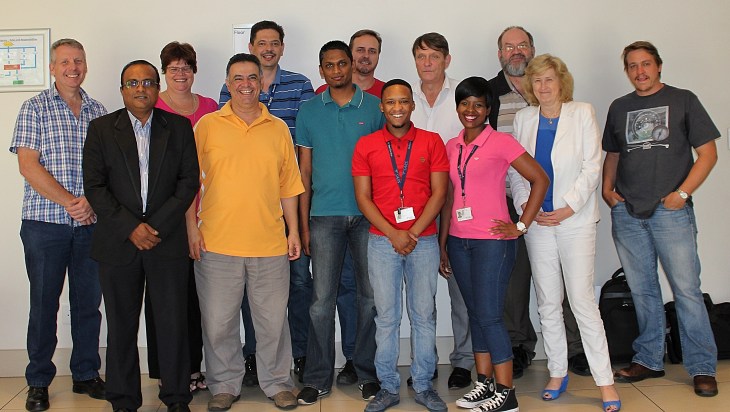
WCO Data Model Workshop, Pretoria, South Africa, Dec. 2015

SARS’ EDI and Customs Business Systems representatives with WCO Data Model facilitators Mr. Giandeo Mungroo (2nd from the left) and Ms. Sue Probert (2nd from the right) [Photo – SARS]

Officials of the South African Revenue Service (SARS) last week attended a WCO workshop on the Data Model facilitated by Ms. Sue Probert and Mr. Giandeo Mungroo. The event, held in Pretoria, South Africa was sponsored by the CCF of China as part of the WCO’s Capacity Building endeavours to promote the adoption and use of customs standards and best practice amongst it’s  member states.

The workshop was requested by SARS ahead of new technical and systems developments and requirements informed by SARS’ new Customs Control and Duty Acts. Moreover, there are also political ambition to institute a Border Management Agency for the Republic of South Africa. All of this requires that SARS Customs has a robust electronic tool to assist the organisation in mapping national data requirements according to specific needs.

Besides the use of a value added Data Model tool – GEFEG, it is imperative for the organisation to develop capacity in the knowledge and understanding of the WCO Data Model. SARS has successfully EDI (Electronic Data Interchange) for the last 15 years with various local supply chain trading partners and government agencies. Over the last few years SARS has been actively pursuing and promoting IT connectivity with regional trading partners with the express purpose to extend the benefits of eCommerce across borders.

GEFEG.FX software is used to model data formats and develop implementation guidelines for data interchange standards such as UN/EDIFACT. It is a software tool that brings together modelling, XML schema development, and editing of classic EDI standards under a unified user interface, and supports the development of multilingual implementation guidelines.

Version 3 of the WCO Data Model brought about a distinct shift towards an ‘all-of-government’ approach at international borders with the introduction of the GOVCBR (Government Cross Border Regulatory) message. The message and underlying data requirements facilitate the exchange of customs and other government regulatory information to support a Single Window environment.

WCO Data Model not only includes data sets for different customs procedures but also information needed by other Cross-border Regulatory Agencies for the cross-border release and clearance at the border. The WCO Data Model supports the implementation of a Single Window as it allows the reporting of information to all government agency through the unique way it organizes regulatory information. This instrument is already 10 years old and is seeing increased use by WCO members.

Amongst the benefits derived from the workshop, SARS staff acquired the following competencies that will not only aid their work but business user support as well –

  • Competence in operating the tool to build a source control collaborative environment to support national and regional harmonization;
  • Competence to build a base to conduct national/ regional data harmonization based on the WCO Data Model to support national Single Window implementation as well as Regional Integration;
  • Competence to build systems/ electronic interfaces between Customs and its partner government agencies including a Border Management Agency; and
  • Provide needed competence to develop, maintain and publish national and regional information packages based on the WCO Data Model.

WCO declares 2016 to be the year of Digital Customs

WCO Customs Theme 2016The Secretary General of the WCO, Kunio Mikuriya, announced today that 2016 will be dedicated to promoting the digitalization of Customs processes under the slogan “Digital Customs: Progressive Engagement.” WCO Members will have the opportunity to showcase and further promote their use of Information and Communication Technologies (ICT).

The term Digital Customs refers to any automated or electronic activity that contributes to the effectiveness, efficiency, and coordination of Customs activities, such as automated Customs clearance systems, the Single Window concept, electronic exchange of information, websites to communicate information and promote transparency, and the use of smart phones.

This new era of Digital Customs has transformed the way that Customs operates. Ultimately, it ensures progression – the enhanced ability of Customs Administrations to communicate, process goods, receive and exchange information, coordinate border activities, collaborate on law enforcement actions, and promote transparency. Improved technologies thus have the ability to positively impact and transform the Customs landscape through:

  • Improved compliance as a result of increased access to regulatory information and functions, as well as services, on the part of all international trade stakeholders;
  • Faster clearance times for legitimate trade;
  • Enhanced coordination between Customs units, as well as between Customs and other border regulatory agencies at the national and international level;
  • Increased transparency in regulatory processes and decision-making;
  • The use of performance measurement to improve Customs procedures and levels of integrity, such as through the techniques presented in the WCO Performance Measurement Contracts (PMC) Guide;
  • Enhanced detection of irregularities and illicit consignments through the collection and analysis of data.

Such positive outcomes will contribute significantly towards the realization of Customs’ objectives, including improved revenue collection, border security, the collection of trade statistics, and trade facilitation. “Border agencies are increasingly embracing digitalisation to enhance their effectiveness and efficiency.

The WCO has an extensive portfolio of instruments and tools to support WCO Members in their efforts to further adopt Digital Customs.” said WCO Secretary General Kunio Mikuriya.

“Over the course of 2016, I invite all WCO Members to promote and share information on how they are implementing and using digital technologies to advance and achieve their objectives.” Mr. Mikuriya added.

The WCO’s annual theme will be launched on International Customs Day, which is celebrated annually by the global Customs community on 26 January in honour of the inaugural session of the Customs Co-operation Council (CCC) which took place on 26 January 1953.

The WCO invites the Customs community to mark 26 January 2016 in their diary. Source: WCO

SA – Hub for computerised Regional Integration?

AfricaFrom time to time it is nice to reflect on a good news story within the local customs and logistics industry. Freight & Trade Weekly’s (2015.11.06, page 4) article – “SA will be base for development of single customs platform” provides such a basis for reflection. The article reports on the recent merger of freight industry IT service providers Compu-Clearing and Core Freight and their plans to establish a robust and agile IT solution for trade on the African sub-continent.

In recent years local software development companies have facilitated most of the IT changes emerging from the Customs Modernisation Programme. Service Providers also known as computer bureaus have been in existence as far back as the early 1980’s when Customs introduced its first automated system ‘CAPE’. They have followed and influenced Customs developments that have resulted in the modern computerised and electronic communication platforms we have today. For those who do not know there are today at least 20 such service providers bringing a variety of software solutions to the market. Several of these provide a whole lot more than just customs software, offering solutions for warehousing, logistics and more. As the FTW article suggests, ongoing demands by trade customers and the ever-evolving technology space means that these software solutions will offer even greater customization, functionality, integration and ease of use for customers.

What is also clear is that these companies are no longer pure software development houses. While compliance with Customs law applies to specific parties required to registered and/or licensed for Customs purposes, the terrain on which the software company plays has become vital to enable these licensees or registrants the ‘ability to comply’ within the modern digital environment. This means that Service Providers need to have more than just IT skills, most importantly a better understanding of the laws affecting their customers – the importers, exporters, Customs brokers, freight forwarders, warehouse operators, etc.

Under the new Customs Control Act, for instance, the sheer level of compliance – subject to punitive measures in the fullness of time – will compel Service Providers to have a keen understanding of both the ‘letter of the law’ as well as the ability to translate this into user-friendly solutions that will provide comfort to their customers. Comfort to the extent that Customs registrants and licensees will have confidence that their preferred software solutions not only provide the tools for trading, but also the means for compliance of the law. Then, there is also the matter of scalability of these solutions to keep pace with ongoing local, regional and global supply chain demands.

The recent Customs Modernisation Programme realised significant technological advances with associated benefits for both SARS and trade alike. For the customs and shipping industry quantification of these benefits probably lies more in ‘improved convenience’ and ‘speed’ of the customer’s interaction with SARS than cost-savings itself. My next installment on this subject will consider the question of cross-border trade and how modern customs systems can influence and lead to increased regional trade.

Rotterdam Maasvlakte II – World’s first Remote-Controlled Container Port

APM Terminals has released drone footage of its Rotterdam Maasvlakte II terminal. The terminal set a loading record last month on the Madison Maersk with 17,152 TEU loaded, including ten high above deck stowage.

The facility launches the world’s first container terminal to utilize remotely-controlled ship-to-shore (STS) gantry cranes. The cranes move containers between vessels and the landside fleet of 62 battery-powered Lift-Automated Guided Vehicles (Lift-AGVs) which transport containers between the quay and the container yard, including barge and on-dock rail facilities.

The Lift-AGV’s also represent the world’s first series of AGV’s that can lift and stack a container. A fleet of 54 Automated Rail-Mounted Gantry Cranes (ARMGs) then positions containers in the yard in a high-density stacking system. The terminal’s power requirements are provided by wind-generated electricity, enabling terminal operations, which produce no CO2, emissions or pollutants, and which are also considerably quieter than conventional diesel-powered facilities.

The facility, constructed on land entirely reclaimed from the North Sea, has been designed as a multi-modal hub to reduce truck traffic in favor of barge and rail connections to inland locations.

Construction began in May 2012, with the first commercial vessel call in February 2015.

2015 and 2016 are the years of ramping up operations and refining the terminal operating system. The 86 hectare (212 acre) deep-water terminal features 1,000 meters of quay, on-dock rail, and eight fully-automated electric-powered STS cranes, with an annual throughput capacity of 2.7 million TEU.

At planned full build-out, the terminal will cover 180 hectares (445 acres) and offer 2,800 meters of deep-sea quay (19.65 meters/64.5 feet depth), with an annual throughput capacity of six million TEUs. Source: Maritime Executive

Have Mega Containerships reached their Size Limit?

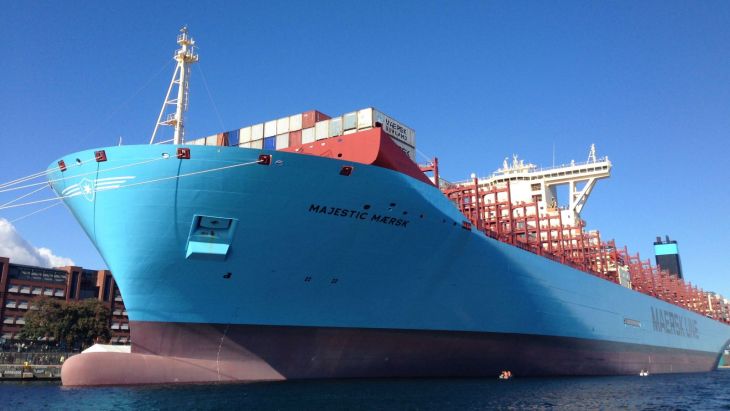
Majestic MaerskContainer shipping lines are poised to take delivery of a new generation of “megaships” over the next two years, just as the growth of world trade is slowing down, contributing to massive overcapacity in the market.

Megaships, which can be up to 400 meters long, seem to be here to stay, not least because so many more are already on order, the product of high fuel costs and low interest rates.

But the trend towards larger vessels is not without problems especially for other businesses in the transport system, and the trend could be nearing its limit as the economies of scale associated with megaships decline.

Container shipping capacity has doubled every seven years since the turn of the millennium and will reach nearly 20 million TEU in 2015 up from five million TEUs in 2000.

But since the financial crisis, container capacity has continued to grow rapidly, even as the growth in freight volumes has slowed, creating a massive overhang in shipping capacity and pressuring freight rates.

Capacity growth is being driven by the trend towards larger vessels. The size of container ships has been growing faster than for any other ship type according to the OECD’s International Transport Forum.

Between 1996 and 2015, the average carrying capacity of container ships increased 90 percent, compared with a 55 percent increase for dry bulk carriers and 21 percent for tankers.

The growth in container ship size has been accelerating. It took 30 years for the average container ship size to reach 1,500 TEU but just one decade to double from 1,500 to 3,000 TEU.

Between 2001 and 2008, the average size of newly built ships hovered around 3,400 TEU but then jumped to 5,800 TEU between 2009 and 2013, and hit 8,000 TEU in 2015.

Megaships
Both the average size of new container ships and the maximum size are set to continue growing over the next five years. Shipping lines have already taken ownership of 20 megaships with a capacity of more than 18,000 TEU each and another 52 are on order, according to the OECD.

The largest ship so far delivered has a capacity of 19,200 TEU, but carriers with capacity up to 21,100 have been ordered and will be in service by 2017.

Megaships are being introduced into service between the Far East and North Europe, the world’s largest route by volume, where potential economies of scale are greatest, but are having a cascade effect on other routes.

Large ships that formerly plied the Far East-North Europe route are being displaced into Trans-Pacific service, and former Trans-Pacific carriers are moving to the Trans-Atlantic route.

The new generation of ultra-efficient megaships is credited with cutting the cost of shipping even further and lowering greenhouse gas emissions.

But researchers for the OECD question whether megaships are contributing to unsustainable overcapacity and imposing unintended costs on shippers, port operators, freight forwarders, logistics firms and insurers.

Fuel Costs
The new generation of megaships is the lagged effect of the era of high oil prices between 2004 and 2014 and low interest rates since the financial crisis in 2008.

Costs in the shipping industry can be divided into the capital costs associated with the construction of new vessels, operating costs, and voyaging costs primarily related to fuel consumption.

Construction costs increase more slowly than ship size. Increasing a container ship from 16,000 TEU to 19,000 TEU cuts the annual capital cost per TEU-slot by around $69 according to the OECD.

Larger ships are slightly more operationally efficient than smaller ones, with an annual saving of perhaps $50 per slot on a 19,000 TEU ship compared with a 16,000 TEU vessel.

But the real savings are on the fuel bills. Megaships are “astonishingly fuel efficient” and actually consume less fuel on a voyage than 16,000 TEU carriers, according to the OECD.

With overwhelming cost advantages, especially on fuel, and cheap finance readily available, the upsizing decision appears to have been a straightforward one for shipping lines.

Slow Steaming
The new generation of megacarriers has been optimized to save fuel by voyaging much more slowly than previous container vessels.

Fuel consumption is related to the cube of speed. If a vessel travels twice as fast it will consume eight times as much fuel. The cube-rule has important implications for the economics of the shipping industry.

When fuel prices are high, it makes sense to voyage slowly to cut fuel bills, even if it means operating more ships to move the same amount of cargo. When fuel prices are low, it makes sense to travel faster and use fewer ships.

During the period of soaring oil prices, container lines instructed captains to cut speed in order to conserve fuel.

The new ships ordered were specifically designed to operate most efficiently at slower speeds to take advantage of slow steaming economies. In fact some carriers are so large they cannot operate at higher speeds.

Crucially, slow steaming has now been designed into the new generation of vessels entering container service, so it will not be easily reversed, even though fuel prices have plunged since 2014.

According to the OECD, most of the voyaging cost reductions in the new generation of megaships come from their optimization for slow steaming rather than from increased size.

“Between 55 and 63 percent (at least) of the savings per TEU when upgrading the vessel size from an early 15,000 TEU design to a modern 19,000 TEU design are actually attributable to the layout for lower operation speeds,” the OECD estimated.

“Cost savings are decreasing as ships become bigger,” the OECD concluded. “A large share of the cost savings was achieved by ship upsizing to 5,000 TEU, which more than halved the unit costs per TEU, but the cost savings beyond that capacity are much smaller.”

Unintended Costs
The consolidation of container volumes into fewer, larger megaships is creating challenges for other firms in the freight business.

Insurers are worried about the costs if a megaship sinks or develops mechanical problems. Insurer Allianz has warned the industry must prepare for losses of more than $1 billion, or even up to $2 billion in the event of a collision between two megaships.

Economies of scale depend on megacarriers being loaded close to maximum capacity and spending as much time as possible at sea rather than in port.

The need to fill megaships is one reason that the industry is consolidating into an alliance network.

Shipping lines are also adopting the hub-and-spoke system employed by airlines to ensure their ultra-large container vessels sail nearly full.

Shipping schedules for the megacarriers have been consolidated into fewer sailings each week from fewer ports (about six in North Europe and eight in Asia).

Containers for other destinations must be transhipped, either on a smaller container vessel or by road, rail and barge. Schedule consolidation is not necessarily favored by shippers and freight forwarders who prefer regular and reliable service (fewer sailings can mean more concentrated risk).

Port operators, too, have been forced to invest heavily to attract and handle the new megacarriers. Port channels must be dredged to greater depths to handle the deeper drafts of the megaships. Quaysides must be raised and strengthened to handle the increased forces when a megaship is tied up.

The biggest problem comes from the scramble to unload a megacarrier quickly so it can put to sea again. The average turnaround time for a container ship is now just one day, and less in Asia.

The arrival of fewer vessels but with larger numbers of containers is creating intense peak time pressure on the ports.
Ports need more cranes, more highly skilled staff to operate them fast, more space in the yard, and the ability to handle more trucks, railcars and barges to move the containers inland.

The OECD estimates megaships are increasing landside costs by up to $400 million per year (one third for extra equipment, one third for dredging, and one third for port infrastructure and hinterland costs). Source: Maritime Executive/Reuters.

EU fighting Customs Fraud – JRC research leads to new legislation

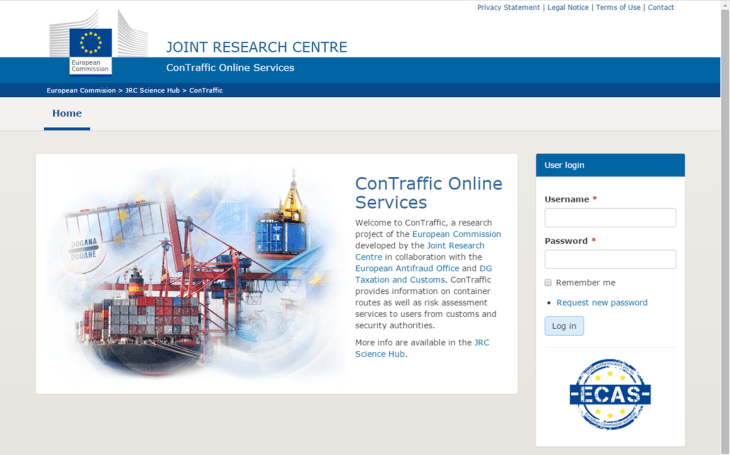
ConTraffic HomepageA new regulation adopted by the European Parliament and the Council will allow customs to access information to track the origins and routes of cargo containers arriving in the EU to support the fight against customs fraud both at EU and national level. The Joint Research Centre (JRC) has been instrumental in the conception and adoption of this legislation as it provided the scientific evidence on the importance of analysing the electronic records on cargo container traffic.

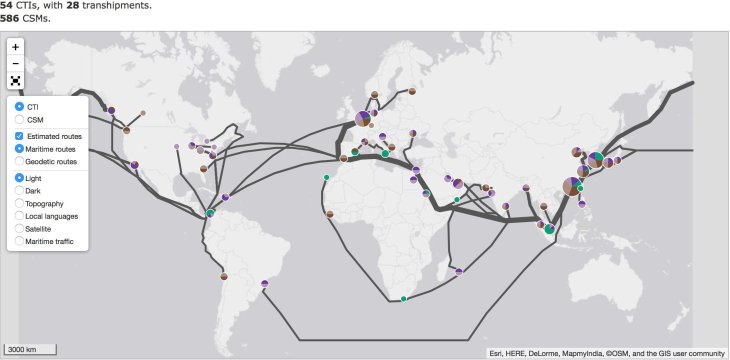
The EU customs authorities have been long aware that information on the logistics and actual routes of cargo containers arriving in Europe is valuable for the fight against customs fraud. However, they had very limited ways to obtain such information and no means to systematically analyse cargo container traffic both for fraud investigations as well as for risk analysis. On the other hand, the ocean carriers that transport the cargo containers, as well as their partners and clients, have easy on-line access to the so-called Container Status Messages (CSM): electronic records which describe the logistics and the routes followed by cargo containers.

jrc-cargo-container-routes-world-mapIn collaboration with the European Anti-Fraud Office (OLAF), the JRC has worked extensively on how to exploit CSM data for customs anti-fraud purposes. The JRC proposed techniques, developed the necessary technology, and ran long-term experiments involving hundreds of EU customs officers to validate the usefulness of using CSM data. The results of this research led the Commission to bring forward a legislative proposal that would enable Member States and OLAF to systematically use CSM data for these anti-fraud purposes. It also served to convince Member States of the value of the proposed provisions.
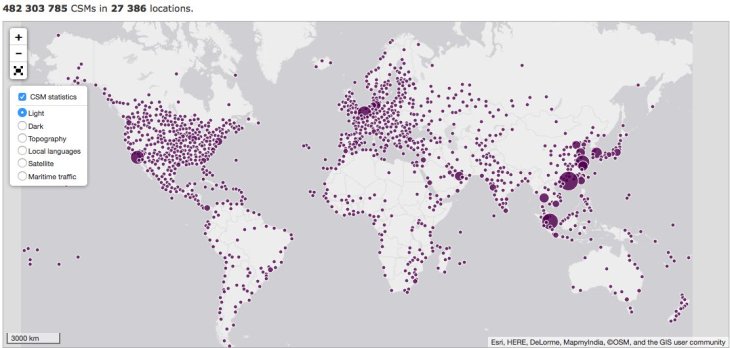
The financial gains from the avoidance of duties, taxes, rates and quantitative limits constitute an incentive to commit fraud and allow the capacity to properly investigate in cases, such as mis-declaration of the origin of imported goods. The information extracted from the CSM data can facilitate the investigation of some types of false origin-declarations. With the new legislation an importer will no longer be able to declare – without raising suspicions – country X as dispatch/origin of goods if these were transported in a cargo container that started in country Z (as indicated by the CSM data).

jrc-csm-dataset-world-map (1)The technologies, know-how and experience in handling CSM data, developed by the JRC through its experimental ConTraffic platform, will be used by OLAF to set up the system needed to implement this new legislation applicable as from 1 September 2016. The JRC will continue to analyse large datasets of CSM records (hundreds of millions per year) as these are expected to be made available through the new legislation and will continue to support not only this new regulation but to exploit the further uses of this data notably for security and safety and real-time operations. Its focus will be on data mining, new automated analysis techniques and domain-specific visual analytics methods. Source and Images: EU Commission
TFA – Africa is on the move! Why not go faster?

WTO LogoThe following article is published with the kind permission of the author, Tapia Naula who is Principal Transport Economist at African Development Bank, based in the Ivory Coast. He is an international project manager and transport economist with experience in logistics business, research and trade facilitation. This article is a must for anyone associated with or working on the TFA on the African sub-continent, and a bit of a wake up call to those countries who have as yet done little or nothing to progress their participation.

In the World TFA Cup Asia is leading Africa 72 – 35. The first scores of the WTO Trade Facilitation Agreement are out as member countries submit their Category A notifications. Initial results of the African first series are somewhat unfulfilling. Some teams are playing defensive even if attacking tactic is the only way to win.

In December 2013, WTO members concluded negotiations on a Trade Facilitation Agreement (TFA) at the Bali Ministerial Conference, as part of a wider “Bali Package”. Among trade facilitation practitioners the Agreement was received with great enthusiasm: finally there was a legal instrument, which is concrete enough to make a difference! TFA will enter into force once two-thirds of members have completed their domestic ratification process. Section I contains substantive provisions in 12 main Articles. The members are required to categorize and notify each provision of the Agreement as either A, B or C Category. The A Category commits a country to implement the provision upon entry into force of the TFA, or one year after for LDC’s. For B-Category there will be a transitional period. C-Category provisions are allowed a transitional period, technical assistance and capacity building.

First, let it be said loud and clear: the WTO TFA is an excellent collection of modern trade and transport facilitation instruments in one folder. In developing countries its implementation would mean reforms that would save time, money and efforts for regular business people and consumers. These reforms may be painful but the countries that can do it, will be the future winners of their regional competition and they will be the ones that will most benefit from joining the global value chains. TFA is the best vehicle for poverty reduction invented so far and that is why it is so important.

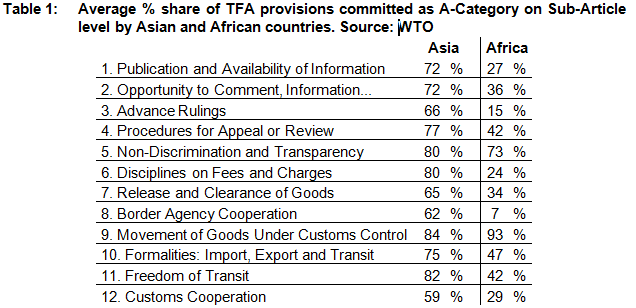
In August, 2015, 14 African countries and 25 Asian countries had submitted notifications for category A provisions. Asian countries had “accepted” 72 % of all the provisions as A-Category commitments on average where the respective share of the African countries is only 35 %. On Article-level African countries lag behind on every Article except one (Table 1).

In addition to the low overall share of category A-notifications, the African notifications generally look like “random picks” of sub-paragraphs, compared to many Asian members that have commonly chosen the strategy of basically accepting the whole Agreement and making exceptions for certain few paragraphs according to their particular needs.

Were African governments well-informed of the impact and substance of each paragraph – or are they just being cautious, perhaps trying to delay the final commitment? The patterns between African and Asian countries are in any case different.

Table 1

TFA includes also “low hanging fruit” – sections that require little technical expertise to be implemented. At least some of these should have been easy for member countries to accept. “Publication and Availability of Information” is one of those sections. Access to information through internet is routine and affordable. It should not require transition periods or particular technical assistance. Donors are even competing to assist governments with such low cost and high-return activities. Still, less than one third of the African Governments notified this Article.

Here are some other peculiar findings:

  • Out of 14 African countries only Morocco accepted “Border Agency Cooperation” as A –Category provision. Three of the others countries that did not notify it are landlocked countries;
  • Only four out of 14 African countries had fully notified “Freedom of Transit.” Transit challenges in Africa are probably the single most significant source of inefficiency in trade logistics;
  • One of the foundations of modern customs management is the introduction of Risk Management. Only 3 out of 14 African countries had notified this provision;
  • Only Morocco notified Trade Facilitation Measures for Authorized Economic Operators (AEO), which gives certain privileges to traders and transport operators, who show high level of compliance to regulations. One wonders why Kenya, Uganda, Rwanda, Burundi and Tanzania did not notify it as we know that an AEO program is being piloted in the East African Community;
  • Only Senegal notified the sub-Article on Single Window, which is probably the most important one of the whole Agreement. Senegal perhaps deserves this honor – being the first truly African-based single window country – and also representing the good practice of SW management. Yet, according to the African Alliance for e-Commerce, currently there are at least 16 other single windows either already operational or under development in Africa. Why weren’t these developments recognized?

Despite the above “peculiarities” the African situation is fortunately nowhere near as somber as the A-Category notifications indicate. There are plenty of trade and transport facilitation initiatives under implementation – and Africa is indeed “on the Move.” We should on one hand side make sure that the valuable TFA Agreement is not becoming a separate formal process alongside the practical actions on the ground, but rather a framework for coaching governments in climbing up the stairs toward greater competitiveness. On the other hand, the countries should not ignore the existing achievements. A lot has been achieved in Africa in recent years and this process should go on and gain speed. Some sub-regions, which have been less successful in this field need  benchmarks, encouraging and coaching. This is where African and international organizations can play a role.

Although the direct cost of TFA implementation is relatively low, the indirect cost may be extremely high. The indirect cost concerns existing structures, which generate income for organizations and individuals, who often greatly benefit from the status quo. Some governments have entered into concessions outsourcing critical government functions such as pre-customs clearance operations and processing and submissions of declarations to customs. Western firms have efficiently seized the opportunity and negotiated deals, which guarantee profits for in many cases for decades to come. Single Windows in certain countries are good examples for these. In an unnamed Southern African country for example, humanitarian aid is exempt from taxes and duties in import. If however a UN agency for example imports a container of pharmaceuticals worth five million USD, it will have to pay for a Single Window fee of 42,500 USD! Such Ad Valorem fee arrangements are against the TFA. Such concessions are often built inside structures, which profit from the concessions and in exchange – protects its operations and continuity. This is why they are difficult to tackle. This is an example of the problematics that African policy makers must deal with when taking a position in committing in TFA provisions. It may be a whole lot more complicated than what it looks like.

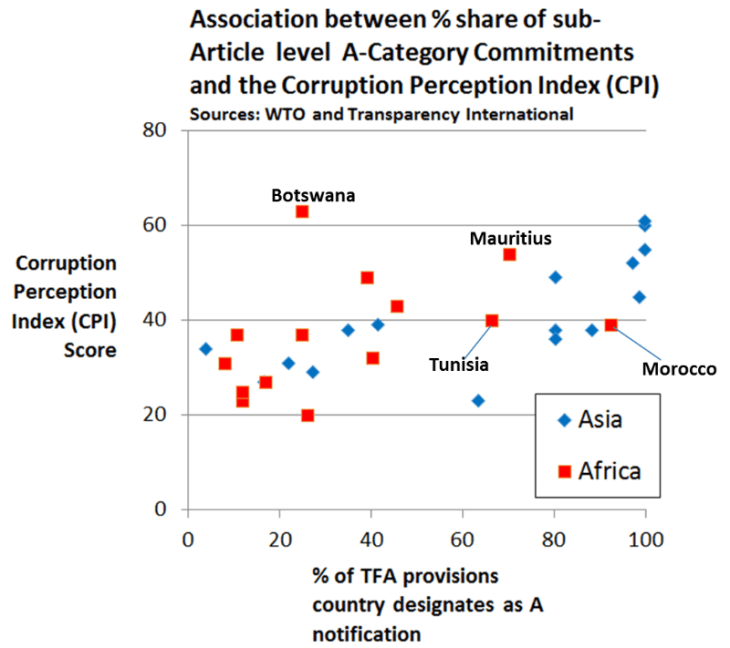
Association between % Share of Sub-Article Level A-Category Commitments and the Corruption Perception Index Score (CPI). Sources: WTO and transparency International.

The diagram above shows the association of share of the provisions that have been covered by A-Category notifications and the Corruption Perception Index (CPI) score of the countries. For African countries the correlation is moderate (correlation co-efficient: 0.42) but for Asian countries the association is strong (correlation co-efficient: 0.73). The association of the two variables is understandable: the less corruption a country has (the higher the CPI rank is), the more reforms the government is in liberty to conduct (the higher coverage of TFA as A-category Notifications).

We need to better understand the underlying reasons why policymakers cannot let reforms take off. Traditions, corruption and outdated structures are usually the biggest obstacles. These cannot be overcome by merely providing short-term technical assistance and bench-marking the world best practices but only strong political leadership can make the change. Developing partners should raise this topic on the highest political level and “live together” through the reforms with the counterparts.

The Northern Corridor (Kenya, Uganda, Rwanda) provides an encouraging example how multiple reforms can be carried out in very short time. Only two years ago it took staggering 27 days to transport a container from Mombasa Port and deliver it in Kigali, Rwanda. Today it takes only seven days. The improvement was enabled by series of reforms, which were championed by the Heads of States of the Corridor member countries. The example proves that major improvements can indeed be achieved in very short time. On the other hand, even with the most sophisticated instruments, reforms will not succeed if there the high-level ownership is not there. Author: Tapio Naula

Kenya cut flower exports rise by 11.7%

Kenya Cut Flower ExportsKenya’s cut flower exports rose by 11.7 per cent during the first quarter of this year to 136,601 tonnes. This was a remarkable growth for the sector at nine per cent in volumes and 18 per cent in value compared with the same period last year.

“This was a remarkable growth for the industry that has endured many challenges in the recent past. This calls for the government to continue creating a conducive environment for doing business,” said Kenya Flower Council chief executive officer Jane Ngige.

Vegetable exports, however, declined by 3.3 per cent from 16,600 tonnes to 16,1000 tonnes during the period under review. The agriculture, forestry and fishing sector on the other hand, expanded by 4.4 per cent compared with 2.2 per cent last year. This growth was reflected in the increased use of agricultural inputs during the quarter.

According to Kenya National Bureau of Statistics (Knbs), the country’s horticultural sector earned Sh100.8 billion last year, a six per cent growth in comparison with Sh94.7 billion earned in 2013.

This came despite the challenges that the flower industry faced in the last quarter of the year when Kenya started exporting under the European Union’s Generalised Scheme of Preferences (GSP) from October 1 to December 25 last year, following failure in the finalisation of the East African Community-European Union Economic Partnership Agreement (EPA).

Kenya remains one of the top three exporters of cut flowers in the world. The major markets are the EU, America, Australia, Russia, and Japan. Ngige said increased demand for fertilizer, a key input for agriculture sector, was notable as reflected by its import which grew by 18.4 per cent from 224,000 metric tonnes in first quarter 2014 to 265,9000 metric tonnes in the first quarter of this year.

Tea production and coffee sales declined by 27.2 per cent and 8.6 per cent, respectively. The fall in tea production was attributed to inadequate rains and frost that was reported in some tea zones. Source: Customs Today

Zimbabwe’s manufacturing firms insist on ban of import of second hand clothes

2nd hand clothingZimbabwe’s manufacturing firms want government to consider banning the import of second-hand clothes as part of reforms to protect the local industry, Parliament heard on Tuesday.


Used clothes have flooded the domestic market, compounding the woes of a local textile industry on the verge of collapse. Industry experts say Zimbabwe has a market for 80 million garments but only 20 million of those are locally manufactured. Almost 90 percent of imported new clothes are exempt from duty because of regional trade agreements, analysts noted.

Confederation of Zimbabwe Industries (CZI) national council member Jeremy Youmans told a parliamentary portfolio committee on industry and commerce that industry requires access to long-term capital, as well as clarity on the indigenization and empowerment law among other measures to compete on the same terms with foreign companies that have established a foothold in the country.

“Second hand clothing in South Africa is banned, if they catch (anyone selling) they will burn it. Maybe that is something we need to consider,” Youmans said.

“As a clothing industry certainly, we have always said we don’t want to stop it because that clothing is being donated to some people who cannot buy clothes themselves.

“The problem is that they are not going to those people, they are going into our markets and somebody is buying those clothes, it’s a very difficult situation.”

He added that the revival of the cotton industry would be key in boosting capacity of the country’s textile industry.CZI vice-president Sifelani Jabangwe said Zimbabwe should improve its business climate to become competitive by doing away with bureaucracy which drives the cost of doing business.

“One of the challenges is that in order to comply with being formally registered, we have to be registered with a number of bodies depending with the nature of the business and they charge licence fees,” he said.

“When you add up these costs, individually they seem to be so low but when you add them up just to be formally operational it is actually a significant cost to the extent that this causing other businesses to close down.”

OECD estimates WTO TFA could to cut trade cost by 17.5% on customs rules

cut-red-tape“Simplifying trade documentation”; “automating border procedures”; “streamlining border controls” – all cliche’s of the modern customs and international trade scene, but just how attainable are they? Beyond the pleasantries, and fanfare of ribbon cutting ceremonies, very little seems to happen at the cold face. Sovereign states are inward-looking and jealously wish to preserve their ‘sovereign domains’.

A major World Trade Organization deal on streamlining global customs rules could cut international trade costs by between 12.5 percent and 17.5 percent, a study by the Organization for Economic Co-Operation and Development showed on Thursday.

A deal between India and the United States on the Trade Facilitation Agreement last year, which needs to be backed by all 160 WTO members, had resurrected hopes that the trade body could push through such reforms to cut red tape.

“There are very practical measures that we’ve identified that offer significant benefits,” Ken Ash, the OECD director for Trade and Agriculture, told media.

“Things like simplifying the required trade documentation. Automating border procedures, or streamlining border controls.”
Economists say the Trade Facilitation Agreement could save $1 trillion. Ash declined to endorse this figure, only saying the Paris-based body expected each 1 percent reduction in worldwide trade costs to bring $40 billion in savings.

Australia was to formally accept the agreement later on Thursday, Steven Ciobo, parliamentary secretary to the minister of foreign affairs, said at the news briefing in Paris, making Australia the seventh WTO member to adopt the agreement.

Event – Role of the Private Sector in Support of the Trade Facilitation Agreement

international-trade1The role of the private sector in the implementation of the World Trade Organization’s (WTO) Trade Facilitation Agreement (TFA) will be the focus of the 2015 edition of the Global Facilitation Partnership for Transportation and Trade (GFP) meeting. With the world’s customs administrations currently identifying their respective TFA  implementation commitments and setting up National Trade Facilitation Committees, trade and logistics operators can learn how they can participate in such initiatives by attending these sessions.

The GFP meeting will be held at Palais des Nations, Geneva, on 22 April, and will be divided into three thematic sessions.

The first session, ‘Governments’ Priorities: Strategies for Fostering Private Sector Participation in the TFA Implementation Process’ will look at how governments are planning to implement the TFA.

It will focus on how the private sector is consulted and how an effective participation of the private sector can be facilitated to implement the Agreement.

The second session, ‘Priorities, Perspectives, and Expectations from the Private Sector on TFA Implementation’ will assess how the private sector – including large corporates and small and medium-sized enterprises – view TFA implementation. It will look at the potential benefits from a private-sector perspective, and how the sector can contribute to national and international initiatives to implement the agreement.

The third session, ‘International Organizations’ Co-ordination and Partnership for Supporting TFA Implementation’, will provide an opportunity to share information and experiences on how the TFA can be implemented with public-private partnerships in mind, as how national trade facilitation committees can better support this process.

ITC invites all interested stakeholders to join the GFP meeting at the Palais des Nations on 22 April from 9:00. Click here for link to online registration.

Source: International Trade Centre (Geneva)

Smart Containers – making headway

loginno3Technology once again demonstrates that it not only ‘enables’ but can also provide companies a ‘differentiator’ to get ahead of the competition – at least for a while. This is the second such innovation in recent weeks which addresses the needs of international shippers and logistics operators in meeting stringent security requirements while at the same time offering a compelling solution for supply chain auditability and the management of their assets. Furthermore, with more and more countries offering authorised economic operator (AEO) programs these same shippers and logistics operators will in the longer term enjoy a certain comfort from such technology investments through swifter customs clearance or green-lane treatment.

Two leading intra-Asia box lines are switching their entire container fleet to smart containers as they attempt to differentiate themselves from competitors. Hong Kong-based SITC Shipping Group and SIPG container shipping arm Hai Hua have both announced they will upgrade their entire container fleet to smart containers using products from Loginno. SITC, which has a fleet of 66 vessels with a total capacity approaching 2m teu, said it had decided to use smart containers to try to offer customers a different service to other carriers.

SITC Shipping Group Xue MingYuan said: “In a market with more and more homogeneous services, we have to think about why our customers would choose us over others.

“Being among the first to offer, as a standard service on all of our containers, full insight into their cargo movements and security, for a very low additional cost, we differentiate ourselves instantly, and hopefully save our customers a lot of logistic costs in their supply chain.”

This view was echoed by Hai Hua general manager JP Wang: “We have been looking for an affordable means to convert our fleet to smart containers. Shippers and Cargo owners have been long waiting for this service.”

Smart container technology has been around for a few years, but the cost of the technology and fears of damage and theft of the equipment has been enough to discourage its widespread take up. There have also been concerns from shipping lines about how to monetize the technology.

But the industry is gradually increasing its use of the technology. CMA CGM just recently announced a major initiative to introduce smart container technology to its fleet. Loginno chief technology officer Amit Aflalo said its device, which is slightly larger than a mobile phone, was inexpensive and easy to install. The device offers GPS, temperature monitoring, intrusion detection and a movement detector and can provide updates to mobile phones. Source: Lloyds Loading / Loginno

Forbes – Top 10 Container Ports

Forbes compiled the following list of the world’s top 10 container terminals. For more information visit this link!