Amazon.com China – approved as an NVOCC

Amazon-BoxMarket forces, competition and the desire to be ahead of the competition demonstrate how dynamic the international supply chain is being maneuvered. Amazon’s latest move is not only innovative but demonstrates just how adaptable international trade and Customs Inc. need to be in order to accommodate nuances to traditional accepted norms in global trade. For Customs, it needs to intimately understand the nature of business of its registered or licensed traders so as to properly apply risk and facilitation regimes appropriately. Recent developments in mutual recognition likewise play an important role in awarding real benefits to companies and their supply chains who undertake such global innovations.

According to the U.S. Federal Maritime Commission, Amazon.com Inc’s China arm has registered as an ocean freight forwarder, a move that will give it more control over shipping products from Chinese factories to U.S. shoppers.

The registration is the latest indication that Amazon plans to expand its logistics reach to cut costs for its retail business and potentially provide third-party logistics services to other industries.

It’s new status as a freight forwarder, or “non-vessel operating common carrier,” gives Amazon, the world’s largest online retailer, a foothold in the $350 billion a year ocean freight business. It will not operate ships but subcontract that work.

Amazon is already negotiating a deal to lease 20 jets to start an air-delivery service in the United States, the Seattle Times reported last year. The retailer bought truck trailers to add shipping capacity and started a program last year that uses a fleet of on-demand drivers to deliver packages.

“It has more and more control over the supply chain of their business and it gives them the ability to squeeze (costs) even further,” said Satish Jindel, a logistics consultant and president of SJ Consulting Group.

He added the move gives Amazon an even bigger edge against traditional U.S. retailers in negotiating lower prices for goods.

The Federal Maritime Commission, a U.S. government agency that regulates the U.S.-international ocean transportation system, said on Thursday a business named Beijing Century Joyo Courier Service Co Ltd, with the trade names Amazon China, Amazon.CN and Amazon Global Logistics China, was registered in its database to provide ocean freight services.

Amazon China submitted its registration request on Nov. 9, the commission said Thursday, and it was reviewed and registered on Nov. 13. It is the entity’s first registration.

“Amazon’s ocean freight services will be far more attractive to Chinese sellers than to American buyers. Chinese suppliers would love direct access to Amazon’s vast American customer base,” wrote Ryan Petersen, chief executive officer of Flexport, a San Francisco-based freight forwarder who first wrote about Amazon’s registration on his company blog on Thursday.

Petersen added that Amazon’s third-party merchants were unlikely to use its shipping service because it would expose key data like wholesale pricing and supplier names to a rival. Source: Reuters

Positive future for Electronic Bills of Lading

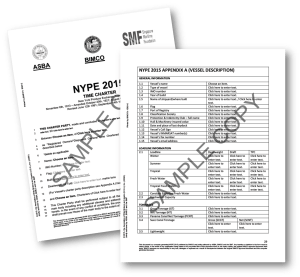
BIMCO E-Bill of LadingPaper bills of lading have been used throughout the world to document and effect international trade for centuries. Yet whilst the world has become increasingly digitalised the paper bill of lading has, on the whole, remained a constant feature of global trade. Its continued use is mainly due to its combination of three legal characteristics that it has developed over time: (i) it is a receipt of the goods carried; (ii) it provides evidence of the terms of the contract of carriage; and (iii) it is a document of title to the goods. It is these characteristics that have, until relatively recently, foiled attempts to replace the paper bill of lading with an electronic equivalent. However, with the inclusion of an electronic bills of lading clause in BIMCO’s NYPE 2015 time charter form, as well as the International Group of P&I Clubs’ approval of the coverage of three electronic trading systems, the dominance of the paper bill of lading may well be coming to an end.

Reed Smith LLP Ship Law blog posts an interesting article in regard to change in law and the impact of e-commerce on bills of lading.

Issues with the paper system
Whilst the paper bill of lading has been used for centuries it is not without its faults, the principal problems being that:

  • Carriers are obliged to discharge the goods carried on production of an original bill of lading: this is particularly problematic today given both the speed of transport and the fact that the cargo may be sold multiple times during carriage. As a result of this the bill of lading is often not delivered to the consignee in time, and the carrier is often required to accept a letter of indemnity. This indemnity does not, however, remove the carriers’ liability under the bill of lading and creates an additional administrative burden and cost to the trade.
  • The paper system is hugely expensive (such cost is estimated to be between 5 – 10% of the value of the goods carried each year).
  • A paper bill of lading may be forged with relative ease and carriers are liable for misdelivery against a forged bill of lading.

Benefits of an electric bill
The electronic bill of lading or e-bill, in theory, addresses many of the flaws of the paper system, bringing with it a number of advantages:

  • It can be sent around the world instantaneously, hugely lowering the administrative burden of trade (especially where cargo is subject to multiple transfers of ownership during carriage).
  • Any amendments or corrections required can be made far more efficiently and cost effectively.
  • Electronic payment systems, and related advances in security, make an electronic system considerably more secure than its paper equivalent. This is obviously subject to cyber issues.

These benefits will cut the administrative costs of trade significantly and reduce, if not eradicate, situations where carriers discharge their cargo against letters of indemnity.

So why so slow on the uptake?
One of the main reasons the widespread use of the e-bill has been slow to proliferate stems from the fact that it is not treated in the same manner, legally, as its paper equivalent. Significantly:

  • A paper bill of lading is a document of title, enabling it to be negotiated and transferred as possession of the bill is evidence of title to the goods. This is not automatically the case at law with an e-bill.
  • The Hague Rules / Hague Visby Rules (HR / HVR) apply to a contract of carriage by reference to the bill of lading, or similar document of title, and it has been less clear whether they would apply to any electronic trading system used. The solution developed to these legal obstacles is essentially a multiparty contract. This takes the form of a set of rules to which users of an electronic trading system are all required to subscribe to use that system. Such rules then set out the specific form of electronic trading documentation to be used and that the consequences of using such documentation shall mirror the position at law as if they were paper bills of lading.

This, however, means that electronic trading systems such as BOLERO, which has been in existence since the 1990s, are only able to function between their members (i.e. those that have agreed to the uniform set of rules and systems that will govern their transactions). Where a member of an electronic trading system enters into a transaction with a non-member, the electronic system cannot be utilised and a paper bill of lading is issued. This feature has limited their growth, as electronic trading systems are only really effective once they have a large number of members, but are not cost-effective for traders to join until they have a large number of members.

The present situation
The benefits of electronic trading systems are particularly tangible to container carriers (as there is often a separate bill of lading for each container carried) and as such have been utilised by liner companies before wider adoption in the industry. However, the efficiencies of electronic trading systems are not confined to the container industry alone and with members of the largest trading companies, trade finance banks, mining companies and oil majors using such systems, it is clear that they are becoming increasingly prevalent in the shipping industry as a whole.

The growth of the use of electronic trading systems in the wider shipping industry is something that BIMCO, by including an e-bills clause in its latest iteration of the NYPE form, has also recognised. In sum the new clause provides that:

  • use of an electronic trading system is at charterers’ option;
  • owners shall subscribe to the system elected by charterers, provided such a system is approved by the International Group of P&I Clubs;
  • charterers shall pay any fees incurred by owners in subscribing to such elected system; and
  • charterers shall indemnify owners for any liabilities incurred arising from the use of the elected system, so long as such liability does not arise from owners’ negligence.

The International Group of P&I Clubs have now ‘approved’ three electronic trading systems (BOLERO, essDOCS and E-title). An ‘approved’ system is one that is found to replicate the legal characteristics of a paper bill (namely (i) as a receipt; (ii) a document of title; and (iii) a contract of carriage which incorporates the HR / HVR). This means that the International Group of P&I Clubs will provide cover for any liabilities arising under carriage covered by these three electronic trading systems (or any such other subsequently ‘approved’ system), provided that such liability would also have arisen under a paper bill. However, members should be advised that risks connected with the use of a non-approved electronic trading system will not be covered.

The use of an electronic trading system does, however, lead to other risks from things such as hacking, systems collapse, e-theft and viruses, none of which are traditionally covered by P&I clubs and would need to be insured separately. In this regard, essDOCS (which is now used throughout 71 countries by over 3,300 companies) has insurance cover of up to USD $20 million per electronic bill of lading for “eRisks” resulting from an electronic crime or electronic system failure.

With the rise in usage of electronic trading systems, the recent judgment in Glencore v MSC (albeit currently under appeal) provides a timely reminder that the release of cargo should only be made in accordance with the contract evidenced by the bill of lading, even where an electronic release system for cargo is being operated. In this instance cargo was released on presentation of a PIN, despite no provisions for this in the bill of lading, two of the released consignments of cargo were misappropriated and the carrier was held liable.

The future?
With the International Group of P&I Clubs’ approval of three electronic systems, the inclusion of an electronic bills of lading clause in BIMCO’s latest NYPE form and the proliferation of the use of electronic trading systems throughout the wider shipping industry, it is clear that the use of electronic trading systems is increasing. Whilst there is no doubt that we can expect teething problems as the industry continues to adapt to such electronic trading systems, and the cyber risks they may bring, it seems that the efficiencies are too great to be ignore. Source: Ship Law log / ReedSmith

Rapiscan introduces advanced dual-view X-ray system

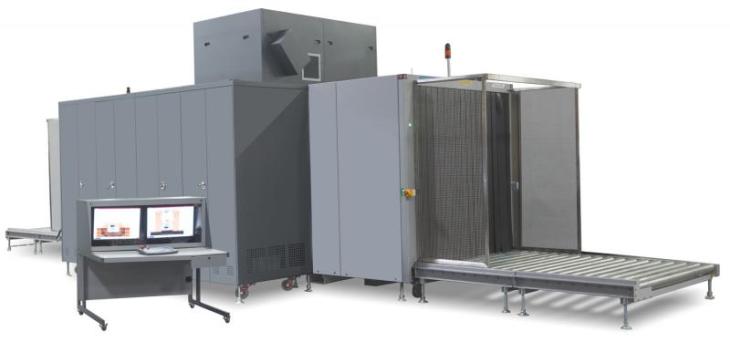
rapiscan_638dv-320_version2__largeThe new Rapiscan 638DV 320kV is an advanced dual-view X-ray system with a 1837 mm wide by 1800 mm high tunnel opening for screening ULD type, ISO standard, and large cargo pallet type freight.

The new 638DV 320kV features high penetration, dual-view technology and explosives and narcotics detection alert supporting secure inspection and higher throughput for air cargo screening and customs applications.

Detection of Explosives and Narcotics Alert
Target™ and NARCScan™ are designed to assist operators in the detection of a wide range of explosives and narcotics respectively in real time during the scanning process by marking a potential threat on the X-ray image. Rapiscan detection algorithms are based on regulatory material analysis techniques.

Dual View Advanced Technology
As mandated by US and EU regulators, the 638DV 320kV utilizes a dual-view technology which produces two simultaneous images (vertical and horizontal views) of the scanned object. It provides a more complete image, thereby reducing the need for repositioning and rescanning and enabling rapid, accurate and comprehensive threat detection.

Ease of Use Providing Highest Throughput
With over 14 image processing tools and detection alert algorithms, the feature-rich software allows the operator to more easily and accurately search for contraband. Source: Rapiscan

Aerial view of Rotterdam Container Terminal

Aerial view of Rotterdam Container Terminal

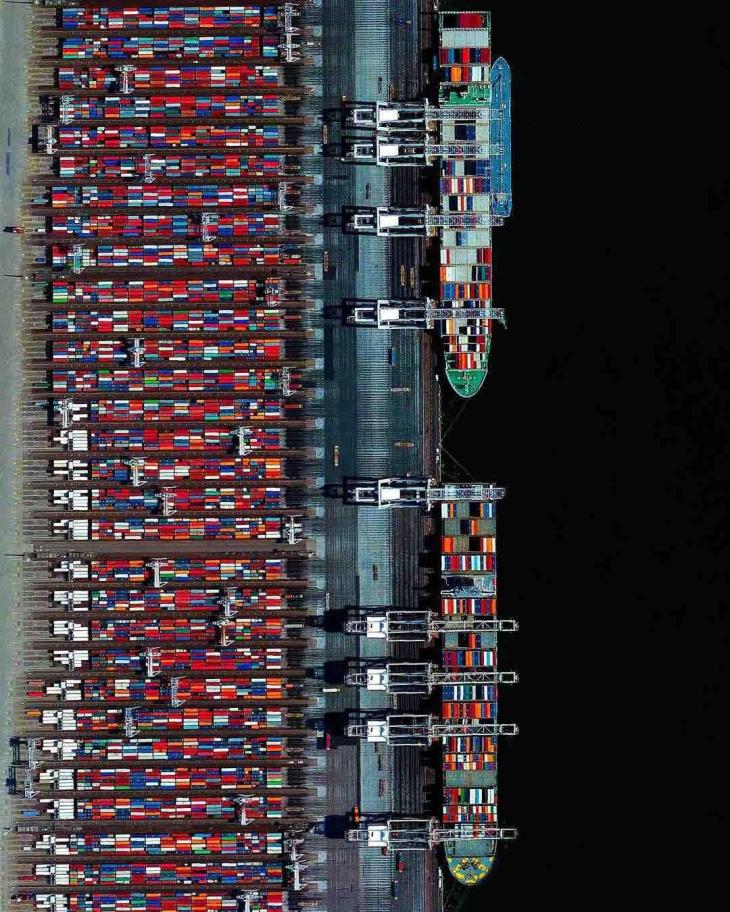
The Port of Rotterdam, Netherlands, is the largest port in Europe covering 105 square kilometers. (Picture: Benjamin Grant/Google Earth/Digital Globe)

SA – Hub for computerised Regional Integration?

AfricaFrom time to time it is nice to reflect on a good news story within the local customs and logistics industry. Freight & Trade Weekly’s (2015.11.06, page 4) article – “SA will be base for development of single customs platform” provides such a basis for reflection. The article reports on the recent merger of freight industry IT service providers Compu-Clearing and Core Freight and their plans to establish a robust and agile IT solution for trade on the African sub-continent.

In recent years local software development companies have facilitated most of the IT changes emerging from the Customs Modernisation Programme. Service Providers also known as computer bureaus have been in existence as far back as the early 1980’s when Customs introduced its first automated system ‘CAPE’. They have followed and influenced Customs developments that have resulted in the modern computerised and electronic communication platforms we have today. For those who do not know there are today at least 20 such service providers bringing a variety of software solutions to the market. Several of these provide a whole lot more than just customs software, offering solutions for warehousing, logistics and more. As the FTW article suggests, ongoing demands by trade customers and the ever-evolving technology space means that these software solutions will offer even greater customization, functionality, integration and ease of use for customers.

What is also clear is that these companies are no longer pure software development houses. While compliance with Customs law applies to specific parties required to registered and/or licensed for Customs purposes, the terrain on which the software company plays has become vital to enable these licensees or registrants the ‘ability to comply’ within the modern digital environment. This means that Service Providers need to have more than just IT skills, most importantly a better understanding of the laws affecting their customers – the importers, exporters, Customs brokers, freight forwarders, warehouse operators, etc.

Under the new Customs Control Act, for instance, the sheer level of compliance – subject to punitive measures in the fullness of time – will compel Service Providers to have a keen understanding of both the ‘letter of the law’ as well as the ability to translate this into user-friendly solutions that will provide comfort to their customers. Comfort to the extent that Customs registrants and licensees will have confidence that their preferred software solutions not only provide the tools for trading, but also the means for compliance of the law. Then, there is also the matter of scalability of these solutions to keep pace with ongoing local, regional and global supply chain demands.

The recent Customs Modernisation Programme realised significant technological advances with associated benefits for both SARS and trade alike. For the customs and shipping industry quantification of these benefits probably lies more in ‘improved convenience’ and ‘speed’ of the customer’s interaction with SARS than cost-savings itself. My next installment on this subject will consider the question of cross-border trade and how modern customs systems can influence and lead to increased regional trade.

Rotterdam Maasvlakte II – World’s first Remote-Controlled Container Port

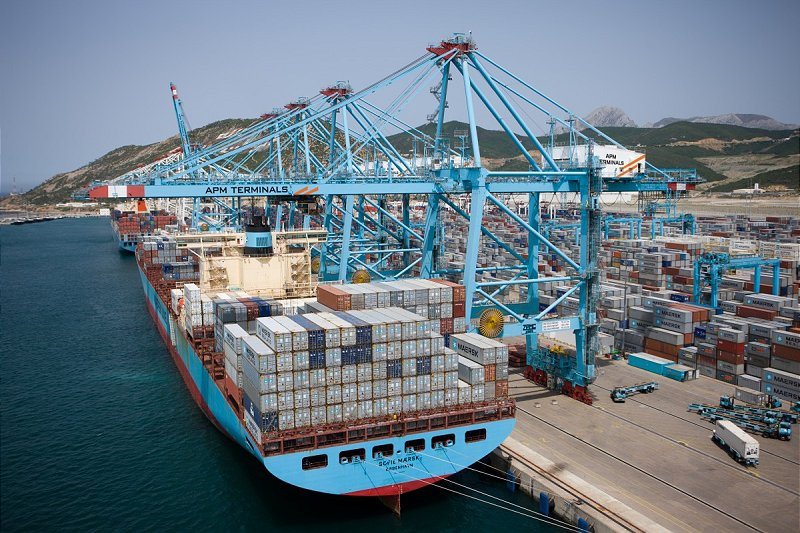
APM Terminals has released drone footage of its Rotterdam Maasvlakte II terminal. The terminal set a loading record last month on the Madison Maersk with 17,152 TEU loaded, including ten high above deck stowage.

The facility launches the world’s first container terminal to utilize remotely-controlled ship-to-shore (STS) gantry cranes. The cranes move containers between vessels and the landside fleet of 62 battery-powered Lift-Automated Guided Vehicles (Lift-AGVs) which transport containers between the quay and the container yard, including barge and on-dock rail facilities.

The Lift-AGV’s also represent the world’s first series of AGV’s that can lift and stack a container. A fleet of 54 Automated Rail-Mounted Gantry Cranes (ARMGs) then positions containers in the yard in a high-density stacking system. The terminal’s power requirements are provided by wind-generated electricity, enabling terminal operations, which produce no CO2, emissions or pollutants, and which are also considerably quieter than conventional diesel-powered facilities.

The facility, constructed on land entirely reclaimed from the North Sea, has been designed as a multi-modal hub to reduce truck traffic in favor of barge and rail connections to inland locations.

Construction began in May 2012, with the first commercial vessel call in February 2015.

2015 and 2016 are the years of ramping up operations and refining the terminal operating system. The 86 hectare (212 acre) deep-water terminal features 1,000 meters of quay, on-dock rail, and eight fully-automated electric-powered STS cranes, with an annual throughput capacity of 2.7 million TEU.

At planned full build-out, the terminal will cover 180 hectares (445 acres) and offer 2,800 meters of deep-sea quay (19.65 meters/64.5 feet depth), with an annual throughput capacity of six million TEUs. Source: Maritime Executive

South Africa Registers First Vessel in 30 Years

[Picture:  tropic maritime photos, Australia]

[Picture: tropic maritime photos, Australia]

For more than 30 years, the South African Maritime Safety Authority (SAMSA) has not had a registered vessel. The M/V Cape Orchid, a bulk carrier, is its first vessel registered since 1985.

While South African imports $102 billion and exports $97 billion each year, the Cape Orchid is the country’s first registered vessel and is currently transporting iron ore from Saldanha Bay to China.

The 172,600-dwt bulker is owned by Vuka Marine, which is a joint venture between South Africa’s Via Maritime Holdings and Japan-based K-Line. South Africa will also soon register the Cape Enterprise, a 185,900 dwt vessel, which is also owned by K-Line during next few weeks.

The SAMSA and the South African Department of Transport hope that Vuka Marine’s registration will l encourage other vessel operators join the nation’s flag registry. More than 12,000 foreign flagged ships call South Africa each year, which is the gateway for African trade.

South Africans own about 19 vessels including three petroleum tankers, which are all registered in foreign countries. The country’s key ports are Cape Town, Durban, Port Elizabeth, Richards Bay, and Saldanha Bay. Its prime container port is Durban, which handled about 2,712,975 boxes last year.

Have Mega Containerships reached their Size Limit?

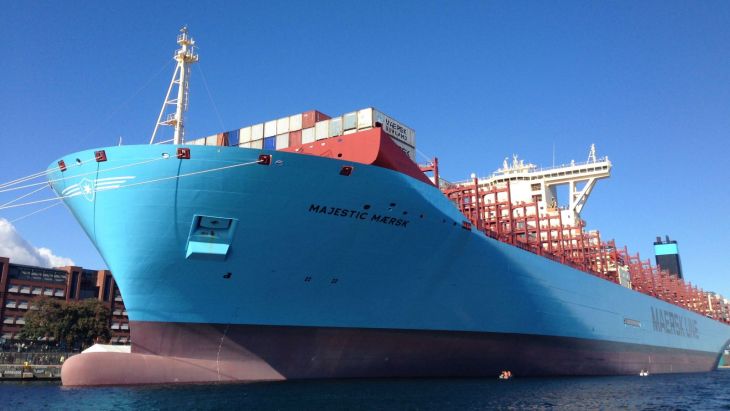
Majestic MaerskContainer shipping lines are poised to take delivery of a new generation of “megaships” over the next two years, just as the growth of world trade is slowing down, contributing to massive overcapacity in the market.

Megaships, which can be up to 400 meters long, seem to be here to stay, not least because so many more are already on order, the product of high fuel costs and low interest rates.

But the trend towards larger vessels is not without problems especially for other businesses in the transport system, and the trend could be nearing its limit as the economies of scale associated with megaships decline.

Container shipping capacity has doubled every seven years since the turn of the millennium and will reach nearly 20 million TEU in 2015 up from five million TEUs in 2000.

But since the financial crisis, container capacity has continued to grow rapidly, even as the growth in freight volumes has slowed, creating a massive overhang in shipping capacity and pressuring freight rates.

Capacity growth is being driven by the trend towards larger vessels. The size of container ships has been growing faster than for any other ship type according to the OECD’s International Transport Forum.

Between 1996 and 2015, the average carrying capacity of container ships increased 90 percent, compared with a 55 percent increase for dry bulk carriers and 21 percent for tankers.

The growth in container ship size has been accelerating. It took 30 years for the average container ship size to reach 1,500 TEU but just one decade to double from 1,500 to 3,000 TEU.

Between 2001 and 2008, the average size of newly built ships hovered around 3,400 TEU but then jumped to 5,800 TEU between 2009 and 2013, and hit 8,000 TEU in 2015.

Megaships
Both the average size of new container ships and the maximum size are set to continue growing over the next five years. Shipping lines have already taken ownership of 20 megaships with a capacity of more than 18,000 TEU each and another 52 are on order, according to the OECD.

The largest ship so far delivered has a capacity of 19,200 TEU, but carriers with capacity up to 21,100 have been ordered and will be in service by 2017.

Megaships are being introduced into service between the Far East and North Europe, the world’s largest route by volume, where potential economies of scale are greatest, but are having a cascade effect on other routes.

Large ships that formerly plied the Far East-North Europe route are being displaced into Trans-Pacific service, and former Trans-Pacific carriers are moving to the Trans-Atlantic route.

The new generation of ultra-efficient megaships is credited with cutting the cost of shipping even further and lowering greenhouse gas emissions.

But researchers for the OECD question whether megaships are contributing to unsustainable overcapacity and imposing unintended costs on shippers, port operators, freight forwarders, logistics firms and insurers.

Fuel Costs
The new generation of megaships is the lagged effect of the era of high oil prices between 2004 and 2014 and low interest rates since the financial crisis in 2008.

Costs in the shipping industry can be divided into the capital costs associated with the construction of new vessels, operating costs, and voyaging costs primarily related to fuel consumption.

Construction costs increase more slowly than ship size. Increasing a container ship from 16,000 TEU to 19,000 TEU cuts the annual capital cost per TEU-slot by around $69 according to the OECD.

Larger ships are slightly more operationally efficient than smaller ones, with an annual saving of perhaps $50 per slot on a 19,000 TEU ship compared with a 16,000 TEU vessel.

But the real savings are on the fuel bills. Megaships are “astonishingly fuel efficient” and actually consume less fuel on a voyage than 16,000 TEU carriers, according to the OECD.

With overwhelming cost advantages, especially on fuel, and cheap finance readily available, the upsizing decision appears to have been a straightforward one for shipping lines.

Slow Steaming
The new generation of megacarriers has been optimized to save fuel by voyaging much more slowly than previous container vessels.

Fuel consumption is related to the cube of speed. If a vessel travels twice as fast it will consume eight times as much fuel. The cube-rule has important implications for the economics of the shipping industry.

When fuel prices are high, it makes sense to voyage slowly to cut fuel bills, even if it means operating more ships to move the same amount of cargo. When fuel prices are low, it makes sense to travel faster and use fewer ships.

During the period of soaring oil prices, container lines instructed captains to cut speed in order to conserve fuel.

The new ships ordered were specifically designed to operate most efficiently at slower speeds to take advantage of slow steaming economies. In fact some carriers are so large they cannot operate at higher speeds.

Crucially, slow steaming has now been designed into the new generation of vessels entering container service, so it will not be easily reversed, even though fuel prices have plunged since 2014.

According to the OECD, most of the voyaging cost reductions in the new generation of megaships come from their optimization for slow steaming rather than from increased size.

“Between 55 and 63 percent (at least) of the savings per TEU when upgrading the vessel size from an early 15,000 TEU design to a modern 19,000 TEU design are actually attributable to the layout for lower operation speeds,” the OECD estimated.

“Cost savings are decreasing as ships become bigger,” the OECD concluded. “A large share of the cost savings was achieved by ship upsizing to 5,000 TEU, which more than halved the unit costs per TEU, but the cost savings beyond that capacity are much smaller.”

Unintended Costs
The consolidation of container volumes into fewer, larger megaships is creating challenges for other firms in the freight business.

Insurers are worried about the costs if a megaship sinks or develops mechanical problems. Insurer Allianz has warned the industry must prepare for losses of more than $1 billion, or even up to $2 billion in the event of a collision between two megaships.

Economies of scale depend on megacarriers being loaded close to maximum capacity and spending as much time as possible at sea rather than in port.

The need to fill megaships is one reason that the industry is consolidating into an alliance network.

Shipping lines are also adopting the hub-and-spoke system employed by airlines to ensure their ultra-large container vessels sail nearly full.

Shipping schedules for the megacarriers have been consolidated into fewer sailings each week from fewer ports (about six in North Europe and eight in Asia).

Containers for other destinations must be transhipped, either on a smaller container vessel or by road, rail and barge. Schedule consolidation is not necessarily favored by shippers and freight forwarders who prefer regular and reliable service (fewer sailings can mean more concentrated risk).

Port operators, too, have been forced to invest heavily to attract and handle the new megacarriers. Port channels must be dredged to greater depths to handle the deeper drafts of the megaships. Quaysides must be raised and strengthened to handle the increased forces when a megaship is tied up.

The biggest problem comes from the scramble to unload a megacarrier quickly so it can put to sea again. The average turnaround time for a container ship is now just one day, and less in Asia.

The arrival of fewer vessels but with larger numbers of containers is creating intense peak time pressure on the ports.
Ports need more cranes, more highly skilled staff to operate them fast, more space in the yard, and the ability to handle more trucks, railcars and barges to move the containers inland.

The OECD estimates megaships are increasing landside costs by up to $400 million per year (one third for extra equipment, one third for dredging, and one third for port infrastructure and hinterland costs). Source: Maritime Executive/Reuters.

Nigeria – APMT’s Biggest Ever Port Investment

APM Terminals 2The Maersk-owned company APM Terminals has revealed it is investing about 14 billion kroner (US$2 billion dollars) into a new port in Bagadry, Nigeria, in what will be its biggest ever investment. The port will become the second-largest port in Africa – only surpassed by Port Said in Egypt – and is a clear signal that the Danish shipping giant’s terminal operator sees the African continent as a long-term hotbed for economic growth.

“We are currently purchasing property from the state and will start construction later this year. The port is scheduled to be completed in 2019,” David Skov, the managing director for APM Terminals in Nigeria, told Børsen business newspaper.

“Globally, it will be APM Terminal’s largest ever investment and marks a strategic shift to multi ports. It means we will supplement our own experience in container ports with the establishment of a free zone, an oil port and a bulk port, so in other words a complete port.”

APMT recently acted on its decision to invest $1.5 billion on the Port of Tema in Ghana, Africa, with the establishment of a Greenfield port outside of the existing facility and upgrades to the adjacent road network.

Kenya – Drugs Found on Auto Carrier in Port of Mombasa

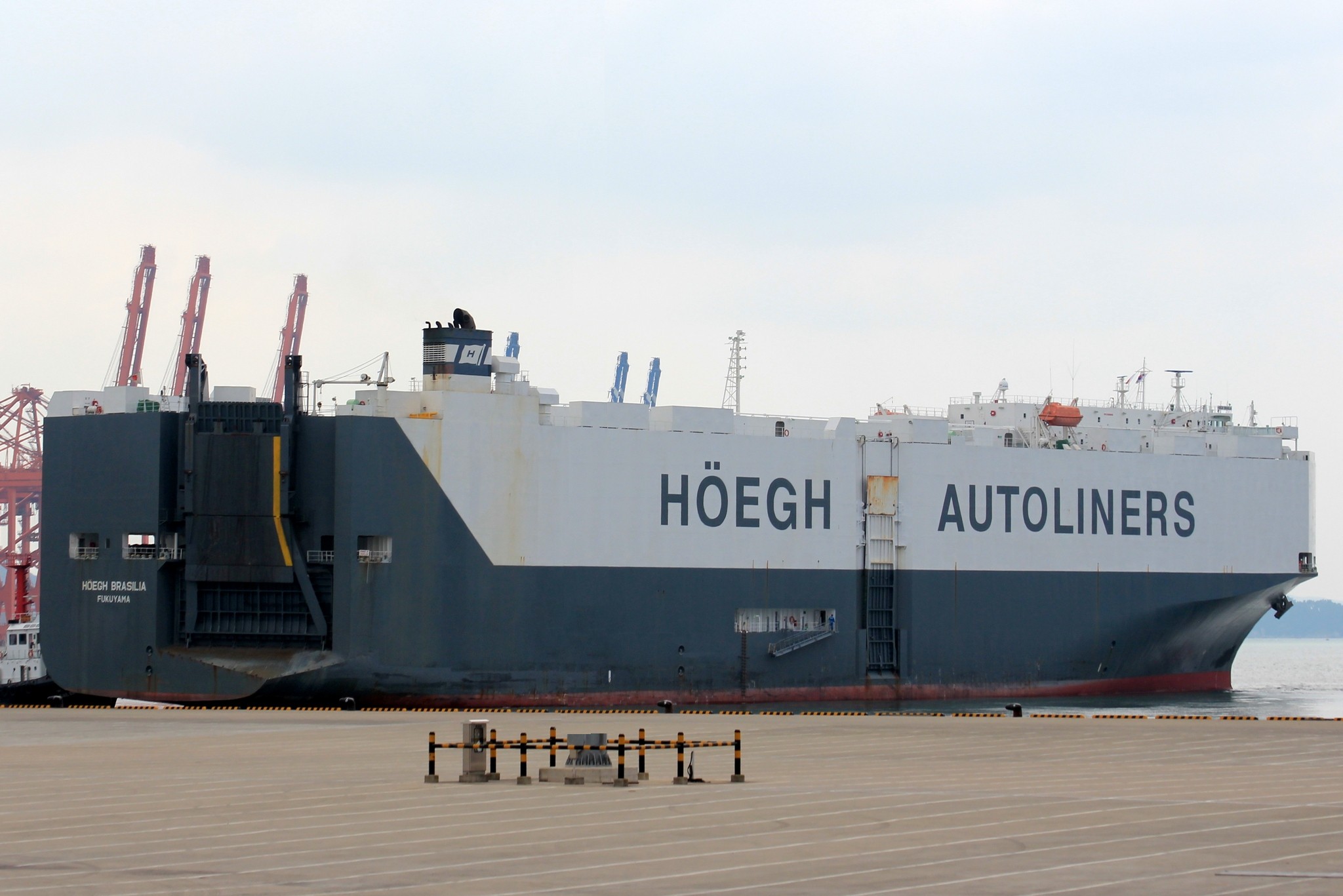
hoeghKenyan and U.S. authorities found drugs aboard the Höegh Autoliners “Pure Car/Truck Carrier” (PCTC), which was detained at Port Mombasa on September 17. The crew of the ship has been arrested and currently being questioned by authorities.

According to authorities, cocaine was found inside the tires of three military trucks aboard the Hoegh Transporter, a Singapore-flagged car carrier.

Kenyan officials raided the vessel after receiving a tip from the U.S. Federal Bureau of Investigation (FBI) that the vessel had been loaded with the coke at India’s Port of Mumbai.

Kenyan soldiers and security personnel shut down the port for hours before seizing the ship and halting operations. Mombasa, which is Africa’s largest port, serves as the main gateway for imports and exports in the region.

East Africa is a major shipping route for Afghan narcotics bound for Europe. Maritime forces have been unable to curb the flow of drug transport in the region.

The Höegh Transporter was built in 1999 and was transporting nearly 4,000 vehicles, including about 250, which are to be used for peacekeeping missions in South Sudan. Source: Maritime Executive

E-freight software solution connects to more than 90 airlines

eFreightIndia-based e-freight software development company Hans Infomatic has teamed up with the Worldwide Information Network (WIN) – an online platform for independent freight forwarders -to offer its customers a streamlined e-Customs process.

“Hans Infomatic’s web-based ‘AMS’ application enables customers to access one streamlined process for e-Customs filing, as well as electronic Air Waybills (e-AWBs), and e-manifests to over 90 airlines, using the WIN platform,” WIN said in a statement.

Benefits also include full electronic tracking, with AWB information automatically loaded into the AMS system, so shipments no longer have to be checked manually.

Hans Infomatic’s managing director, Parvinder Singh, said that the new integrated system would help forwarders collate and consolidate information into a single system.

“With this system of e-filing, export documents will be accessible to Customs (for Shipping Bills) as well as airlines without duplication, thereby saving costs and also helping to conserve the environment,” he added.

WIN’s online collaboration platform for freight forwarders is used by agents in 111 countries and 450 cities.

EU fighting Customs Fraud – JRC research leads to new legislation

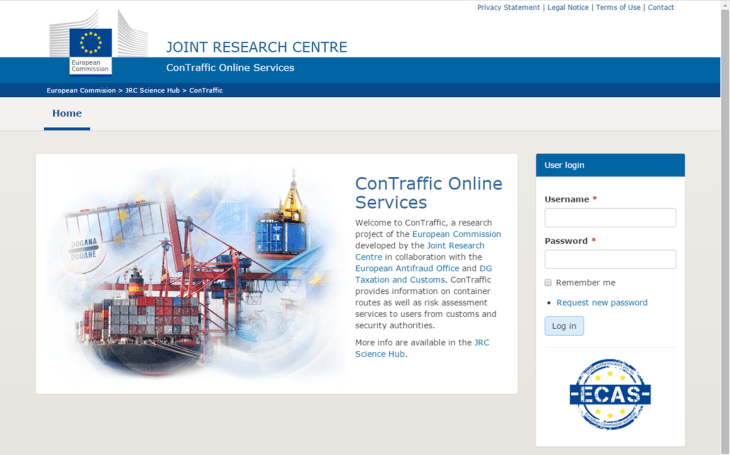
ConTraffic HomepageA new regulation adopted by the European Parliament and the Council will allow customs to access information to track the origins and routes of cargo containers arriving in the EU to support the fight against customs fraud both at EU and national level. The Joint Research Centre (JRC) has been instrumental in the conception and adoption of this legislation as it provided the scientific evidence on the importance of analysing the electronic records on cargo container traffic.

The EU customs authorities have been long aware that information on the logistics and actual routes of cargo containers arriving in Europe is valuable for the fight against customs fraud. However, they had very limited ways to obtain such information and no means to systematically analyse cargo container traffic both for fraud investigations as well as for risk analysis. On the other hand, the ocean carriers that transport the cargo containers, as well as their partners and clients, have easy on-line access to the so-called Container Status Messages (CSM): electronic records which describe the logistics and the routes followed by cargo containers.

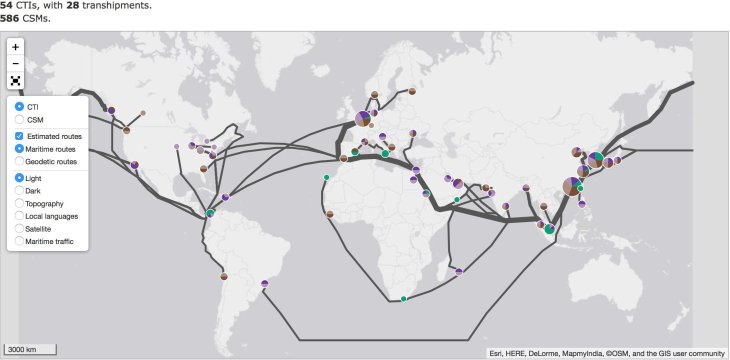
jrc-cargo-container-routes-world-mapIn collaboration with the European Anti-Fraud Office (OLAF), the JRC has worked extensively on how to exploit CSM data for customs anti-fraud purposes. The JRC proposed techniques, developed the necessary technology, and ran long-term experiments involving hundreds of EU customs officers to validate the usefulness of using CSM data. The results of this research led the Commission to bring forward a legislative proposal that would enable Member States and OLAF to systematically use CSM data for these anti-fraud purposes. It also served to convince Member States of the value of the proposed provisions.
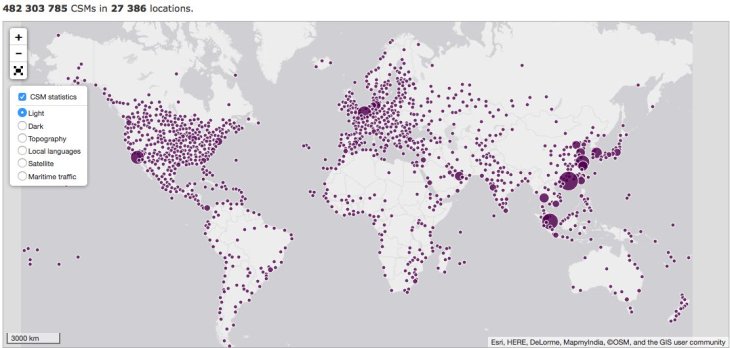
The financial gains from the avoidance of duties, taxes, rates and quantitative limits constitute an incentive to commit fraud and allow the capacity to properly investigate in cases, such as mis-declaration of the origin of imported goods. The information extracted from the CSM data can facilitate the investigation of some types of false origin-declarations. With the new legislation an importer will no longer be able to declare – without raising suspicions – country X as dispatch/origin of goods if these were transported in a cargo container that started in country Z (as indicated by the CSM data).

jrc-csm-dataset-world-map (1)The technologies, know-how and experience in handling CSM data, developed by the JRC through its experimental ConTraffic platform, will be used by OLAF to set up the system needed to implement this new legislation applicable as from 1 September 2016. The JRC will continue to analyse large datasets of CSM records (hundreds of millions per year) as these are expected to be made available through the new legislation and will continue to support not only this new regulation but to exploit the further uses of this data notably for security and safety and real-time operations. Its focus will be on data mining, new automated analysis techniques and domain-specific visual analytics methods. Source and Images: EU Commission
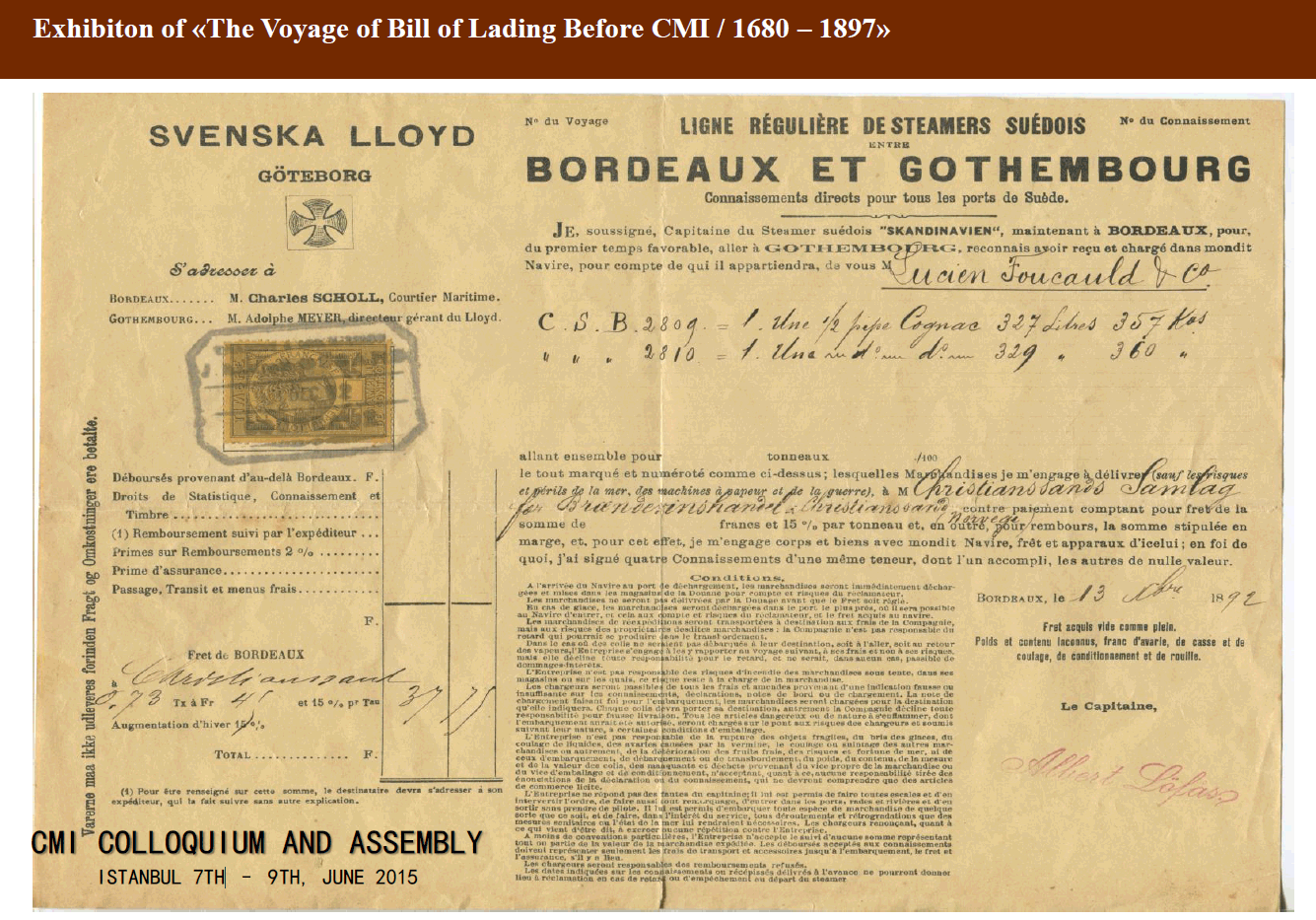
A collection of Bills of Lading

BoLAn article about a collector of Bills of Lading can be found on the Hariesh Manaadiar’s very popular educational blog Shipping and Freight Resource. Follow the hyperlink below –

Source: A collection of Bills of Lading

Devastation at Port of Tianjin

IT System to Transform SA Ports into ‘smartPORTS’

At the launch of Transnet National Ports Authority's new Integrated Port Management System (IPMS) [Transnet]

At the launch of Transnet National Ports Authority’s new Integrated Port Management System (IPMS) [Transnet]

Transnet National Ports Authority’s new web-based Integrated Port Management System (IPMS) went live on 26 July at the pilot site, the Port of Durban, with the crude oil tanker, Colorado, the first to be brought into the port using the new system.

Developed by Navayuga Infotech, a company based in India, in collaboration with their South African partner Nambiti Technologies, the IPMS is a strategic project that aims to support the broader objectives of the Transnet Market Demand Strategy (MDS) in terms of efficiency and productivity.

The project will cost TNPA around R79 million for the entire system, for all eight South African ports, covering concept development, architecture, implementation and rollout.

TNPA Chief Executive, Richard Vallihu, said: “Since 2008, various feasibility studies were undertaken where we identified the need for an automated and web-based system to improve port operations, strengthen efficiencies and enhance competitiveness. This online system will help transform our ocean gateways into smartPORTs by using advanced information technology that will make them more intelligent and sustainable, while conserving resources, time, space and energy.”
The system replaces manual processes, with key port operations now set to be automated, online and in real time.

Vallihu said the IPMS was benchmarked against Malaysian and Singaporean ports which were among the world’s most efficient. The IPMS system will be a groundbreaking initiative in that for the first time in the world a system such as this is integrated across multiple ports on a single platform.

“For us as a customer-focused organisation this state-of-the-art information technology will ensure that port information and processes are transparent and easily accessible to users throughout the South African port logistics chain,” he said.

Yugen Reddy of Sharaf Shipping Agency was excited about being able to work more efficiently. “My role as an agent is to make sure that ships are in and out of the port as quick as possible because time is money. With IPMS we will be able to use our smart phones or tablets while we’re out and about to update the system and get acknowledgment from TNPA on the spot with regards to sailing or berthing of vessels,” he said.

Vessel agent, Londa Small of Thembani Shipping agreed. “I am optimistic about the IPMS system because everything’s going to be in real-time enabling quicker turnaround,” he said.

IPMS will link to Transnet Freight Rail’s Integrated Train Plan (ITP) and Train Execution Management System (TEMS). It is also integrated with global systems such as Lloyds Register, AIS (for vessel traffic management), IPOSS (for weather), EDI (Electronic Data Interchange) and SAP (for business operations, customer relations and finance).

From Durban the project team will move on to Cape Town and Saldanha, then Port Elizabeth, Ngqura and East London and finally to Richards Bay and Mossel Bay.

TNPA conducted daily intensive training for internal and external users at the Maritime School of Excellence in Durban during June. Source: Transnet