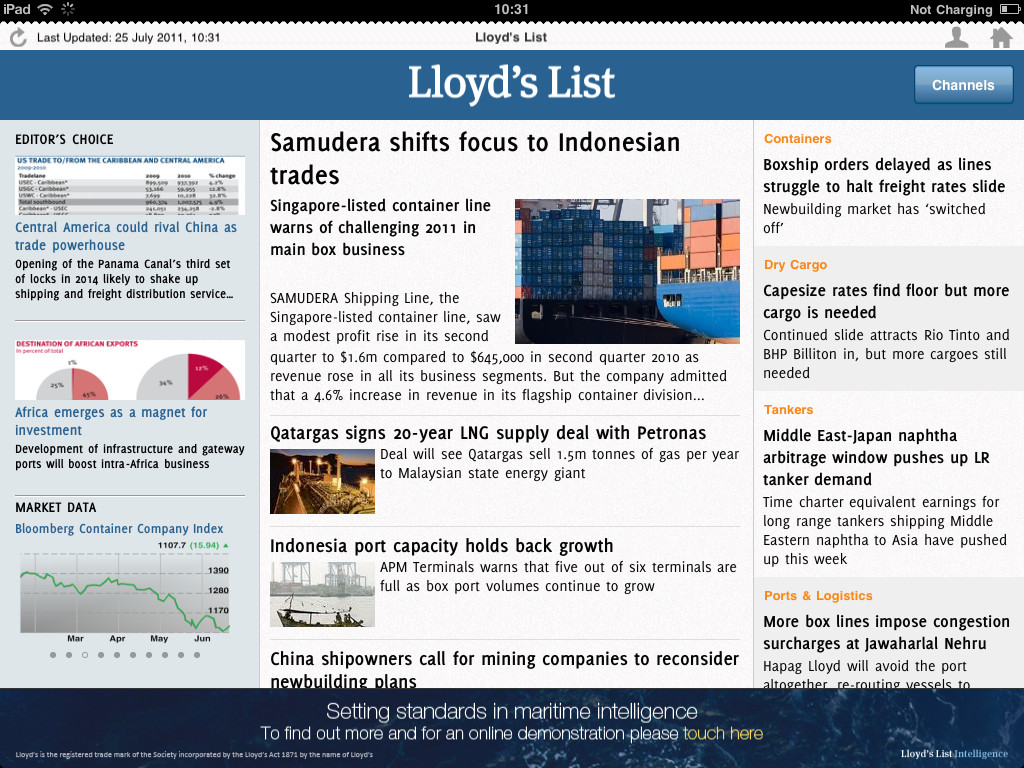
The Lloyd’s List App enables subscribers to access current news and market data anytime and anywhere. Once the news is uploaded, it is “cached” within the app, giving users the ability to read the latest headlines on the go without an internet connection. Stories are arranged in recency and categorised into channels Containers, Dry Cargo, Tankers, Ports & Logistics, Finance & Markets, Insurance, Ship Operations, and Regulation. Lloyd’s List subscribers can simply use their existing login details to access the new App. The App is free to download and has been formatted in keeping with mobile devices while retaining the familiar feel of Lloyd’s List.
Category / International Shipping
New Zealand Time Release Study 2010
 Besides rugby, the Kiwis also do Customs pretty well. It is clear that Customs administrations outside of a revenue authority model can place more time and emphasis on the things that are meaningful. Perhaps South Africa will soon attain this level of performance reporting. Before this however, the ability of the impacted parties to report both spontaneously and reliably is a given.
The trading community are directly impacted by the response times. Not only does it affect whether or not storage and demurrage might occur, it also (more importantly) affects their local and international reputation as suppliers of choice. One of the methods used for the review of clearance procedures is to measure the average time taken between the arrival of the goods and their release. This facilitates Customs to identify both the problem areas and potential corrective actions to increase their efficiency. The use of automation and other sophisticated selectivity methods allow Customs to improve compliance and at the same time improve facilitation for the majority of low risk goods.
The time required to release goods is also increasingly becoming the measure by which the international trading community assesses the effectiveness of a Customs administration. The WCO Time Release Study provides guidance for a Customs administration on the best way to apply this method of internal review.
Shakeup!
Unpacking of the Customs draft Bills reveals more and more surprises – despite the fact that there is still no site of the subordinate rules. Without any shadow of doubt, the ‘clearing and forwarding industry’ will be hardest effected by the ‘change’. Why is this? Well there are a number of factors.
Firstly, this industry has always faced the immediate brunt of the law. Customs historical focus on the goods declaration – to ensure optimum revenue collection – has always relied on a high degree of competence and compliance from this sector. As mentioned before, ITC has made significant inroads in this industry to the extent that specialisation in qualified entry clerks (for instance) is no longer an attribute in this sector. Consequential developments, and in particular, the creation of an deferment scheme gave ‘clearing agents’ even more flexibility to manage cash flow and minimise administrative burden. Several clerks and runners either lost their jobs or were otherwise absorbed in the company. The first round of accreditation also gave forwarding brokers some leverage to accrue their client base. This did however prove ineffective from a compliance point of view especially where shady shippers merely used brokers for their apparent accreditation. Many brokers did however institute due diligence mechanisms to vet existing and prospective clients to ensure their own credibility and compliance with SARS.
Secondly, the specialised skills in valuation, tariff and trade remedies became more difficult to hold onto. This expertise will be found now mostly in the big ‘audit firms’. Still, the larger forwarding houses have retained some of these skills as it is vital to their overall service offerings to local conglomerates and multi-national clients.
Thirdly, the emergence of ITC service providers has likewise created a niche industry that for all intents and purposes seeks increased business knowledge and understanding of the customs compliance regime. Growth in this sector can be attributed to an organic increase in the need to service a greater and more mechanised supply chain. This has been particularly beneficial to the Customs Modernisation Programme as these entities have been relied on to champion the ICT change externally for Customs.
Naturally, the ‘clearing and forwarding’ sector will bound to feel some pain, as there would appear to be no less emphasis of Customs’ pressure on them to maintain ‘seemingly impossible’ levels of compliance. Forwarders would also no doubt feel some level of grievance in that there is still no visibility of parity in the supply chain. By this I mean the allocation and expectation of binding agreements (legal obligations) by SARS on other supply chain operators – carriers, transit sheds, terminals, etc. Truthfully, this is being done albeit slow and tedious.
Change, despite all the anxiety it creates, brings about opportunity. My wish is that all parties recognise this and make the best of the situation, irrespective of the challenges. In this latter regard challenges relate to the mercenary-like approach of some role-players versus, honesty and business acumen of others. In todays’ world, being scrupulous and morally right does not always translate into being successful or prosperous. Modernisation implies that everyone changes! Some casualties are inevitable.
Next up: We’ll discuss the attributes of the bills in terms of liability, compliance and punitive measures.
Securing the Global Supply Chain Without U.S. Leadership
In 2007 the European Union’s Framework Programme for Research and Technological Development (FP7) was established as “…a key tool to respond to Europe’s needs in terms of jobs and competitiveness, and to maintain leadership in the global knowledge economy.”
A new research component called the SMART-CM project (SMART Container Chain Management) was created within the 7th Framework Programme. Its purpose is to … advance technology implementation and research in order to overhaul the complete container door-to-door transport chain so that it is more efficient, secure, market driven, and competitive. It systematically analyses current processes and systems, produces new innovative concepts for processes and technologies, and demonstrates all these in a set of 2 world scale Demonstrators covering 4 supply chain corridors.
Read the full article – Securing the Global Supply Chain Without U.S. Leadership.
Contrasting fortunes for Freight Forwarders
Freight forwarder associations were celebrating this week after helping force through changes to the International Air Transport Association’s (IATA) Cargo Accounts Settlement System (CASS) in Europe, which could save forwarders having to provide bank guarantees of up to £400,000 (US$655,440). On the other side of the globe, in the US, two US Congressmen have introduced a bill aimed at clamping down on fraudulent brokers and freight forwarders.
The British International Freight Association (BIFA) said that until the recent global financial crisis, the requirement for forwarders, when appropriate, to undergo a financial assessment by IATA had largely been dormant. However, the crisis had sparked a u-turn by IATA, with European forwarders having to undergo financial assessment, and as a consequence, provide CASS with a bank guarantee.
One member, it said, had been faced with having to provide a £400,000 guarantee. However, BIFA along with international freight forwarder association FIATA managed to get this requirement overturned after a small working group – of BIFA, FIATA and IATA – was established through a meeting of the European Air Cargo Programme (EACP) joint council.
In the US, Congressmen Russ Carnahan and Frank Guinta’s bill has won the backing of the US-based Owner-Operator Independent Drivers Association (OOIDA), the Transportation Intermediaries Association (TIA) and the powerful American Trucking Association (ATA). The Fighting Fraud in Transportation Act 2011 would put a stop to a system that allows ruthless brokers and scam artists to continue to operate unchecked. Moreover it would require brokers and freight forwarders to carry a US$100,000 bond rather than the current requirement of $10,000. It would also improve transparency of those seeking to become brokers and establish “significant” penalties, including unlimited liability for freight charges, for those operating without authority. The TIA believes brokers, forwarders, owner-operators and carriers need each other, and the speed of today’s logistics marketplace means that companies must be able to reasonably rely on representations made in the terms of their agreement.
Just goes to show the power of lobbying!
The mystery of the identity of the carrier on an inland haulage leg
Herewith an interesting article on a topic which many of us in the customs and supply chain industry are not always fully aware of – authored by Tony Norton and Crispen Camp of Edward Nathan Sonnenbergs.
Over ninety percent of the world‟s commodities are transported by sea. Since the 1960‟s, containerised cargo has steadily grown to become the leading means by which goods are transported across the world‟s oceans.
Importers of containerised cargo have to consider a number of factors when contemplating the most cost-effective means to bring about the importation of their goods. These factors include the financing of the transaction, insurance, customs duties as well as how the goods are to be conveyed. Importers that have their places of business located at an inland destination, such as Johannesburg, also have to consider who will undertake the onward carriage to Johannesburg from a discharge port such as Durban.
The contracts which govern the conveyance of the cargo are in most cases evidenced by the terms of documents known as „bills of lading‟. Bills of lading traditionally perform three functions, namely: they act as a receipt by the carrier of the cargo concerned; they evidence the terms of the contract of carriage, and they reflect the entitlement of the holder thereof to the goods.
The parties reflected on the Bill of lading are ordinarily the shipping line engaged to transport the goods which is reflected as the carrier, the shipper of cargo and the party to whom the cargo has been consigned.
The terms of the agreement of sale concluded between the exporter and importer of the cargo will impose the obligation on one of the two parties to arrange the transport of the cargo to either the discharge port, for example, Durban, or point of final destination, for example, Johannesburg. Where the agreement of sale does not impose a duty on the exporter to arrange the transport of the cargo to final destination, the importer will have to arrange to do so.
Where an importer has to arrange for the transport of cargo to an inland destination it can do so by a number of different methods.
Firstly, it can make its own arrangements to contract a local road or rail haulier to do so. This is generally known as “merchant haulage” in that it is the merchant or receiver that contracts for the haulage, which has nothing whatsoever to do with the ocean carrier. In those circumstances, if the cargo is lost or damaged en route on the land leg between, say, Durban and Johannesburg, the merchant looks directly to the local road or rail haulier and not to the ocean carrier for compensation. Of course the advantage for importer in choosing to arrange for the onward carriage of the cargo to Johannesburg is that it will be in a position to negotiate transport rates with its nominated road haulage company.
Secondly, the importer can arrange to ensure that the bill of lading contract for the carriage of the cargo extends to Johannesburg, in which event the land leg is generally known as being covered by “carrier haulage”, with the ocean carrier being directly responsible for any loss of, or damage to, the cargo during that leg subject to the terms of the bill of lading concerned.
Lastly, there is a third variation which is commonly and misleadingly known as “carrier assisted haulage” or “carrier haulage”. This is when the importer approaches the ships agent of the ocean carrier to arrange for the on carriage of the cargo from the discharge port, for example, Durban, to the point of final destination, for example, Johannesburg. However, the ships agent generally has no authority from the ocean carrier in these circumstances to agree to extend the ocean carriage to a point of final destination and any assistance rendered by the ships agent in this respect is generally intended by the ships agent to be rendered with the importer as principal so that the contract for the road or rail haulage is directly between the road or rail haulier and the importer, and not between the ocean carrier or the ships agent, on the one hand, and the importer, on the other.
The problem here is that the correspondence between the parties in this respect does often not clearly reflect that intention, with the term “carrier haulage” or “carrier assisted haulage” leaving the importer with the impression that the ocean carrier or the ships agent is responsible for the road or rail haulage of the cargo and the actual agreement between the ships agent and the importer not clearly reflecting who is responsible one way or another.
As a general rule of thumb importers should be aware of the fact that if the contract of carriage in the bill of lading does not extend to the inland point of final destination, it is unlikely that the ocean carrier will assume responsibility for the road or rail haulage concerned. In those circumstances, the agreement for the road or rail haulage with the ships agent concerned should be closely examined and clarified to ascertain who the responsible party is for the road or rail haulage leg. Generally it will be found that the intention is that it is the road or rail haulier contracted by the ships agent, on behalf of the importer, notwithstanding the term “carrier haulage” or “carrier assisted haulage” applied to that situation.
In an ever increasing globalised world economy, the transportation of containerised goods will only continue to expand and, in this environment, importers of goods will have to consider numerous factors along the import chain, not least of which will be whether or not to conclude land leg merchant or carrier haulage contracts or variants thereof and to properly understand the significance of them.
Source: Lexology.com
Related articles
- What is the difference between Carrier Haulage & Merchant Haulage..?? What are the implications..?? (theshippingblog.wordpress.com)
Shipping lines get tough over new EU cargo information rules
Seems like ‘cargo reporting’ is becoming as infectious as a virus! The shipping industry has warned its customers that failure to comply with new EU regulations will mean fines and their cargo will not be loaded. Following similar measures introduced by the US in 2002, it seems that not only is there a possibility of “fines” and “no loading of cargo”, but that shipping lines even get to cash in on a revenue opportunity; some to the extent of US$25 per bill of lading. It absolutely amazes me that this is allowed to happen – talk about non-tariff barriers! While SARS, for example, can give thousands of ZA Rands worth of intellectual property (for free) to the trading community – with the hope of making trading easier – why can the bastions of the sea not do likewise? Seems as though the “war on terror” has been interpreted by some as a ‘cash cow’! Read the full article online: www.bdpinternational.com.
Penalties for non-compliant Cargo Reporters
Recently SARS issued a communication signalling its intention to penalise non-conforming cargo reporters as of 1 July 2011, if they fail to report their cargo manifests electronically to SARS. Following international practice, all parties who engage in the contract of carriage of goods internationally are obliged to report the details of such cargoes. While customs has traditionally placed more emphasis on the correctness of the goods declaration alone – due to it being the sole means of duty and tax assessment and collection of revenue, the introduction of measures to safeguard the supply chain and combat other forms of nefarious activities, implies that all supply chain operators are ‘known’ and share in the responsibility for their actions and activities.
Perhaps seen in this guise, the whole matter of supply chain security encompassing the universal adoption of the Authorised Economic Operator (AEO) concept seems less appealing than it did a few years ago. Yes, Customs wants to know more and more about your business and who you do business with. Freight forwarders / Clearing Brokers have borne much of the brunt from customs over the years, it’s now time for parties involved in the conveyance of cargoes to come forward and be counted.
Because international shipping by its very nature transcends borders, it has always been difficult for national authorities to apply effective controls over information and parties who in all honesty are representatives/agents for those supplying the ‘original’ shipping documents. What the law now says is that those acting on behalf of foreign principles, liable for the import leg of imported goods are obligated to submit the ‘manifest information’ of those goods (electronically) to SARS.
For those customs brokers who operate as freight forwarders, this is in essence a further requirement which SARS places on your organisation. In essence a freight forwarder has a dual requirement with SARS – declaring the manifested contents of a consignment, as well as making due clearance for regulatory compliance and payment of duties. Another party with a similar dilemma are certain ‘ground handlers’, specifically those who are contractually responsible for the inbound operations of foreign air carriers, as well as the deconsolidation of aircargo upon arrival in their transit shed. They too must report the aircargo manifests electronically to SARS, and secondly to report the outturn of such goods, once unpacked for temporary storage and customs clearance and release.
The NVOCC or Vessel’s Agent must also report all cargo – for which they are contractually responsible – for the inbound leg into the Republic. These parties represent the foreign carrier and must consequentially report the carrier’s manifest (electronically) to SARS.
SARS is for now focussing principally on the reporting of master and house (sea and air)cargo manifests in this phase. Other reports are to follow.
Details for the registration for reporting electronically to SARS’ Automated Cargo Management (ACM) system have been widely distributed, and for sake of convenience are available for download here.
Consequences for non-compliance post 1 July 2011
SARS has put into place mechanisms to identify non-reporters. In such instances customs officers will call for administrative penalties to the extent of R1000,00 for each ‘manifest’ not reported. Moreover, should SARS take measures to ensure that these penalties are not ‘passed on’ to the importer – this would surely defeat the object of SARS’ intentions? Shortly, we’ll discuss the future matching of electronic cargo reports and goods declarations, but first lets endeavour to accomplish the first milestone.
Related articles
- Addressing Apathetic Compliance Mentality – Part 2 (mpoverello.wordpress.com)
- Addressing Apathetic Compliance Mentality – Part 3 (mpoverello.wordpress.com)
- Addressing Apathetic Compliance Mentality – Part 1 (mpoverello.wordpress.com)
- Automated Cargo Management – Whipping up Industry Awareness (mpoverello.wordpress.com)
Durban’s Dugout Port Proposal – Reality or Pipe Dream?
 I received these pictures in an e-mail today. 15 minutes of surfing (the web kind) reveals plans by Transnet to procure the old Durban International Airport site from ACSA and dugout a new port to meet future demand and ensure that Durban remains Africa’s busiest port. Point of correction, Durban Harbour seeded this title to Port Said in Egypt a few years ago, so it would appear someone has a grandiose plan to bring about a mega development which is all honesty is ludicrous given the under-utilisation of Port of Ngqura (Coega) and its adjacent ‘white elephant’, the Coega Industrial Development Zone (IDZ). Government realised after 10 years that Coega was not a great strategic investment. Current levels of activity at Ngqura are due largely to volumes since diverted from Port Elizabeth container terminal and some new transhipment activity. As long as South African high port charges, piracy up the east coast of Africa and the efficiency of the Suez Canal persist, it is highly unlikely that the shipping conferences are going to increase their traffic around the southern tip of Africa.
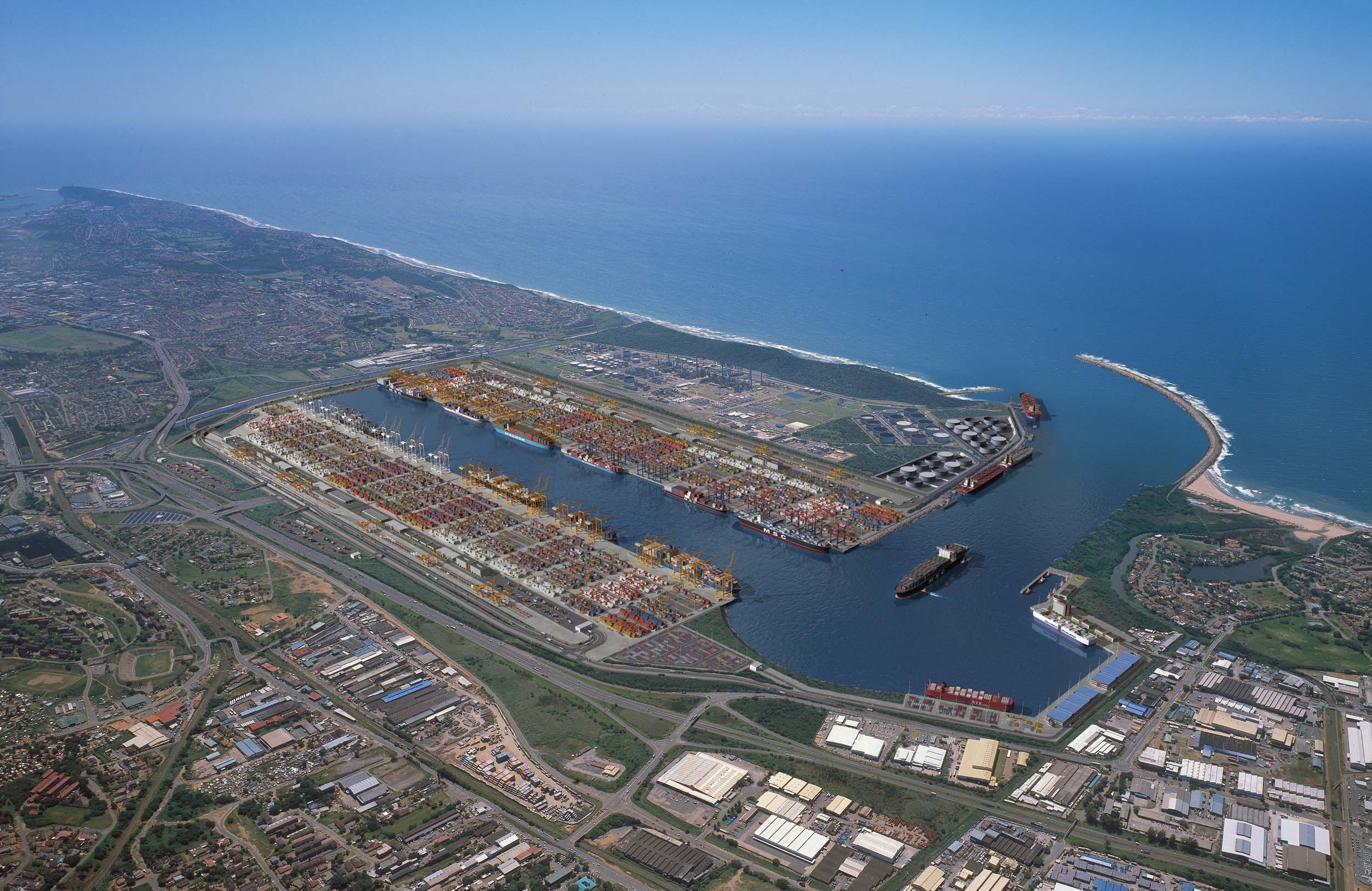 The dugout development cost is estimated at R50 billion, with a further R100 billion to be spent on infrastructure and inland logistics. Was FIFA 2010 not sufficient warning on over-capitalisation with limited return? Unless our ports and inland logistics pipelines begin offering significant advantages over Namport, Maputo and Beira, developments such as the old Durban airport will never realise its fullest potential. It has to be admitted that the concept is brilliant and awe inspiring, but realisation of such is but a daunting pipe dream, me thinks! Transnet chairman Mafika Mkwanazi, is most optimistic insisting that the project will happen with development needing to commence in 2015 to be ready for 2019. I would like to share in this optimism but not at the expense of the taxpayer. Source: IOLProperty.co.za
Thinking out-of-the-box
If container shipping is to assure itself of a licence to operate in the future, the industry needs to change now. No more battles on rates; instead, shipping lines should be giving customers what they really want. This is the view of MAERSK Line CEO Eivind Kolding. The challenge being posed for container shipping is the following:
- What if we could guarantee that cargo would be on time, every time?
- What if placing a shipping order was as easy as buying an airline ticket?
- What if the shipping industry was known for beating environmental expectations — not struggling to meet them?
The company has recently launched a manifesto on the need for change. A campaign site – www.changingthewaywethinkaboutshipping.com — has been set up to host the discussion with all stakeholders in the industry. Even sceptics are encouraged to participate! Source: MAERSK website.
More iTunes Gadgets for the Shipping Industry
 How about this free Safmarine app. for iPhone and the iPad. Look for the latest up-to-date sailing schedules by origin and destination locations, together with transit times and vessel names. Trace your cargo by entering your container, booking or bill of lading number. Via the ‘hotlist’ you can store your most important searches for easy reuse later on. Containers saved in the hotlist are monitored actively and you will be notified when your container has moved. View the location and contact details of our country offices with a simple look-up or find the nearest office via your iphone’s GPS.
Addressing Apathetic Compliance Mentality – Part 3
In conclusion of this topic, let’s consider the importance of both cargo and goods clearance. The goods declaration attests to the admissibility of goods according to the Customs tariff, valuation, origin, and all other government regulatory requirements. The cargo declaration and associated cargo reports allow Customs to confirm that what has been cleared has in fact been physically out-turned and accounted for. Moreover, in the case of transit movements, it allows Customs to track cargo movements.
It is therefore not difficult to understand that any non-participating party will undoubtedly impact on whether or not an importer receives his/her goods timeously. It is true to state that until now, the emphasis on valid clearance and release has been placed at the doorstep of the clearing and forwarding agent – the party that presents the goods declaration to Customs. In essence this is little more than a data validation exercise. It does not in any way prove the location of the goods, and the quantities received. Neither does it prove that the correct formalities have been applied as concerns the handling and temporary storage of the goods upon arrival.
What benefit is this to the country if Customs can only satisfactorily control the goods declaration? For exports this is even more nonsensical – after clearing goods for export, how often does it happen that no physical shipment leaves the country for one or other reason; and in such instances are these transactions cancelled with Customs? True, Customs should not be a barrier to trade, but it must still account to the fiscus and trade and industry with accurate trade statistics. Therefore, Customs information requirements are crucial to much more than just the clearance of goods. The SA Reserve Bank is likewise a recipient of Customs data whereupon it monitors foreign exchange and payments.
The difference now is that SARS requires this information in advance, and electronically. To re-iterate – the first phase of ACM is to ensure the registration of all sea and air cargo reporters and the consequential compliance of the cargo data which they submit. As alluded to in Part 2, SARS will continue its liaison with the business community and will mobilise campaigns shortly to get all remaining parties registered. Supply chain security is a myth if certain operators fly under the radar. The consequence of non-participation implies that importers (and exporters) will unwittingly find themselves at the wrong end the stick once SARS commences formal manifest/declaration matching.
Should SARS penalise the importer, exporter or clearance broker, where a cargo reporter fails to submit a manifest? Certainly not, the consequential delay of the latter’s action would have already damaged the his/her reputation, if not the viability of the consignment concerned. Therefore it is important for any ‘qualifying’ cargo reporter to come forward and register. As unsettling as this may sound, it is the best way to clean up the industry and bring it in line with requirements that are ‘standard’ practice in other parts of the world.
Interested parties can open the ACM Fact File, which provides the necessary details and information for registration. Further details will also be available on the Customs Modernisation webpage, shortly.
Research stuff: Supply Chain, Optimization and Compliance
Logistics operators, shippers, trade practitioners and customs officials will all find something useful visiting Management Dynamics Incorporated. They provide several white papers of educational interest. So if you’re looking for information relating to current trends in international shipping, this is a good place to start.
 What Happened to the Portcullis?
You must be logged in to post a comment.