Boosting Transshipment: Kenya Lifts Cargo Stripping Ban

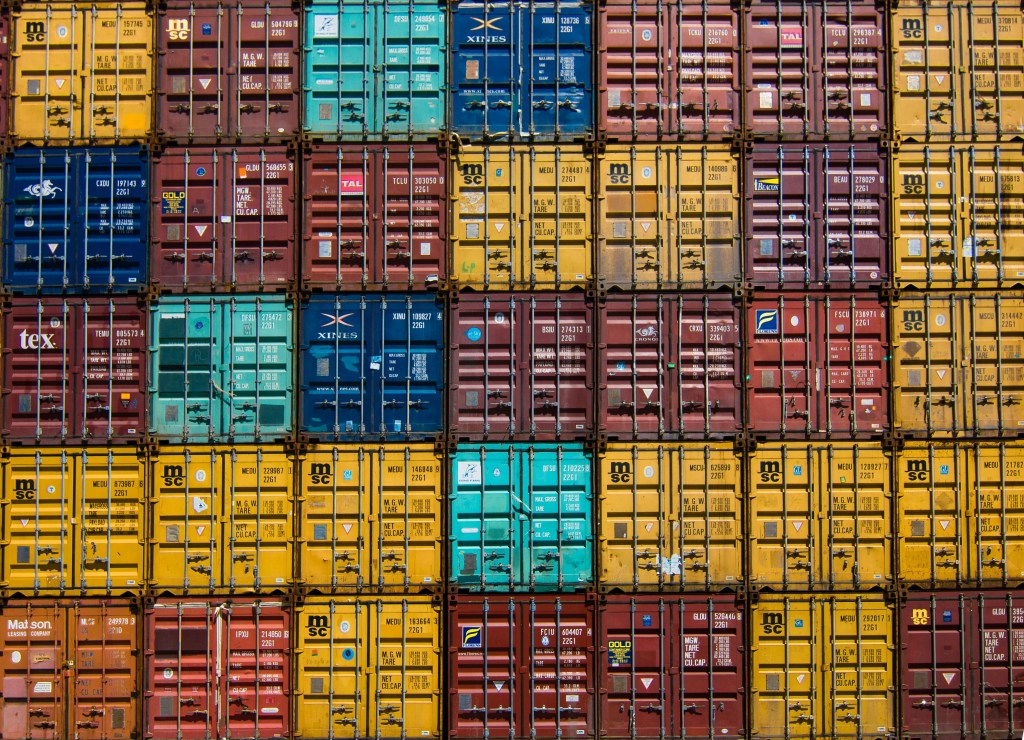
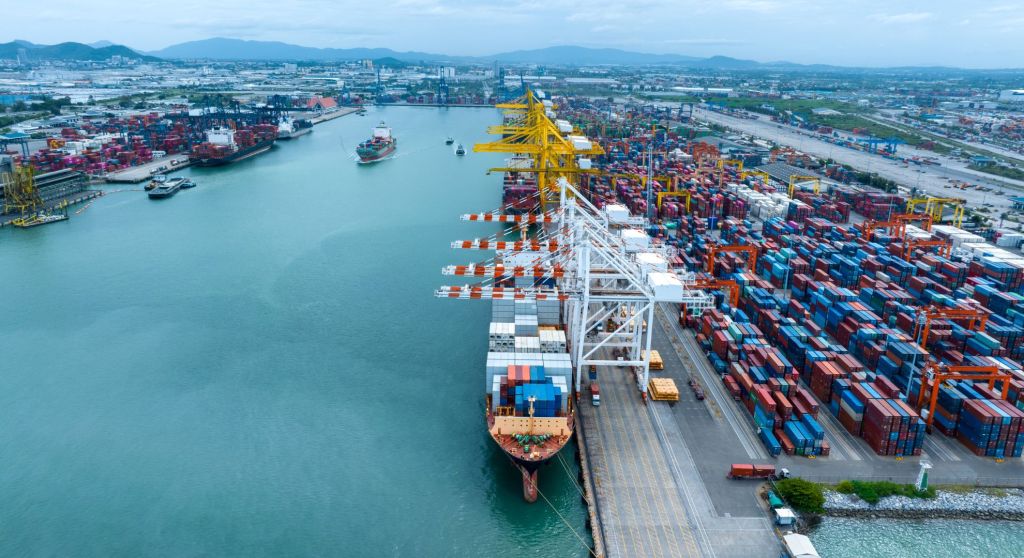
Mombasa port projects an increase in transshipment cargo after Kenya lifted the seven-year ban of stripping of cargo in containers at the port before onward delivery by dhows and barges to Zanzibar and Pemba.

The Kenya Revenue Authority (KRA) announced reintroduction of stripping, which is destuffing containerised cargo, after putting in place measures to curb smuggling, where before cargo is diverted in the ocean and finds its way into the East African Community (EAC) market.

The move is expected to cut the cost of container charges, considering that the boxes will be returned to the shipping line on time, since they will not be leaving the port as before.

Millers Association’s representative at the Mombasa port Naseeb Mbarak said the reintroduction of stripping would reduce the cost of transporting cargo to Zanzibar and Pemba by returning containers on time. 

“Smaller traders will also benefit out of this as they can now import in groups,” he said. Mombasa-based clearing and forwarding agent Roy Mwanthi said the two destinations are the main transshipment destinations for Mombasa and the move will increase cargo numbers.

“Last year, Mombasa registered exceptional growth in transshipment traffic, which recorded 491,666 twenty-feet equivalent units (Teus), reflecting an extraordinary increase of 280,593 Teus and translating into 132.9 percent growth against 2023. With these numbers, stripping will surpass 500,000 units which will mean more Mombasa port revenues,” Mr Mwanthi said.

In 2018, the KRA in a public notice banned the stripping of containers destined for Zanzibar and Pemba. Before the ban, cargo destined for Zanzibar was being redirected to ports closer to the destination, such as Dar es Salaam, Tanga, or Zanzibar itself under a different manifest.

In November 2022, the Tanzania Revenue Authority (TRA) wrote to KRA requesting a review of the ban on stripping to facilitate their importers in Zanzibar and Pemba. 

“KRA reviewed the same and granted indulgence on the stripping of cargo to Zanzibar and Pemba under conditions. In this regard, the earlier public notice issued is hereby set aside in line with this communication,” said the notice by KRA.

Before the ban, the volumes of cooking oil and other food stuff destined for Pemba and Zanzibar surpassed the consumption capacity of the two islands as a result of cargo diversion and smuggling.

KRA also seized different products, including edible oil cleared at Old Port in the go-downs of Mombasa, emanating from cargo stripped at the port of Mombasa.

To avert cargo diversion and control stripping, the KRA has prohibited changing the status of goods through manifest amendments.

The taxman said goods from the port of Mombasa have to be entered under the Single Customs Territory Framework (SCT) in Zanzibar before they are allowed into the islands.

“The shipments are to be cleared under SCT arrangement on duty paid basis and verified by TRA (Tanzania Revenue Authority) officers stationed in Mombasa before stripping and shipment. KRA enforcement to supervise stripping and loading of the cargo in the port before shipment,” read the notice dated April 8, 2025, and signed by customs officer Nicholas Ngeera.

Mr Ngeera said KRA will continue to liaise with the Kenya Ports Authority (KPA) to ensure that standard operating procedures and best practices on transshipment are implemented to protect and facilitate legitimate business.

Investigations by KRA and TRA show risks and challenges regarding transshipment cargo stripped at the port of Mombasa with increased cases of smuggling adversely Zanzibar islands and Pemba reported.

KRA also flagged med prolonged risks posed by stripping of cargo at the Port of Mombasa.

Last month, while in Mombasa, Zanzibar’s Minister of State in the President’s Office (Labour, Economy, and Investments), Sharif Ali Sharif, said delays in cargo delivery from Mombasa have historically caused shortages and price hikes in Zanzibar thus need to streamline transshipment process.

“Our cargo from China and the Middle East is first offloaded in Mombasa but, due to a lack of reliable transshipment, it often takes weeks or even months to reach Zanzibar. This has contributed to price increase for essential goods,” he said.

He said that the government had introduced tax exemptions and reductions on essential goods to keep prices reasonable.

With stripping of cargo reintroduced, Zanzibar expects a smoother supply of goods and ensures food security and price stability.

Source: The East African, article by Anthony Kitimo
First Containership with Integrated Automation Systems Departs Korea

Picture: Maritime Traffic

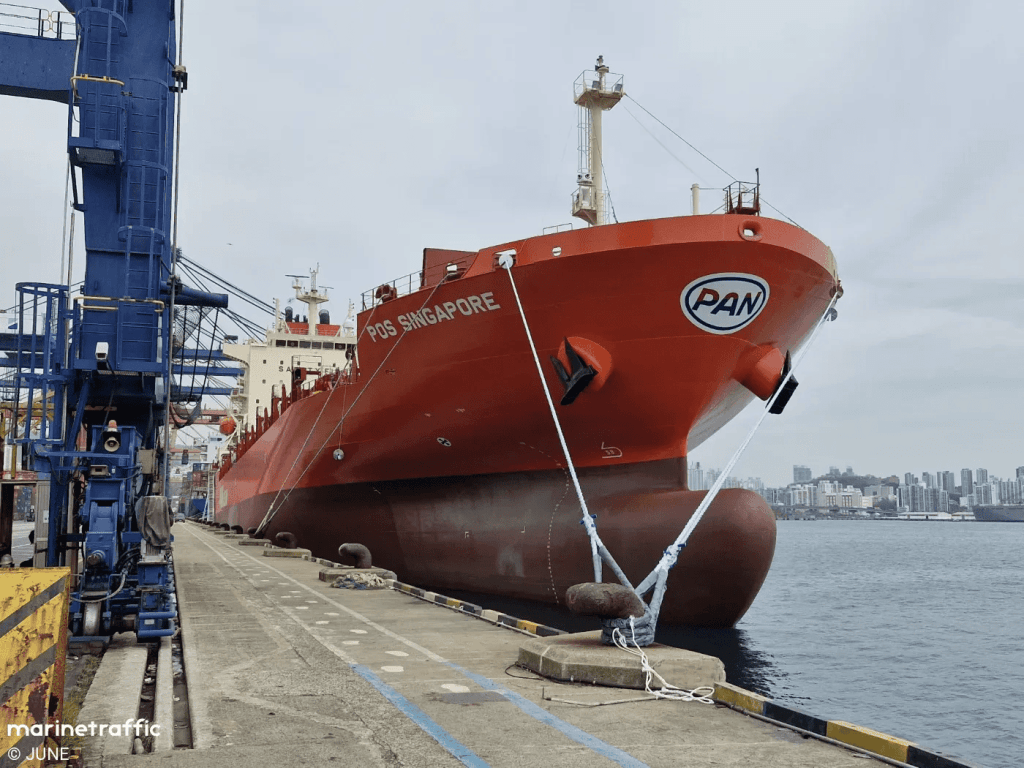
South Korea highlights that the first containership designed with an integrated automation system has completed its installation and testing and is now starting international service. The project which was supported by South Korea’s Ministry of Trade, Industry and Energy and the Ministry of Oceans and Fisheries is designed to advance and commercialize autonomous shipping.

The automation systems for the vessel, POS Singapore (22,867 dwt) were designed in South Korea as part of a government-sponsored program to develop the new technologies. PAN Ocean, South Korea’s bulk shipping company, is participating in the program and worked to integrate the systems into the 1,800 TEU vessel. 

POS Singapore was ordered in 2022 and built by Hyundai Mipo Dockyard in Ulsan. It measures 576 feet (172 meters) in length and is registered in Liberia. The ship was floated in March and delivered in April. Since then, it has been undergoing the outfitting and testing of the automation system.

During today, September 23, sendoff ceremony, government officials highlighted that the ship will be used for the next year in testing and validation of the automation systems. The ship is currently underway bound for Shanghai. It will operate for the next year on routes between Korea and Southeast Asia.

The ship integrates core technologies including intelligent navigation and monitors and interprets the weather conditions for situation awareness and navigation. Other systems provide for engine automation and maintain cybersecurity. The ministries have invested $119 million in the project which they view as a blueprint for the commercialization of automation technology.

Using the results from this year of demonstrations, Korea also looks to lead the development of international standards for the automation of ships. The International Maritime Organization launched the effort to develop the MASS Code (international automation standards). Academics, researchers, and government officials are contributing to the creation of the new standard.

Korea looks to lead the development of automation to create a competitive edge in the next generation of shipbuilding. HD Hyundai led the first test of automation during a Pacific voyage on an LNG carrier in 2022. Korea has conducted additional tests including last year with a smaller domestic cargo ship.  

Source: The Maritime Executive online, 23 September 2024

CMA CGM vessel loses containers off the coast of South Africa

Picture by Guillame Bolduc

Adverse weather conditions impacting South Africa last week have led to yet another large container vessel losing as many as 99 containers off the east coast of South Africa, according to the South African Maritime Safety Authority (SAMSA).

In response, a navigational warning to sailing vessels has been issued and a public call made to report any sighting of the cargo containers possibly still floating at sea.

In a statement at the weekend, SAMSA confirmed that “the CMA CGM Belem, a container ship sailing under the Maltese flag, encountered severe weather off the coast of Richards Bay on Thursday, resulting in a significant stow collapse and a loss of 99 containers.”

“The vessel had initially sought refuge at Maputo Bay. However, after further assessment, the decision was made to redirect the ship to Qheberha. The CMA CGM Belem is currently slow steaming towards Port of Ngqura, with an expected time of arrival on 18 August 2024,” said SAMSA on 17 August.

According to SAMSA, the vessel, built in 2024, measures 336 meters in length, and 51 meters in height, and has a draft of 14.8 meters. The 13,000 TEU vessel is LNG dual-fuelled.

The CMA CGM Belem is the second vessel of its kind and from the same France-based company to be battered by adverse weather conditions while sailing around South Africa’s Indian Ocean area, resulting in substantial loss of containers overboard at sea.

A month ago, the ultra-large container vessel CMA CGM Benjamin Franklin, also Maltese flagged, reportedly lost up to 40 containers in about the same region of the South African Indian Ocean area, while also sailing past the country from Asia to Europe.

Due to its size, it also had to take cover at the deep water port of Ngqurha in Algoa Bay near Gqeberha, Eastern Cape both for shelter as well as an adjustment of its cargo load for the rest of the journey to Europe. A few days later, having been cleared by SAMSA to sail, it departed South Africa, while a search for its lost containers remained alive.

In Pretoria on Saturday, SAMSA said the CMA CGM Belem was also a sizeable vessel best likely to be temporarily, safely berthed at the Eastern Cape’s newest deep-water port in Algoa Bay.

“Given her draft, the Port of Ngqura has been identified as the only suitable port of refuge. Stowage collapses have been confirmed, and the affected containers will need to be discharged at a container port facility upon arrival,” SAMSA added.

Meanwhile, said SAMSA, the owners of the vessel were “cooperating with the Authorities and that a navigational warning has been promulgated for the safety of navigation of other vessels in the vicinity.”

SAMSA added: “Vessels traversing the ocean area, and the public, are requested to report any sightings of the lost containers to the relevant authorities by contacting the Maritime Rescue Coordinating Centre (MRCC) on telephone number 021 938 3300 with the position, number, and colour of the containers observed.”

Source: World Cargo News, dated 19 August 2024

First commercial ships sail through Baltimore’s deep-draft channel

Picture by USACEBaltimore (Twitter/X)

After over a month since the Baltimore bridge collapse, the first commercial vessels have started to move out of the Port of Baltimore via newly opened 35-feet channel.

he first commercial vessels have started to transit through the limited access channel at the Francis Scott Key Bridge site, in conjunction with scheduled passages for a limited number of commercial vessels into and out of the Port of Baltimore, the U.S. Army Corps of Engineers (USACE) said.

The channel, named the Fort McHenry Limited Access Channel, opened on Thursday, April 25 as part of the response effort to the suspension of vessel traffic at the Port of Baltimore, following the collapse of the Key bridge.

The channel has a controlling depth of at least 35 feet (around 11-12 meters) and provides a crucial route for vessels that have been stranded in the Port of Baltimore following the bridge collapse, offering them a path back to the open waters. It is the fourth alternative channel opened near the wreckage site, and runs the length of the northeast side of the federal channel, providing additional access to commercially essential traffic.

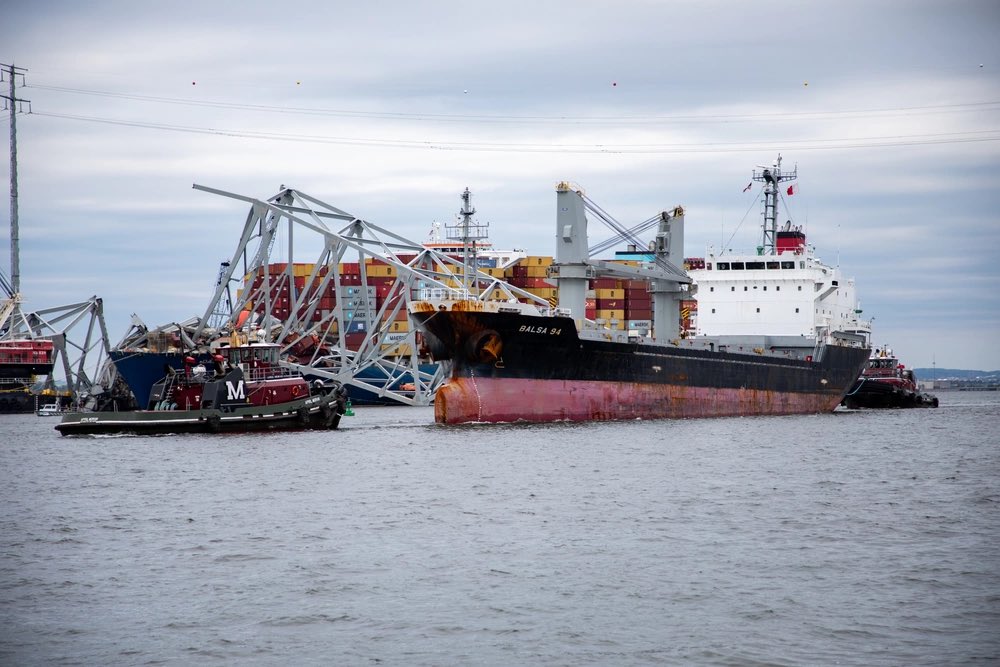
The first vessel to pass the channel was Balsa 94, USACE Baltimore said. Balsa 94 is a general cargo ship built in 2019 and sailing under Panamanian flag. The ship’s registered owner is Eastern Capital Marine from Panama, according to the data from VesselsValue. The ship was guided through the channel by two tugs, and the vessel continued its voyage toward Canada.

Source: World Cargo News, article by Jasmine Ovcina Mantra, 26 April 2024

Port of Durban – to be partially privatised

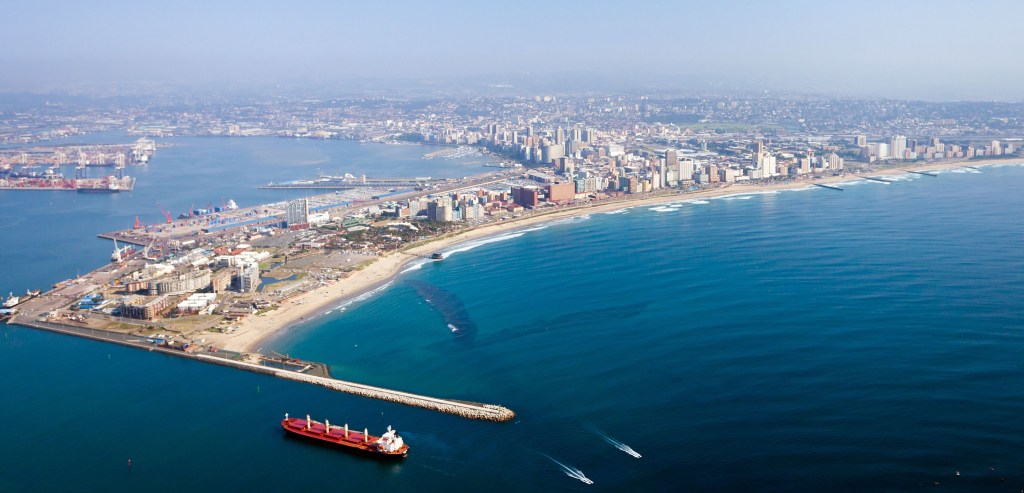
View of Durban city and harbour, South Africa – Hongqi Zhang

Africa’s biggest harbour will be partly owned and operated by the Philippines’ International Container Terminal Services Inc., a first for South Africa’s national ports company.

The company, ICTSI, has been selected as an equity partner to run and expand Durban Container Terminal Pier 2.

Almost three-quarters of the freight volume moved through the eastern port goes through the terminal, accounting for 46% of South Africa’s total port traffic, according to state logistics company Transnet.

This agreement “is a key catalyst for repositioning the Port of Durban as a container hub port,” Transnet said in a statement on Monday.

South Africa is seeking to boost private participation in its ports, the poor performance of which is a drag on the economy. In a 2021 World Bank index of container port performance, Durban ranked 364th out of 370, and two other Transnet ports were in the bottom 10.

Transnet will own a 50% plus one share in a new company that will manage the terminal for 25 years and will seek to boost its annual capacity to 2.8 million twenty-foot equivalent units, or TEU’s, from 2 million, it said. 

Ultimately Transnet wants to boost Durban’s total container capacity to 11.4 million TEUs from 3.3 million.
ICTSI, which operates terminals across six continents, was one of six bidders for the contract, Transnet said. It didn’t specify whether ICTSI will pay for its stake or whether it will have to fund the expansion.

An announcement on the port of Ngqura will follow, Transnet said.

Source: Bloomberg/Daily Investor dated 17 July 2023

World’s largest boxship delivered to MSC

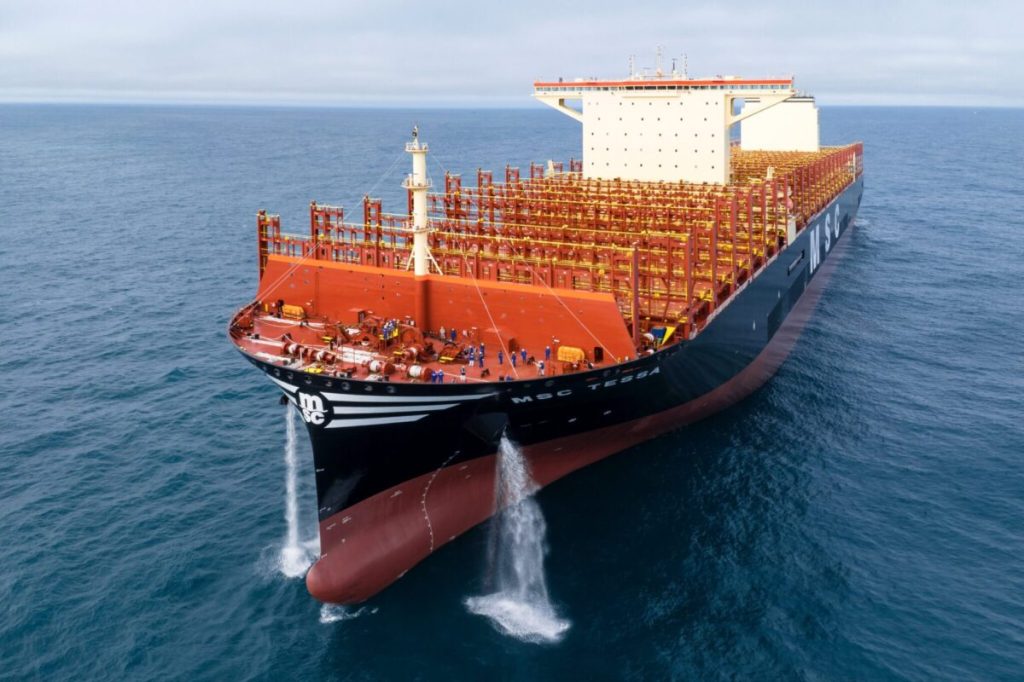
Chinese shipbuilder Hudong-Zhonghua Shipbuilding has delivered the 24,116 TEU MSC Tessa, the world’s largest containership.

The delivery takes place as part of a four-vessel deal with Mediterranean Shipping Company (MSC), worth around $600 million.

MSC Tessa is one of only a handful of ships to surpass the 24,000 TEU mark and is classed by DNV classification society.

According to the shipyard, vessels in the same class measure 1,312 feet in length, making them almost 200 feet longer than a typical aircraft carrier, with a beam of nearly 202 feet.

While the loading configuration varies slightly between different shipyards, all the vessels can stack containers up to 25 layers high.

The MSC Tessa uses air lubrication, reducing its energy consumption and carbon emissions by between 3 per cent and 4 per cent. It is also fitted with a hybrid scrubber, a small bulbous bow, large diameter propellers and energy-saving ducts.

The giant vessel will be calling at Rotterdam, Antwerp, and Felixstowe in Northern Europe, with a call at Tanger during the return trip, before proceeding to Singapore.

Hudong-Zhonghua Shipbuilding Group reported that the second ship on order from the series has completed sea trials and that the third and fourth containerships are also under construction.

The Swiss-based container shipping giant has the largest order book in the industry with around 131 containerships on order, according to Alphaliner.

The ships are scheduled for delivery in 2023, with orders spread between Chinese and South Korean shipbuilding majors.

Upon completion, the 14 new Ultra Large Container Vessels (ULCVs) ordered by MSC will constitute one-third of the company’s current fleet, with a combined capacity of 1.7 million TEU.

Although the current ships run on conventional fuel, MSC is venturing into the use of more sustainable options, such as biofuels and LNG dual-fuel vessels. The company has already conducted tests with biofuels and plans to increase its usage in the near future.

Additionally, MSC has recently ordered its first ammonia-ready designs, which are being built in China.

Source: PortTechnology, article by Marghertia Bruno, dated 10 March 2023

Digital FIATA Bill of Lading, to be launched for SAAFF members and exporters in South Africa

The introduction of the new generation digital FIATA Bill of Lading (FBL) has been confirmed and will be launched by the South African Association of Freight Forwarders (SAAFF) as a new standard to members and exporters for use across the Supply Chain in South Africa.
 
This development will positively impact supply chain efficiencies and South Africa’s competitive position as a provider of world class logistics services, says Dr Juanita Maree, Chief Executive Officer of SAAFF.
 
South Africa hosted the Annual Rotational Presidency meeting of the International Federation of Freight Forwarders (FIATA) in Cape Town earlier this month. The FIATA delegation, led by President Ivan Petrov had the opportunity to delve deeper into the South African supply chain logistics sector during their visit, in consultation with industry leaders. Terry Gale, representing Exporters Western Cape and the Fresh Produce Exporters Forum (FPEF) welcomed the imminent introduction of the digital FBL.
 
Industry recognises the digital FBL and its proven tracking service as a strong solution that will add capacity and increase security of cargo movement through the entire logistics process – a valuable development in a challenging trading environment.
 
In global terms, the Bill of Lading is recognised as the most important document used in the transportation of goods, FIATA’s Multimodal Transport Bill of Lading is seen as the benchmark; long-standing but in constant evolution and acknowledged by the International Chamber of Commerce (ICC) as a document fully aligned to the UNCTAD/ICC Rules for Multimodal Transport.
 
This new generation secured digital FBL and tracking solution allows FIATA to protect against fraudulent manipulation and to promote a digital ecosystem of trust for transport and trade documents. It supports transparency and security across the supply chain and will help member companies accelerate their digitalisation efforts. The digital FBL data model is fully aligned with the UN/CEFACT MMT Reference data model to ensure its interoperability with other standards and all trade parties.
 
Verifiable at any time by legitimate stakeholders interacting with the document, which dramatically reduces fraud risk, the digital FBL can be issued in digital and paper format and cannot be tampered with, with each document also being recorded on an immutable ledger. Stakeholders will be able to access the document audit trail through a unique QR code or on FIATA’s verification portal to certify the validity of the document, the integrity of its issuer and the integrity of its content.

The tracking solution used by FIATA for the digital FBL is already implemented and used by banks, corporates, warehouses, and inspection companies to protect other documents. Software providers worldwide make the secured digital FBL accessible in 17 territories so far through FIATA Association members. Forwarders can implement the digital FBL solution on their own in-house system or use a free digital FBL generator tool.

MSC takes delivery of first Cargo Aircraft

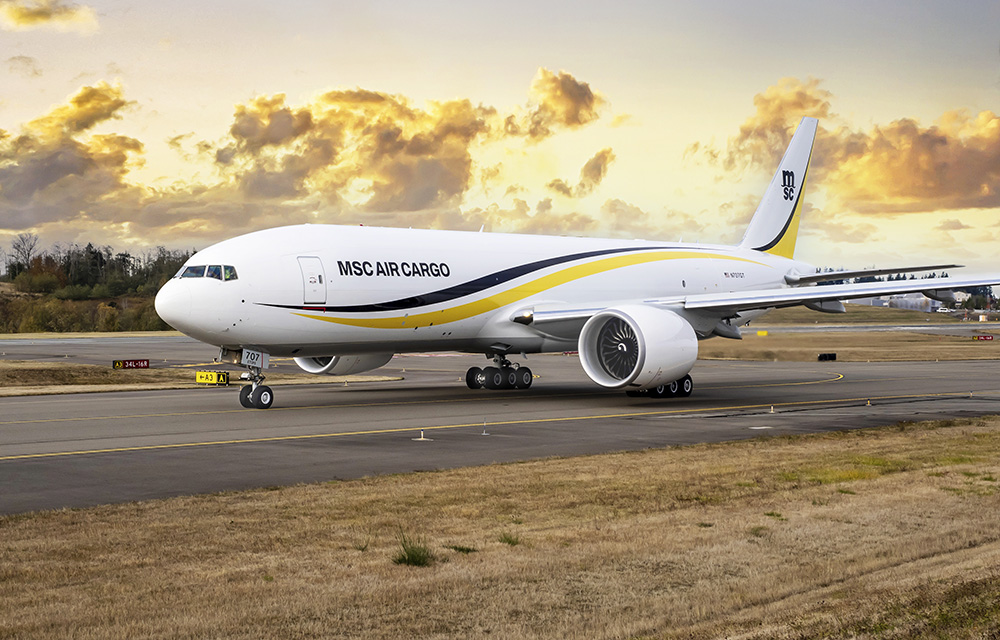
MSC has taken the next step in developing its Air Cargo solution with the delivery of the first MSC-branded aircraft, built by Boeing and operated by Atlas Air. The B777-200 Freighter will fly on routes between China, the US, Mexico and Europe.

Jannie Davel, Senior Vice President Air Cargo at MSC, said: “Our customers need the option of air solutions, which is why we’re integrating this transportation mode to complement our extensive maritime and land cargo operations. The delivery of this first aircraft marks the start of our long-term investment in air cargo.”

Jannie Davel brings extensive air cargo experience, having worked in the sector for many years, most recently heading Delta’s commercial cargo operations, before joining MSC in 2022.

He said: “Since I started at MSC, I have spoken to numerous partners and customers right across the market and it is very clear that air cargo can enable a range of companies to meet their logistics needs. Flying adds options, speed, flexibility and reliability to supply chain management, and there are particular benefits for moving perishables, such as fruit and vegetables, pharmaceutical and other healthcare products and high-value goods. 

We are delighted to see the first of our MSC-branded aircraft take to the skies and we believe that MSC Air Cargo is developing from a solid foundation thanks to the reliable, ongoing support from our operating partner Atlas Air.”

Atlas Air, Inc., a subsidiary of Atlas Air Worldwide Holdings, Inc. (Nasdaq: AAWW), is supporting MSC on an aircraft, crew, maintenance and insurance (ACMI) basis. This aircraft is the first of four B777-200Fs in the pipeline, which are being placed on a long-term basis with MSC, providing dedicated capacity to support the ongoing development of the business.

The B777-200F twin-engine aircraft has been commended for its advanced fuel efficiency measures. It also has low maintenance and operating costs, and, with a range of 4,880 nautical miles (9,038 kilometres), it can fly further than any other aircraft in its class. It also meets quota count standards for maximum accessibility to noise sensitive airports around the globe.

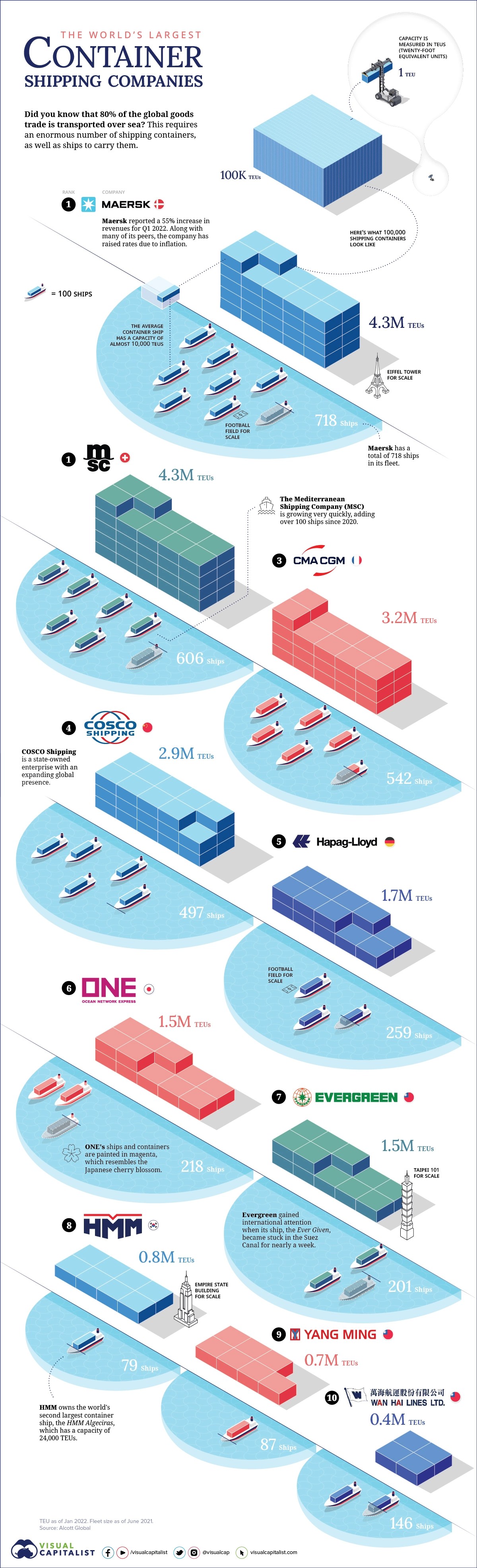
The World’s Largest Container Shipping Companies

Did you know that 80% of the global goods trade is transported over sea? Given the scale of human consumption, this requires an enormous number of shipping containers, as well as ships to carry them. 

At an industry level, container shipping is dominated by several very large firms. This includes Maersk, COSCO Shipping, and Evergreen. If you live along the coast, you’ve probably seen ships or containers with these names painted on them. 

Generally speaking, however, consumers know very little about these businesses. This graphic aims to change that by ranking the 10 largest container shipping companies in the world.

Read the Full Article here!

Maritime Traffic Around the World

Visual Capitalist.com

Each year, thousands of ships travel across the globe, transporting everything from passengers to consumer goods like wheat and oil. 

But just how busy are global maritime routes, and where are the world’s major shipping lanes? This map by Adam Syminton paints a macro picture of the world’s maritime traffic by highlighting marine traffic density around the world.

It uses data from the International Monetary Fund (IMF) in partnership with The World Bank, as part of IMF’s World Seaborne Trade Monitoring System. 

Data spans from Jan 2015 to Feb 2021 and includes five different types of ships: commercial ships, fishing ships, oil & gas, passenger ships, and leisure vessels.

Read the Full Article

FIATA – Launches Paperless FBL Solution

Picture: Glenn Carsten-Pieters

FIATA is proud to bring its members a pragmatic solution to move from paper documents to paperless FIATA BLs, which can be issued directly through their everyday tools. The FIATA solution improves the level of security of the FIATA BL in comparison to the paper version, making use of blockchain technology to authenticate the documents and provide an audit trail. Conscious of the various challenges which remain to be overcome to achieve worldwide adoption and legal recognition of electronic exchange of data, the paperless FBL is an answer to the needs of the industry for improved access and exchange of trade documents. The document issuer can decide in which format (s)he wishes to share the original unaltered document with its stakeholders: in paper form or as a PDF. Based on its eFBL data standard, FIATA has developed an API service, available free of charge to all software providers, allowing them to connect with FIATA to create secured paperless FBLs.

As of today, seven software providers have already signed an agreement with the Federation to implement the solution: AKANEA, CargowiseCargoXedoxOnline (Global Share), InfoSysTech-ISTNabu and Usyncro. We are very pleased to announce that the paperless FBLs can start to be issued as of today with edoxOnline, InfoSysTech-IST and Usyncro who have already finalised the implementation.

FIATA encourages all TMS’s, eBL providers and other software providers to join them and implement their solution to offer this new service to their customers. All technical specifications are available on FIATA’s GitHub repository.

 The solution, developed by FIATA partner Komgo, will help to reduce fraud risks, as each document is recorded on an immutable ledger and will be verifiable at any time by all stakeholders interacting with the document. Stakeholders will be able to either scan the QR code at the top right of the document, or directly upload the PDF on FIATA’s verification page to access the document audit trail which will

  • certify the validity of the document,
  • the identity of its issuer, and
  • the integrity of its content.

Souleïma Baddi, CEO of Komgo, when asked to comment on the paperless FBL launch said: ‘Documents are the bedrock of international trade, but they don’t operate like we need them to and they’re susceptible to fraud and forgery, that happens quite often.

Trakk is the digital ecosystem of trust for trade documents. I am thrilled to see FIATA joining all companies, financial institutions, warehouses and others who are using Trakk to protect their documents against fraud.’

‘WiseTech Global congratulates FIATA on the launch of their electronic bill of lading.’ The company continued: ‘This initiative will support transparency and security across the supply chain and will help companies to accelerate their digitalisation efforts. It was a pleasure to work with FIATA on this initiative. CargoWise customers will be able to request a connection to FIATA’s eFBL from June 2022.’ 

‘FIATA is very excited to embark on this important milestone of its digital journey which paved the way for great opportunities for the future of freight forwarders’, said FIATA Director General Stéphane Graber.

For more information, visit FIATA’s dedicated webpage

SAFE Working Group urges greater harmonization of AEO programmes

Picture – Nazarizal Mohammed

The 26th/27th Meetings of the SAFE Working Group (SWG) were held successfully from 11 to 14 April 2022. The virtual meetings brought together more than 260 delegates representing Customs administrations, the Private Sector Consultative Group (PSCG), other international organizations and academia.

In his opening remarks, Mr. Pranab Kumar Das, WCO Director of Compliance and Facilitation, highlighted that the SWG had reached an important juncture as the new three-year SAFE review cycle 2021-2024 was about to enter into discussions. It was pointed out that 17 years after it was first published, the SAFE Framework of Standards (FoS) had garnered substantial interest from WCO Members. During the meetings, Guyana became the 172nd WCO Member to express its interest in implementing the SAFE FoS. 

With a view to continued enhancement of the AEO criteria and provisions to strengthen the SAFE FoS, WCO Members made several new proposals to revise the Framework. The SWG also received feedback from the private sector on the urgent need to enhance the harmonization of SAFE and AEO implementation. In this context, the SWG heard a presentation by the WCO Anti-Corruption and Integrity Promotion (A-CIP) Programme on maintaining the integrity and transparency of AEO implementation.

On this occasion, the SWG reviewed and adopted the new Work Plan for 2022-2024, which reflected the critical activities the SWG will carry out over the next two years until 2024, in parallel with the SAFE review cycle. The SWG also received an update on the development of new features for the Online AEO Compendium (OAC) and the other extensive work underway in collaboration with other international organizations in the areas of security and facilitation.

Against the backdrop of the WCO’s theme for 2022, the panel discussion on “Scaling up Customs Digital Transformation by Embracing a Data Culture and Building a Data Ecosystem” attracted significant interest from Members and the private sector. The experienced speakers from Member Customs administrations, the private sector and the Secretariat enriched the discussions by sharing their best practices on using data for enhancing risk management and monitoring AEO programmes.

As a way forward, the SWG agreed that efforts will be reserved for a comprehensive review to assess and monitor SAFE implementation for greater harmonization of AEO programmes globally.

Source: World Customs Organisation, 25 April 2022

Satellite Maps – Shanghai’s Supply Chain Standstill

China has mandated a strict “zero COVID” policy since the onset of the global pandemic, which has led to tight lockdowns across the country whenever cases have started to spike. 

Recently, lockdown restrictions have been enacted in major cities like Shenzhen and Shanghai, as China deals with one of its worst outbreaks since Wuhan in December 2019.

These cautionary measures have had far-reaching impacts on China’s economy, especially on its supply chain and logistics operations. Shanghai’s port system, which handles about one-fifth of China’s export containers, is currently experiencing significant delays as a result of the recent government lockdown.

Shipping volume has dipped drastically since early March this year, right after partial lockdowns began in Shanghai. By the end of March, as restrictions continued to tighten up, shipping activity dipped nearly 30% compared to pre-lockdown levels. And while activity has recently picked up, it’s still far below average shipment volumes prior to the recent lockdown.

While the port is still technically operating, shipping delays will likely cause hiccups in the global supply chain. That’s because the Shanghai port is a major hub for international trade, and one of the largest and busiest container ports in the world.

How Bad is the Back-Up?

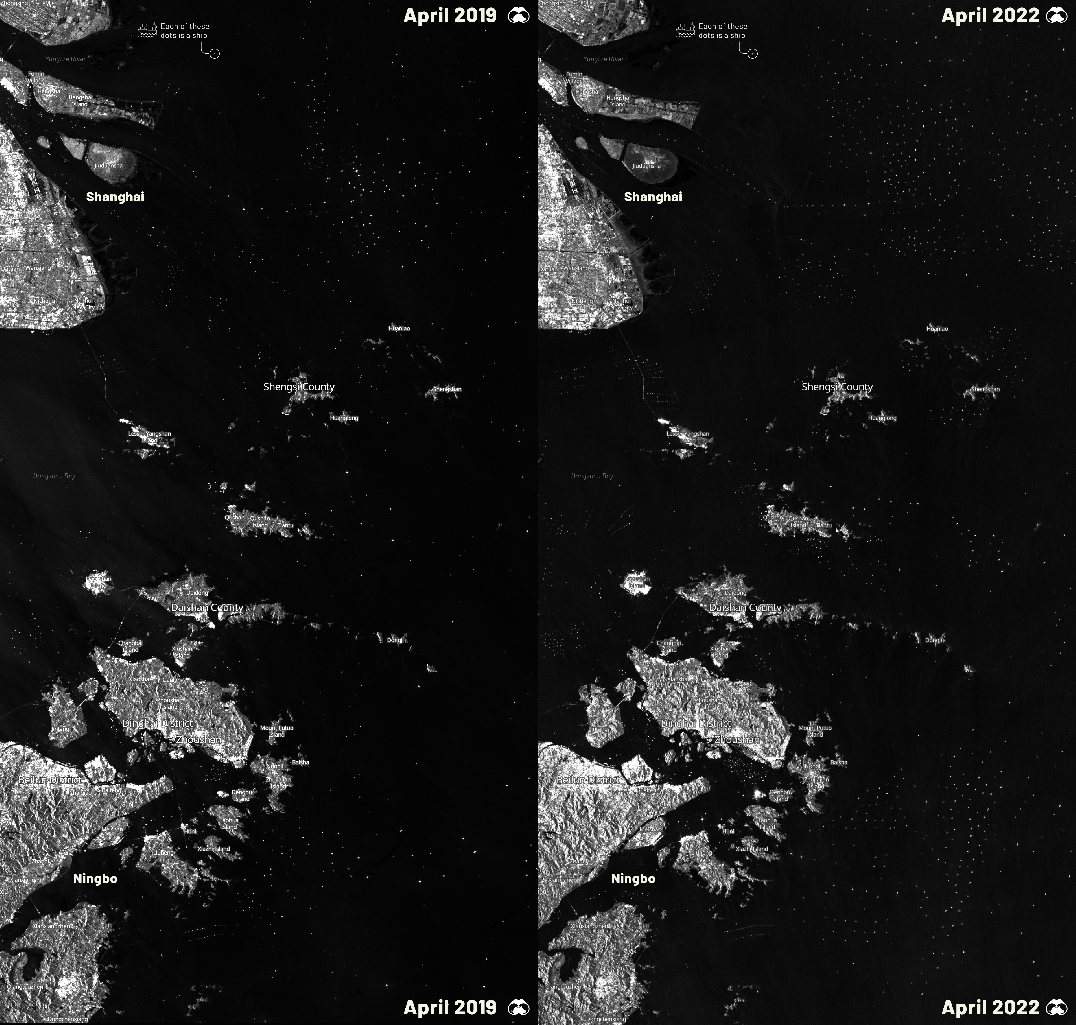
Here’s a closer look at satellite imagery that was captured by the Sentinel-1 satellite, which shows the current congestion at Shanghai’s port as of April 14, 2022. In the image, a majority of the white dots are cargo ships, many of which have been stuck in limbo for days.

Traffic has been building up at the Shanghai terminal. As of April 19, 2022, over 470 ships are still waiting to deliver goods to China. If you’d like to check out the Shanghai ports most up-to-date traffic, this live map by MarineTraffice provides real-time updates.

Much of these delays are due to transport issues—an estimated 90% of trucks that support import and export activities are currently offline, which is causing dwell time for containers at Shanghai marine terminals to increase drastically. 

Wait times for at Shanghai marine terminals has increased nearly 75% since the lockdowns began. Delays at the Shanghai terminal have sent ships to neighboring ports in Ningbo and Yangshan, but those ports are beginning to get congested as well.

The global impacts of this current bottleneck are still pending, and depend greatly on the length of Shanghai’s lockdown. According to an article in Freight Waves, this could turn into the biggest supply chain issue since the start of the pandemic if China’s marine shipping congestion isn’t cleared up soon.

Read Full Article Here!

Source: Visual Capitalist, article by Carmen Ang and Graphics by Nick Routley, dated 21 April 2022

USA – White House Announces New Initiative to Improve Supply Chain Data Flow

Last year, the ports and the private sector moved a historic amount of goods with record holiday sales and delivery times below pre-pandemic levels. Currently, real retail inventories excluding autos are six percent higher than at the end of 2019 and products at grocery and drug stores are 90 percent in stock, just 1 percentage point below pre-pandemic levels.

The US government is also focused on addressing the longer-term weaknesses in our nation’s supply chains, the result of decades of underinvestment, outsourcing, and offshoring instead of investment in long-term security, sustainability, and resilience. The Bipartisan Infrastructure Law (BIL) is now making a generational investment in our ports, highways, and other parts of our physical infrastructure, which will help speed up the movement of goods and lower costs. But we can further strengthen our goods movement supply chains by making a similarly bold improvement in a digital infrastructure to connect the supply chain.

To take the first step toward addressing this challenge, the US government is announcing the launch of Freight Logistics Optimization Works (FLOW), an information sharing initiative to pilot key freight information exchange between parts of the goods movement supply chain. FLOW includes eighteen initial participants that represent diverse perspectives across the supply chain, including private businesses, warehousing, and logistics companies, ports, and more.  These key stakeholders will work together with the Administration to develop a proof-of-concept information exchange to ease supply chain congestion, speed up the movement of goods, and ultimately cut costs for American consumers. DOT will lead this effort, playing the role of an honest broker and convener to bring supply chain stakeholders together to problem solve and overcome coordination challenges. This initial phase aims to produce a proof-of-concept freight information exchange by the end of the summer.

Recent supply chain disruptions have raised national awareness of the need for improved information exchange. Supply chain stakeholders deserve reliable, predictable, and accurate information about goods movement and FLOW will test the idea that cooperation on foundational freight digital infrastructure is in the interest of both public and private parties. FLOW is designed to support businesses throughout the supply chain and improve accuracy of information from end-to-end for a more resilient supply chain.

Resiliency—the ability to recover from an unexpected shock—requires visibility, agility, and redundancy. The lack of digital infrastructure and transparency makes our supply chains brittle and unable to adapt when faced with a shock. The goods movement chain is almost entirely privately operated and spans shipping lines, ports, terminal operators, truckers, railroads, warehouses, and cargo owners such as retailers. These different actors have made great strides in digitizing their own internal operations, but they do not always exchange information with each other. This lack of information exchange can cause delays as cargo moves from one part of the supply chain to another, driving up costs and increasing goods movement fragility.

View the entire Fact Sheet here!

Source: White House, 15 March 2022

Global Supply Chains Making a Huge Bet on Blockchain

System Shock: The $50 Trillion Industry Making a Huge Bet on Blockchain

Blockchain may one day eliminate inefficiencies and lack of transparency in supply chains. While slow in coming, this revolution would benefit not only customers and brands, but the “invisible” workers who power global trade.

In this episode of Bloomberg’s System Shock, we explore how cumbersome, paperwork-bound supply chains—like one stretching from kitchen refrigerators in Europe and the U.S. all the way back to a small farmer in Ecuador—are being transformed by that most modern of technologies.

Source: Bloomberg, System Shock, Gloria Kurnik, 26 January 2022