South Africa Registers First Vessel in 30 Years

[Picture:  tropic maritime photos, Australia]

[Picture: tropic maritime photos, Australia]

For more than 30 years, the South African Maritime Safety Authority (SAMSA) has not had a registered vessel. The M/V Cape Orchid, a bulk carrier, is its first vessel registered since 1985.

While South African imports $102 billion and exports $97 billion each year, the Cape Orchid is the country’s first registered vessel and is currently transporting iron ore from Saldanha Bay to China.

The 172,600-dwt bulker is owned by Vuka Marine, which is a joint venture between South Africa’s Via Maritime Holdings and Japan-based K-Line. South Africa will also soon register the Cape Enterprise, a 185,900 dwt vessel, which is also owned by K-Line during next few weeks.

The SAMSA and the South African Department of Transport hope that Vuka Marine’s registration will l encourage other vessel operators join the nation’s flag registry. More than 12,000 foreign flagged ships call South Africa each year, which is the gateway for African trade.

South Africans own about 19 vessels including three petroleum tankers, which are all registered in foreign countries. The country’s key ports are Cape Town, Durban, Port Elizabeth, Richards Bay, and Saldanha Bay. Its prime container port is Durban, which handled about 2,712,975 boxes last year.

Have Mega Containerships reached their Size Limit?

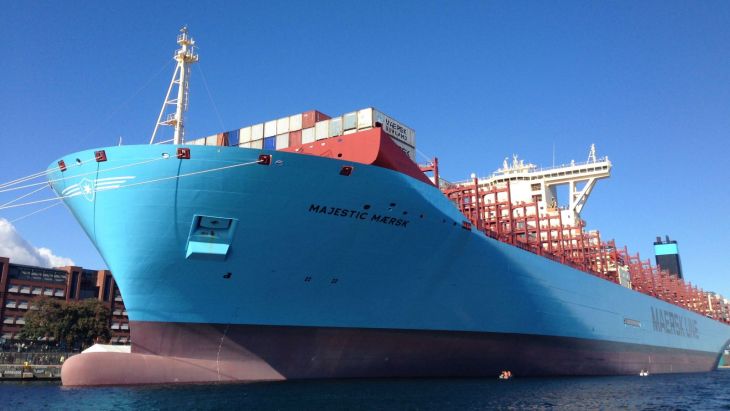
Majestic MaerskContainer shipping lines are poised to take delivery of a new generation of “megaships” over the next two years, just as the growth of world trade is slowing down, contributing to massive overcapacity in the market.

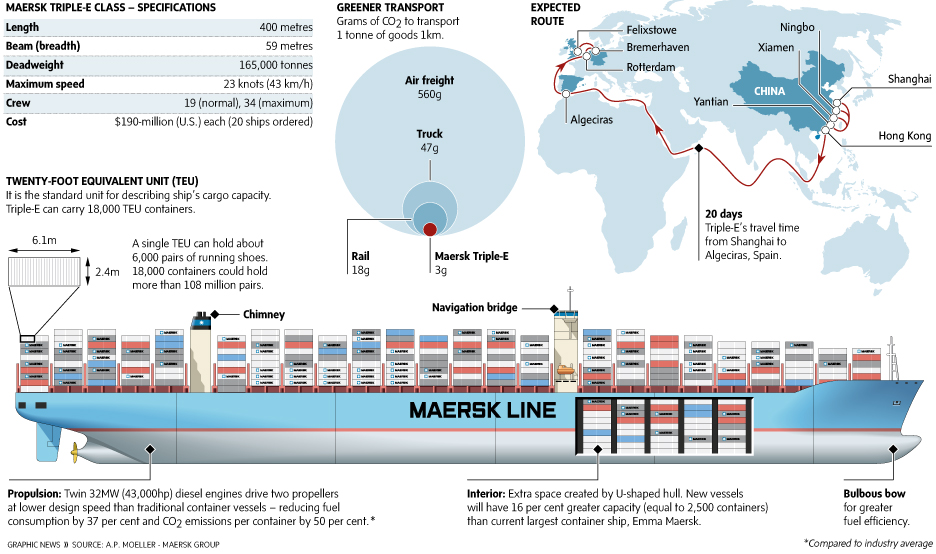
Megaships, which can be up to 400 meters long, seem to be here to stay, not least because so many more are already on order, the product of high fuel costs and low interest rates.

But the trend towards larger vessels is not without problems especially for other businesses in the transport system, and the trend could be nearing its limit as the economies of scale associated with megaships decline.

Container shipping capacity has doubled every seven years since the turn of the millennium and will reach nearly 20 million TEU in 2015 up from five million TEUs in 2000.

But since the financial crisis, container capacity has continued to grow rapidly, even as the growth in freight volumes has slowed, creating a massive overhang in shipping capacity and pressuring freight rates.

Capacity growth is being driven by the trend towards larger vessels. The size of container ships has been growing faster than for any other ship type according to the OECD’s International Transport Forum.

Between 1996 and 2015, the average carrying capacity of container ships increased 90 percent, compared with a 55 percent increase for dry bulk carriers and 21 percent for tankers.

The growth in container ship size has been accelerating. It took 30 years for the average container ship size to reach 1,500 TEU but just one decade to double from 1,500 to 3,000 TEU.

Between 2001 and 2008, the average size of newly built ships hovered around 3,400 TEU but then jumped to 5,800 TEU between 2009 and 2013, and hit 8,000 TEU in 2015.

Megaships
Both the average size of new container ships and the maximum size are set to continue growing over the next five years. Shipping lines have already taken ownership of 20 megaships with a capacity of more than 18,000 TEU each and another 52 are on order, according to the OECD.

The largest ship so far delivered has a capacity of 19,200 TEU, but carriers with capacity up to 21,100 have been ordered and will be in service by 2017.

Megaships are being introduced into service between the Far East and North Europe, the world’s largest route by volume, where potential economies of scale are greatest, but are having a cascade effect on other routes.

Large ships that formerly plied the Far East-North Europe route are being displaced into Trans-Pacific service, and former Trans-Pacific carriers are moving to the Trans-Atlantic route.

The new generation of ultra-efficient megaships is credited with cutting the cost of shipping even further and lowering greenhouse gas emissions.

But researchers for the OECD question whether megaships are contributing to unsustainable overcapacity and imposing unintended costs on shippers, port operators, freight forwarders, logistics firms and insurers.

Fuel Costs
The new generation of megaships is the lagged effect of the era of high oil prices between 2004 and 2014 and low interest rates since the financial crisis in 2008.

Costs in the shipping industry can be divided into the capital costs associated with the construction of new vessels, operating costs, and voyaging costs primarily related to fuel consumption.

Construction costs increase more slowly than ship size. Increasing a container ship from 16,000 TEU to 19,000 TEU cuts the annual capital cost per TEU-slot by around $69 according to the OECD.

Larger ships are slightly more operationally efficient than smaller ones, with an annual saving of perhaps $50 per slot on a 19,000 TEU ship compared with a 16,000 TEU vessel.

But the real savings are on the fuel bills. Megaships are “astonishingly fuel efficient” and actually consume less fuel on a voyage than 16,000 TEU carriers, according to the OECD.

With overwhelming cost advantages, especially on fuel, and cheap finance readily available, the upsizing decision appears to have been a straightforward one for shipping lines.

Slow Steaming
The new generation of megacarriers has been optimized to save fuel by voyaging much more slowly than previous container vessels.

Fuel consumption is related to the cube of speed. If a vessel travels twice as fast it will consume eight times as much fuel. The cube-rule has important implications for the economics of the shipping industry.

When fuel prices are high, it makes sense to voyage slowly to cut fuel bills, even if it means operating more ships to move the same amount of cargo. When fuel prices are low, it makes sense to travel faster and use fewer ships.

During the period of soaring oil prices, container lines instructed captains to cut speed in order to conserve fuel.

The new ships ordered were specifically designed to operate most efficiently at slower speeds to take advantage of slow steaming economies. In fact some carriers are so large they cannot operate at higher speeds.

Crucially, slow steaming has now been designed into the new generation of vessels entering container service, so it will not be easily reversed, even though fuel prices have plunged since 2014.

According to the OECD, most of the voyaging cost reductions in the new generation of megaships come from their optimization for slow steaming rather than from increased size.

“Between 55 and 63 percent (at least) of the savings per TEU when upgrading the vessel size from an early 15,000 TEU design to a modern 19,000 TEU design are actually attributable to the layout for lower operation speeds,” the OECD estimated.

“Cost savings are decreasing as ships become bigger,” the OECD concluded. “A large share of the cost savings was achieved by ship upsizing to 5,000 TEU, which more than halved the unit costs per TEU, but the cost savings beyond that capacity are much smaller.”

Unintended Costs
The consolidation of container volumes into fewer, larger megaships is creating challenges for other firms in the freight business.

Insurers are worried about the costs if a megaship sinks or develops mechanical problems. Insurer Allianz has warned the industry must prepare for losses of more than $1 billion, or even up to $2 billion in the event of a collision between two megaships.

Economies of scale depend on megacarriers being loaded close to maximum capacity and spending as much time as possible at sea rather than in port.

The need to fill megaships is one reason that the industry is consolidating into an alliance network.

Shipping lines are also adopting the hub-and-spoke system employed by airlines to ensure their ultra-large container vessels sail nearly full.

Shipping schedules for the megacarriers have been consolidated into fewer sailings each week from fewer ports (about six in North Europe and eight in Asia).

Containers for other destinations must be transhipped, either on a smaller container vessel or by road, rail and barge. Schedule consolidation is not necessarily favored by shippers and freight forwarders who prefer regular and reliable service (fewer sailings can mean more concentrated risk).

Port operators, too, have been forced to invest heavily to attract and handle the new megacarriers. Port channels must be dredged to greater depths to handle the deeper drafts of the megaships. Quaysides must be raised and strengthened to handle the increased forces when a megaship is tied up.

The biggest problem comes from the scramble to unload a megacarrier quickly so it can put to sea again. The average turnaround time for a container ship is now just one day, and less in Asia.

The arrival of fewer vessels but with larger numbers of containers is creating intense peak time pressure on the ports.
Ports need more cranes, more highly skilled staff to operate them fast, more space in the yard, and the ability to handle more trucks, railcars and barges to move the containers inland.

The OECD estimates megaships are increasing landside costs by up to $400 million per year (one third for extra equipment, one third for dredging, and one third for port infrastructure and hinterland costs). Source: Maritime Executive/Reuters.

Nigeria – APMT’s Biggest Ever Port Investment

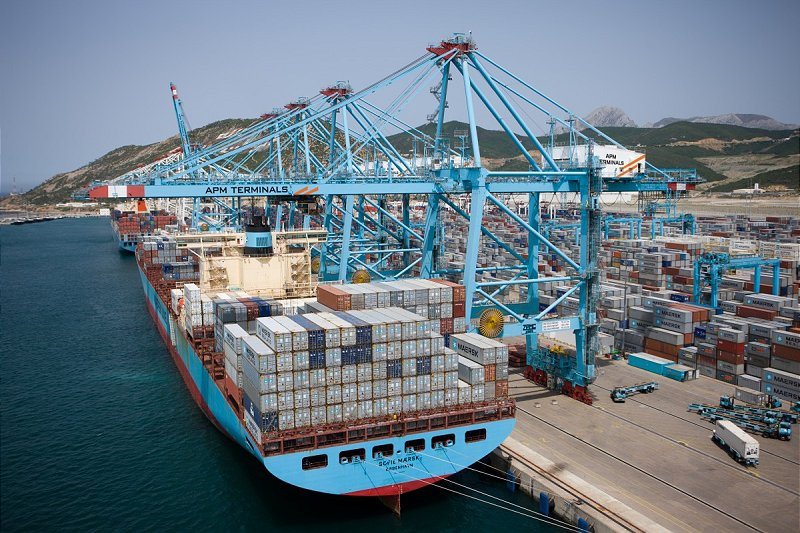
APM Terminals 2The Maersk-owned company APM Terminals has revealed it is investing about 14 billion kroner (US$2 billion dollars) into a new port in Bagadry, Nigeria, in what will be its biggest ever investment. The port will become the second-largest port in Africa – only surpassed by Port Said in Egypt – and is a clear signal that the Danish shipping giant’s terminal operator sees the African continent as a long-term hotbed for economic growth.

“We are currently purchasing property from the state and will start construction later this year. The port is scheduled to be completed in 2019,” David Skov, the managing director for APM Terminals in Nigeria, told Børsen business newspaper.

“Globally, it will be APM Terminal’s largest ever investment and marks a strategic shift to multi ports. It means we will supplement our own experience in container ports with the establishment of a free zone, an oil port and a bulk port, so in other words a complete port.”

APMT recently acted on its decision to invest $1.5 billion on the Port of Tema in Ghana, Africa, with the establishment of a Greenfield port outside of the existing facility and upgrades to the adjacent road network.

Kenya – Drugs Found on Auto Carrier in Port of Mombasa

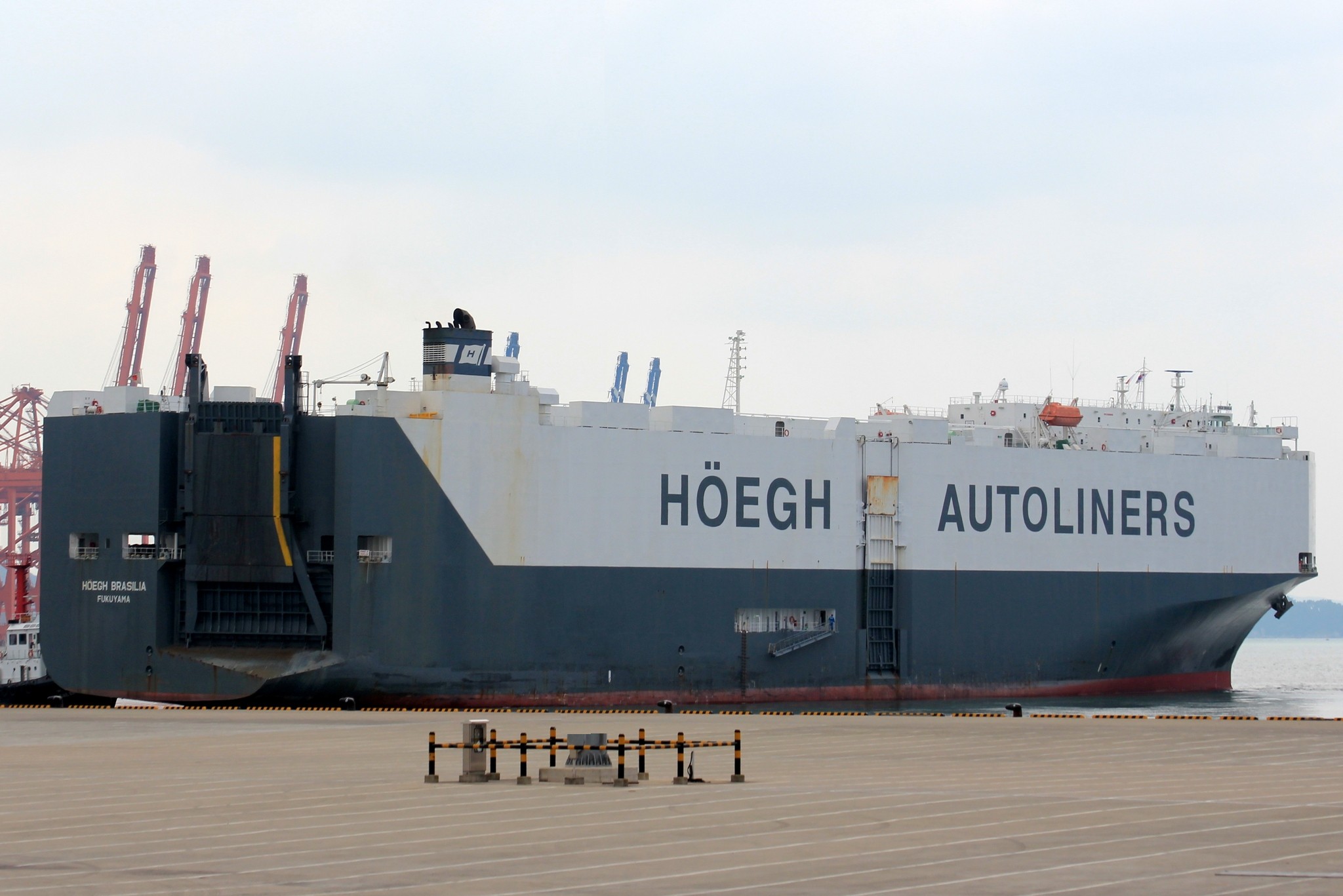
hoeghKenyan and U.S. authorities found drugs aboard the Höegh Autoliners “Pure Car/Truck Carrier” (PCTC), which was detained at Port Mombasa on September 17. The crew of the ship has been arrested and currently being questioned by authorities.

According to authorities, cocaine was found inside the tires of three military trucks aboard the Hoegh Transporter, a Singapore-flagged car carrier.

Kenyan officials raided the vessel after receiving a tip from the U.S. Federal Bureau of Investigation (FBI) that the vessel had been loaded with the coke at India’s Port of Mumbai.

Kenyan soldiers and security personnel shut down the port for hours before seizing the ship and halting operations. Mombasa, which is Africa’s largest port, serves as the main gateway for imports and exports in the region.

East Africa is a major shipping route for Afghan narcotics bound for Europe. Maritime forces have been unable to curb the flow of drug transport in the region.

The Höegh Transporter was built in 1999 and was transporting nearly 4,000 vehicles, including about 250, which are to be used for peacekeeping missions in South Sudan. Source: Maritime Executive

EU fighting Customs Fraud – JRC research leads to new legislation

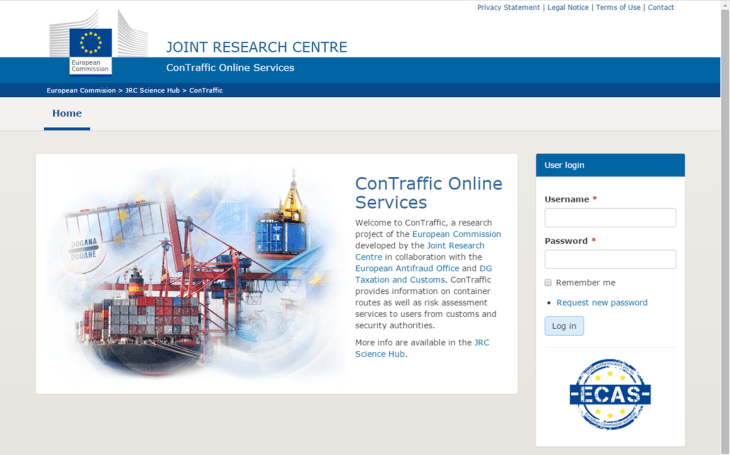
ConTraffic HomepageA new regulation adopted by the European Parliament and the Council will allow customs to access information to track the origins and routes of cargo containers arriving in the EU to support the fight against customs fraud both at EU and national level. The Joint Research Centre (JRC) has been instrumental in the conception and adoption of this legislation as it provided the scientific evidence on the importance of analysing the electronic records on cargo container traffic.

The EU customs authorities have been long aware that information on the logistics and actual routes of cargo containers arriving in Europe is valuable for the fight against customs fraud. However, they had very limited ways to obtain such information and no means to systematically analyse cargo container traffic both for fraud investigations as well as for risk analysis. On the other hand, the ocean carriers that transport the cargo containers, as well as their partners and clients, have easy on-line access to the so-called Container Status Messages (CSM): electronic records which describe the logistics and the routes followed by cargo containers.

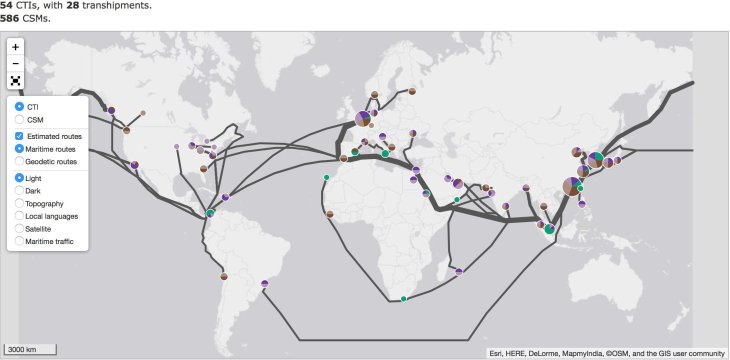
jrc-cargo-container-routes-world-mapIn collaboration with the European Anti-Fraud Office (OLAF), the JRC has worked extensively on how to exploit CSM data for customs anti-fraud purposes. The JRC proposed techniques, developed the necessary technology, and ran long-term experiments involving hundreds of EU customs officers to validate the usefulness of using CSM data. The results of this research led the Commission to bring forward a legislative proposal that would enable Member States and OLAF to systematically use CSM data for these anti-fraud purposes. It also served to convince Member States of the value of the proposed provisions.
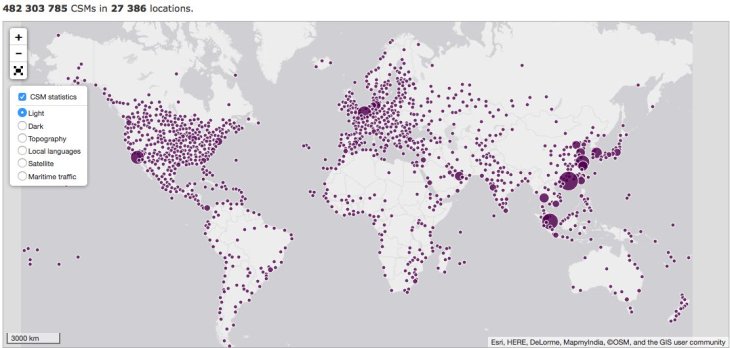
The financial gains from the avoidance of duties, taxes, rates and quantitative limits constitute an incentive to commit fraud and allow the capacity to properly investigate in cases, such as mis-declaration of the origin of imported goods. The information extracted from the CSM data can facilitate the investigation of some types of false origin-declarations. With the new legislation an importer will no longer be able to declare – without raising suspicions – country X as dispatch/origin of goods if these were transported in a cargo container that started in country Z (as indicated by the CSM data).

jrc-csm-dataset-world-map (1)The technologies, know-how and experience in handling CSM data, developed by the JRC through its experimental ConTraffic platform, will be used by OLAF to set up the system needed to implement this new legislation applicable as from 1 September 2016. The JRC will continue to analyse large datasets of CSM records (hundreds of millions per year) as these are expected to be made available through the new legislation and will continue to support not only this new regulation but to exploit the further uses of this data notably for security and safety and real-time operations. Its focus will be on data mining, new automated analysis techniques and domain-specific visual analytics methods. Source and Images: EU Commission
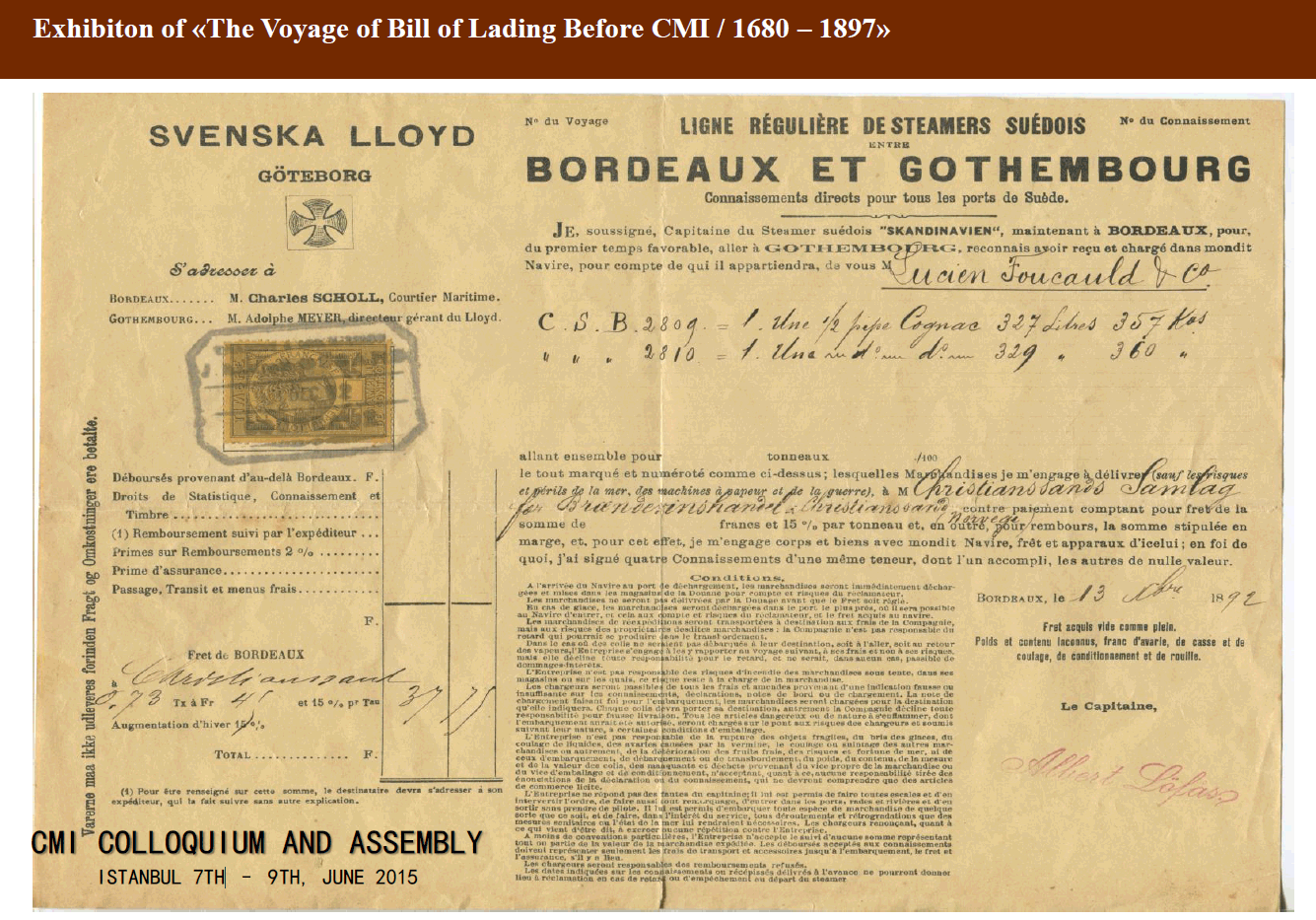
A collection of Bills of Lading

BoLAn article about a collector of Bills of Lading can be found on the Hariesh Manaadiar’s very popular educational blog Shipping and Freight Resource. Follow the hyperlink below –

Source: A collection of Bills of Lading

Illegal Cargo – Colombia Seizes China-flagged Ship

Image - Wikimedia.org

Image – Wikimedia.org

Colombian authorities detained a vessel operated by China’s largest shipping group for illegally transporting thousands of cannon shells, around 100 tons of gunpowder and other materials used to make explosives, the attorney general’s office said.

The Da Dan Xia, operated by Cosco Shipping Co, was headed for Cuba when it was stopped on Saturday in the northern port of Cartagena, on the Caribbean coast, after the materials were detected during an inspection. The cargo was listed in the records of the 28,451dwt ship as grain products. The captain of the Hong Kong-flagged vessel had been arrested, the attorney general’s office said. China’s Foreign Ministry spokeswoman Hua Chunying said the ship was carrying ordinary military supplies to Cuba and was not in violation of any international obligations.

“It is completely normal military trade cooperation. At present, China is communicating with the parties on this matter,” Hua said.

A Cosco Shipping official in the firm’s Guangzhou head office said the ship was operated by the company but added she was unaware of the incident. Cargo documentation the captain presented did not match the load the ship was found to be carrying, Luis Gonzalez, national director of the Colombian attorney general’s office, told reporters.

“Around 100 tons of powder, 2.6 million detonators, 99 projectiles and around 3,000 cannon shells were found,” Gonzalez added.

Photographs from the prosecutor’s office showed wooden cases inside a shipping container with labels stating Chinese defense manufacturer China North Industries Group Corporation as the supplier. The company, known as Norinco, is China’s biggest arms maker. It did not immediately respond to a request for comment.

The recipient was stated as importer Tecnoimport in the Cuban capital Havana. The Cuban company could not immediately be reached for comment. A man who identified himself as the Da Dan Xia’s first officer confirmed the ship had been detained in Colombia when Reuters called the vessel’s phone number on Wednesday. Source: Maritime Executive/Reuters

CMA CGM – to introduce ‘smart’ containers to its box fleet

TraxensFrench shipping giant CMA CGM will start phasing in ‘smart’ containers this year, allowing the line and its customers to keep track of each box equipped with new sensors at all times. In an industry first, technology being developed with a start-up company, Traxens, would enable data on the location and condition of the container to be monitored at all times throughout a delivery.

The world’s third-largest container line and Ocean Three member said it had contributed to the capital increase of French firm Traxens that will enable CMA CGM to have access to an unprecedented amount of information on each container and offer clients what it describes as unique tracking solutions and real-time data collecting from all over the world.

Elie Zeenny, CMA CGM senior vice-president, Group IT Systems, said the technology would bring the shipping industry into a new era. This year, Traxens plans to equip the first CMA CGM containers with the patented technology so it will be possible to know in real-time not only a container’s position, but also its temperature, the vibrations it will be subjected to, any attempted burglary, the presence of traces of specific substances in the air or even the regulatory status of the cargo.

With its “4Trax” solution, Traxens offers the tracking of containers from cargo loading to their final destination, and the forwarding of data in real time to all actors in the multimodal transport chain. Traxens has also worked closely with French Customs in the development of its solution. In this regard the solution aims to record the legal status of the container (customs clearance) with the view to eradicate false declarations and counterfeits and to facilitate controls. Sources: Lloyds loading, CMA CGM and Traxens

Unusual Container Weight Fraud Uncovered

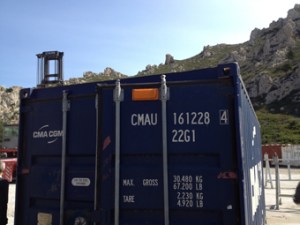
containerThe International Maritime Bureau has been alerted to a fraud involving a shipping container’s weight and size that is atypical of what one might out of a container weight fraud case; the tare weight, or unladen weight of the container itself was unrealistically falsified and much higher than the actual, correct weight of the container.
The IMB reports that the incident concerned a container of aluminium scrap in which the information outside the box was tampered with to show false weight and size. The fraud was uncovered by an IMB member after being notified of a significant weight shortage on the container, which arrived in the Far East from the Middle East.

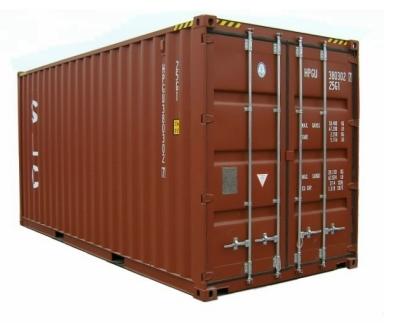
During the investigation, the IMB member noted that the tare weight of the container, as shown on its door – and used by the shipper – was 3,680kg, while the cube, also shown on the door, was 2,700 cubic feet. While the numbers displayed were entirely acceptable for a 40 foot container, the box in question was a 20 foot one, according to the IMB. The shipper has since confirmed that the correct tare weight for the container should have been 2,200kg, much lower than what was declared.

An examination of the photos taken when the container was loaded revealed that the part of the door on which the figures were displayed was a slightly different color, which leads to the conclusion that the door had been repainted at some point, and the new, false figures were added after that. The IMB notes is not known when this was done and it is unlikely to be an isolated case.

The IMB says it has not come across a case before where a container has been repainted with incorrect weight and size information that in hindsight clearly cannot be correct for a 20 foot container, however it does have knowledge of a case where a label was placed over the container number of a stolen container to disguise the theft. The IMB says that this would be a more logical deception since carriers tend to focus on the container numbers themselves, and rely on the shipper to provide any other information required.

The IMB asks that others who detect similar container information tampering to report it so that it can attempt to establish a pattern that might indicate who is responsible and can issue suitable warnings to the industry if it proves widespread in the future.

Apart from being a fraud, mis-declaring the weight of containers can also pose a danger to the vessel and crew, as mis-declared container weights remains a contributing factor to incidents involving containers lost at sea.

This month, the International Maritime Organization’s Maritime Safety Committee is scheduled to adopt amendments to the International Convention for the Safety of Life at Sea chapter VI to require mandatory verification of the gross mass of containers, either by weighing the packed container or by weighing all packages and cargo items and adding the tare mass, in turn boosting the safety of container ships and crew.

The IMB stresses that in this case, the container owner has denied responsibility and the IMB member doubts its supplier was involved. Source: emaritimeexchange.com

Update – Important Clues to MOL Comfort’s Demise

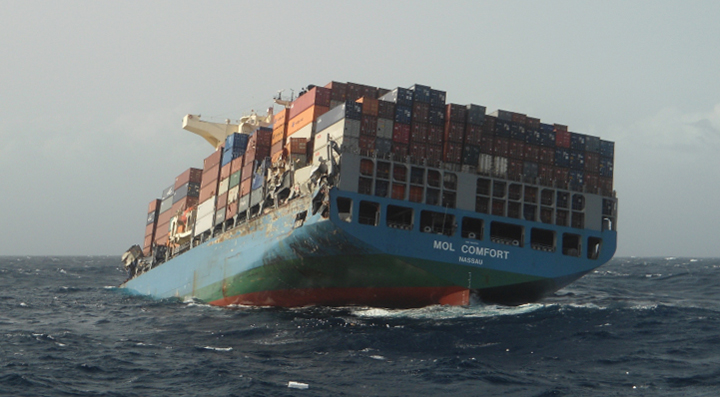
MOL-ComfortMany may recall the shocking pictures of MOL Comfort’s last voyage last year – images of a huge crack in the fully laden container ship on the high sea.

While conducting research for her PhD thesis at the Technical University of Denmark, Ingrid Marie Vincent Andersen, PhD had found clues prior to this incident suggesting the possibility of catastrophic failure was more real than previously thought.

Digging deep into the hydro-elastic structural response of container ships similar to the MOL Comfort, she had discovered some very interesting details.

Clearly, the ship had broken up when the hull girders failed, but what led to that failure was not so obvious. She, like many others, say it very likely had a lot to do with the cargo loading condition of the ship, but the full answer was quite a bit more complicated than that.

Anderson says the MOL Comfort and her sister vessels were simply under engineered by naval architects that didn’t fully account for enormous additional loads which were being placed on the ship.

“It is believed that the hydro-elastic effects and the effect of hull girder flexibility are capable of significantly amplifying the hull girder stresses and thus contribute to fatigue damage as well as to the extreme hull girder loading in container ships,” Andersen notes in her PhD thesis.

In her research, she studied ships in the 8000-9000 TEU range and discovered, “the hull girder vibrations due to hydro-elastic effects is capable of doubling the stress response amidships in some cases – also in the extreme loading cases.” Click here to witness a video of stress experienced on a container ship.

“I don’t think the incident was fatigue-related, but it could be due to under-estimation of the hydro-elastic effects on the wave-induced vertical bending moment at the design stage. The major uncertainty at the design stage is related to estimation of the wave loads,” notes Anderson.

Research published by Lloyd’s Register (LR) engineers Nigel White and Zhenhong Wang support Andersen’s research.

LR notes the principle design challenge inherent to large and ultra-large container ships is the combined effects of whipping, springing and warping/distortion of the hatch openings.

Until recently, Andersen notes that hydro-elastic effects have not been directly taken into account for in the classification societies’ design rules for container ships. In 2014, LR updated their design rules to reflect the discovery of much higher loadings inside the structure of container ships.

Andersen, White and Wang all cite strain data captured aboard a 2006-built CMA CGM 9,600 TEU container ship over a four-year period showing severe spikes in the vertical bending moment as wave strikes on the bow resonate down the ship.

Anderson notes that due to a large uncertainty around sea state conditions a vessel will encounter, maximum wave loading is subsequently uncertain. Wave loading is compounded by container ships that opt for greater cargo space forward, and thus greater bow flare such as on the MOL Comfort and the ultra-large 14,000 TEU+ sized vessels that are currently in operation.

These bending moments, according to their research can be upwards of 300 percent the traditionally calculated wave bending moment using linear ship motion codes – the ones that ships have traditionally been built to. The traditional codes have a realized safety factor of around 200 percent.

Anderson notes that due to a large uncertainty around sea state conditions a vessel will encounter, maximum wave loading is subsequently uncertain. Wave loading is compounded by container ships that opt for greater cargo space forward, and thus greater bow flare such as on the MOL Comfort and the ultra-large 14,000 TEU+ sized vessels that are currently in operation.

“The high strength steel used for the construction of the ship will result in a slightly lower natural frequency and possibly, together with the pronounced bow flare, making the vessel more susceptible to whipping vibrations,” adds Anderson.

Since the MOL Comfort sinking, all of the sister vessels to the MOL Comfort have been retrofitted with additional structural steel, but certainly other ships in that size range have not.

Considering the step changes being made in container ship design, logic would dictate that additional study and consideration be taken when designing and operating such vessels, including the installation of strain gauges to properly measure what is happening inside the ship. Source: gCaptain.com

Global Shipping – One of the Last ‘Wild West’ Frontiers

WindwardShipping activity across the world’s oceans is the lifeblood of the global economy, transporting billions of tons of goods annually and facilitating global commodity flows of oil, coal, grains and metals. Vessel activity is also of critical importance to Intelligence and Security agencies worldwide, as criminal and terrorist activity has become increasingly global and borderless.

And yet, the oceans remain one of the last ‘wild west’ frontiers, with limited visibility on what ships are actually doing once they leave port. AIS data, the most widely used data on ship activity worldwide, underlies decisions from Finance to Intelligence, but the data is unreliable and increasingly manipulated by the very ships it seeks to track.

And this trend is growing, fast, with little-understood and far-reaching implications worldwide.

AIS data, used routinely by decision makers across industries, is widely perceived as a reliable source of information on ship activity worldwide. Massive financial investments and critical operational decisions are based on this data.

New research from Windward reveals that AIS data has critical vulnerabilities when used to track ships, an ‘off label’ use of the system. The data is increasingly manipulated by ships that seek to conceal their identity, location or destination for economic gain or to sail under the security radar.

Manipulation practices are varied, according to Windward’s research, and range from Identity Fraud, to Obscuring Destinations, ‘Going Dark,’ Manipulating GPS, and ‘Spoofing’ AIS. Ships that manipulate AIS undermine not only their own data, but the entire maritime global picture — once some of the data is corrupt, all data is suspect.

If this kind of manipulation is occurring on ships, consider the impact of ‘cargoes/substances’ on board ‘ghost ships’. You can find the Windward Research paper “Analysis of the Magnitude and Implications of Growing Data Manipulation at Sea” as well as a poignant infographic on their website, by clicking the hyperlinks. Source: Windward.eu

Related article

Global container ports could handle 840m TEU a year by 2018

singapore-port

Port of Singapore

Projected throughput four years from now compares with 642m teu in 2013 and 674m teu projected for this year. The 2018 projection is double the 2004 throughput figure of 363m teu.

The combination of faster traffic growth and strong profit levels is attracting aggressive new players to enter the container terminal-operator business , according to the 11th Global Container Terminal Operators Annual Review and Forecast report published by shipping consultancy Drewry. It says Africa and Greater China are the regions that will see the most rapid growth.

Overall , growth rates are expected to average an annual 5.6% in the five years to 2018, compared with 3.4% in 2013. That will boost average terminal utilisation from 67% today to 75% in 2018, Drewry forecasts.

“The sector’s strong financial performance and accelerating growth is encouraging new market entrants and renewed merger and acquisition activity in the container ports sector,” said Neil Davidson, senior analyst in Drewry’s ports and terminals practice. “Financial investors are particularly active at present, attracted by typical ebitda margins of between 20% and 45%.”

Drewry has also added two companies to its league table of 24 terminal operators it considers to be global. Both China Merchants Holdings International and Bolloré Group have been growing aggressively. In the case of CMHI further acquisitions are particularly likely. Other operators, such as Gulftainer and Yilport are also expanding rapidly and are challenging for inclusion in Drewry’s league table.

The composition of the top five players, when measured on an equity teu throughput basis, has changed little from last year, except new entrant CMHI which is now in fifth place. PSA again heads the table, by virtue of its scale and 20% stake in Hutchison Port Holdings which comes second. APM Terminals is third, followed by DP World.

Drewry said that by 2018, it expects both HPH and APM Terminals to be vying closely for the top spot in terms of capacity deployed. Most portfolio expansion will be through greenfield or brownfield terminals in emerging markets, led by APM Terminals, International Container Terminal Services, HPH and DP World. “All port and terminal operators are experiencing a number of key industry trends, some of which have wide ramifications,” said Mr Davidson. “The most important trends are deployment of ever-larger containerships, expansion of shipping-line alliances, financial pressures on shipping lines, rapidly emerging international terminal operators and owners, financial investor churn, as well as the gathering pace of terminal automation.” Source: Lloydslist.com

New CTU Code – IMO Approves Container Weight Verification Requirement

containerThe Maritime Safety Committee (MSC) of the IMO has approved changes to the Safety of Life at Sea (SOLAS) convention that will require verification of container weights as a condition for loading packed export containers aboard ships.

Misdeclared container weights have been a long-standing problem for the transportation industry and for governments as they present safety hazards for ships, their crews, and other cargo on board, workers in the port facilities handling containers, and on roads. Misdeclaration of container weights also gives rise to customs concerns. The approved changes to the convention will enter into force in July 2016 upon final adoption by the MSC in November 2014. In order to assist supply chain participants’ and SOLAS contracting governments’ implementation of the container weight verification requirement, MSC also issued a MSC Circular with implementation guidelines.

MSC also approved a new Code of Practice for the Packing of Cargo Transport Units (CTUs), including intermodal shipping containers. The new CTU Code, which will replace the current IMO/ILO/UNECE Guidelines for packing of CTU, has already been approved by the UNECE (United Nations Economic Commission for Europe) and will now go to the International Labour Organization (ILO) for approval. The CTU Code provides information and guidance to shippers, packers and other parties in the international supply chains for the safe packing, handling and transport of CTUs.

Of particular interest for regulatory authorities is Chapter 4 – “Chains of responsibility and information” which deals with the parties responsible for the provision of information and other security and regulatory requirements concerning containers as they are transported across the supply chain.

The World Shipping Council (WSC), whose members represent about 90 percent of global containership capacity, has been a leading advocate for the container weight verification requirements and has worked cooperatively with the IMO for over seven years to see them materialize. WSC has also participated in the group of experts that developed the new CTU Code.

“In taking these decisions, the IMO has demonstrated its continuing leadership in trying to ensure the safe transportation of cargo by the international shipping industry,” said WSC President & CEO, Chris Koch. “We congratulate the IMO Secretary General and the IMO member governments for developing and approving these measures that, when properly implemented and enforced, should provide for long-needed improvement to maritime safety. The SOLAS amendments and related implementation guidelines regarding container weight verification represent a collaborative effort that we were pleased to be a part of and we look forward to final adoption of the amendments in November 2014.”

The new CTU and supporting material can be accessed at the UNECE website here. Also See the World Shipping Councils webpage here for chronological information about the container weighing issue. Source: Maritime Executive

CINS reveals cargo mis-declaration and packing issues

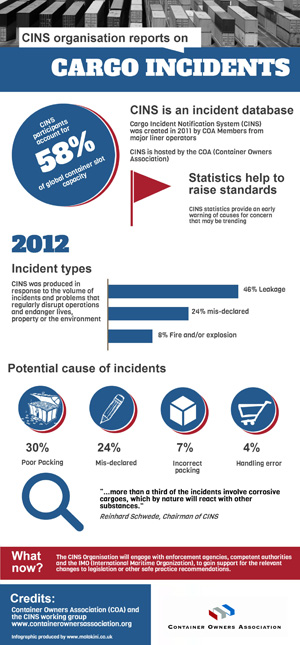
CINS Cargo Incident Visual GraphicPoor or incorrect packing accounts for 37 per cent of cargo incidents in the supply chain, according to data released by the Cargo Incident Notification System (CINS).

And 24 per cent of incidents cases are due to mis-declaration of the cargo, it found. The organisation is managed by the Container Owners Association (COA), and was set up by members from five of the COA’s top 20 liner operators; CMA CGM, Evergreen Line, Hapag-Lloyd, Maersk Line and the Mediterranean Shipping Company.

It was created to capture key data, after an increase in incidents that regularly disrupt operations and endanger lives, property or the environment.

CINS’ analysis revealed that 80 per cent of substances involved in cargo incidents are dangerous goods, with half relating to leakage and a further quarter announced mis-declared.

It also showed that incidents relating to mis-declared cargo have increased significantly within the first four months of 2013, compared to the previous 18 months, which the company says has led it to aspire to identify ways to make the supply chain safer.

“We have identified that 24 per cent of all incidents involve mis-declaration and this is probably the first time that this ‘iceberg’ risk has been quantified, said Reinhard Schwede, chairman of CINS.

“Poor or incorrect packaging are persistent causes, accounting for almost 40 per cent of incidents over nearly two years. This is all the more concerning when we recognise that more than a third of the incidents involve corrosive cargoes, which by nature will react with other substances.

“With these findings, the CINS Organisation will engage with enforcement agencies, competent authorities and the IMO to gain support for the relevant changes to legislation or other safe practice recommendations.” Source: Container Owner Association

Mega ships: positive asset or terminals’ worst nightmare?

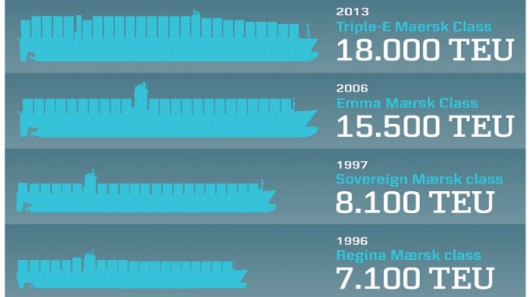
triple-e-maersk-worlds-largest-shipA Financial Times article reported Maersk’s Triple E Class (18,000 TEU) to be 26 percent more cost efficient than the current E class (15,000 TEU). – Wright, R (2011), Financial Times. ‘Big Ships: Container lines reach for scale’. Recent research into supply chain costs indicates that this is not obvious for the entire supply chain – Streng, M. (2012). Slow steaming: an economic assessment of lowering sailing speeds on a supply chain level’, Master Thesis Urban, Port and Transport Economics, Erasmus University Rotterdam.

The capital cost per TEU moved has increased even considering the increase in slot size of newer larger vessels. Due to the increase in transportation duration, the capital costs and insurance of goods transported have gone up. Further cost increase could be accounted for in the increase in time to market. Fast moving goods (such as consumer electronics) that need longer to get from the world’s production centres to the markets is also a cost. Shipping lines are demanding ever shorter port stays in order to make the economies of scale work. The bigger the ship, the greater the cost of hours lost in port, and an increased port stay is a diseconomy of scale.  Port Technology have published the following article which should be useful for shippers, freight forwarders, port planners in better understanding the economics of international shipping and logistics – Mega ships: positive asset or terminals’ worst nightmare?.

Triple E Class Specifications - (AP Moeller/MAERSK Group)

Triple E Class Specifications – (AP Moeller/MAERSK Group) [Click to Enlarge]