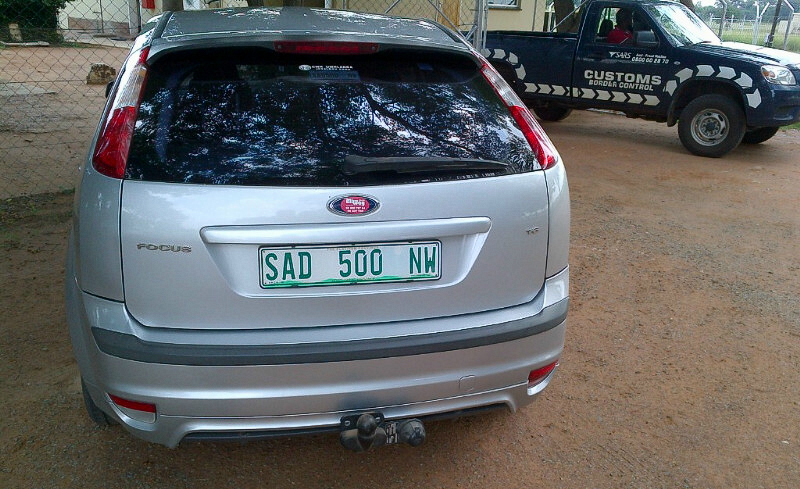
SAD story – Part 1

Die-hard SAD fan! (Tammy Joubert)We all suffer a little nostalgia at one or other point in our lives. Those die-hard legacy officials – the kind who have more than 20 years service – will most definitely have suffered, recoiled, and even repelled mass change which has occurred in the last 10-15 years in South Africa.  In the mid-2000’s the advent and replacement of the tried and tested DA500/600 series customs declaration forms by the Single Administrative Document – better known as the SAD – was unpopular to most customs officers although it was possibly welcomed by SACU cross-border traders.

A political coup had been won by some BLNS states compelling South Africa to harmonise its declaration requirements with those of fellow members, especially those operating ASYCUDA. At the time, SARS saw this compromise necessary to bring about alignment with Namibia and Botswana to facilitate the implementation of a new customs clearance dispensation for the Trans Kalahari Corridor (TKC).

The SAD is almost universally accepted by virtue of its design according to the UN Layout Key. However, why the fuss. A form is a form. Allied industry in RSA were used to the three decade old DA500/600 declaration forms which were designed infinitely better and more logical than the SAD.

None-the-less, South Africans are adaptable and accommodating to change. Following on from my recent post “SACU now a liability” it is now the SAD’s turn to stare death in the face. As it turns out, through wave upon wave of technological advances, we no longer need the SAD. At least in its paper form. In SARS case it no longer needs the SAD – period. A newer derivative (strangely not too dissimilar to the DA500/600) has now gained favour. It is known as the Customs Declaration 1 (Form CD1). However, unlike the DA and SAD forms, the CD1 will most likely never be required in printed format owing to SARS Customs preference for digitized information. Needless to say, if nothing else, the CD1 will provide a graphic representation of the EDI CUSDEC data for the customs officer. Next time, I’ll discuss the rationale behind ‘customs harmonisation’ and its non-dependency on document format. I feel for the die-hard SAD fan!

Zimbabwe Industry slams ASYCUDA

With much talk of intra-African trade, perhaps its a good time to consider increased collaboration between customs administrations regarding modernisation initiatives. It helps little for trade if the system only works on one side of the border. The case in point demonstrates a painful realization of too little mediation with stakeholders.

THE Zimbabwe Revenue Authority‘s introduction of the latest version of an automated customs clearance management system has brought industry to its knees as goods in transit are stuck at the country’s ports. The system challenges at Zimbabwe’s ports is particularly worrisome for importers as the majority are set to close shop today for the festive season. ASYCUDA is an acronym for Automated System for Customs Data, an automated customs clearance management system.

The Shipping and Forwarding Agents’ Association of Zimbabwe (Sfaaz) held a crisis meeting in Harare, where they intended to engage the Ministry of Finance and Zimra officials who had been invited. Ministry of Finance and Zimra officials were, however, conspicuous by their absence. Sfaaz chairman Mr Phanuel Gukwe said the system, whose implementation commenced in October, had significantly slowed down clearance procedures. “There is perennial breakdown of operations at most ports, which means no imports are coming out of Zimra, funds are locked in prepayment accounts and turnaround of bill of entries is taking up to two weeks instead of the normal three hours.

“Contrary to expectations when Zimra proposed the system, the situation at ports has worsened drastically,” he said. The situation at the country’s ports, which is now in its third month, might have implications on the revenue collection targets for the fourth quarter, especially in terms of excise duty, import duty and customs tax.

Questions sent to Zimra were unanswered by the time of publication yesterday. ASYCUDA 2.3 was the earliest version to be introduced in Zimbabwe in 1992 and was upgraded to versions 2.5 and 2.7. ASYCUDA++ later came on board in the form of version 1.15 and 1.18. Currently, Zimra is rolling out ASYCUDA World version 4.0.21 to over 14 stations.

Mr Gukwe said Zimra had ignored the association’s earlier proposal to stagger the implementation of the new system. “We had proposed to Zimra to follow the example of South Africa, which undertook to implement the system at limited ports at a time, but they rather chose to go wholesale. Zimra also ignored us when we pressed them for a fallback system to be put in place,” he said.

The Wednesday crisis meeting, that was emotionally charged, saw importers level a range of accusations against Zimra. Some said Zimra had only two examining officers at some border posts, which means the slow clearance was an issue not just of failure in connectivity but also manpower shortages. It was also observed that when clients of local importers called Zimra to find out about the system challenges, Zimra officials were telling them that problems with the system had since been rectified, a situation that was portraying the local importers in bad light.

“I do not think it is legal for Zimra officials to be discussing these matters with our clients, they should only communicate with those who put in the bill of entry,” said one Sfaaz member. Others accused Zimra for being nonchalant. “Zimra should be taking responsibility on this matter. They could have at least eased our plight by arranging for the reduction or waiving of storage fees. We are paying some serious money for storage for weeks on end, which is driving up our landing costs,” said an importer.

Observers warn that if the problem continues, it could have wider repercussions on the economy, which is still a net importer of most goods. Meanwhile, Sfaaz officials were yesterday engaged in a closed door meeting with top Zimra officials over the matter. Source: The Herald (Zimbabwe)

What Modernisation means for Customs – Part 3

It is important to consider that ‘modernisation’ is not just a facet or trait of the African continent. Through my experience and involvement in other modernisation programmes, it is quite clear that the pre and post 9/11 world of customs administrations has in fact laid most, if not all customs administrations on a platform or cause for much introspection and rebuilding.
The collapse of the Berlin Wall in the 1980’s brought about a significant change beyond the political domain in the so-called dismantling of the Communist Block. Many of the former ‘iron curtain’ countries had little or no internal structures to deal with the impending establishment and rebuilding of their individual economies – in a modern commercial world. From a customs point of view, few in fact had a ‘Customs’ department. The West European countries had a significant advantage over their eastern counterparts from a trade and technological point of view. The burgeoning European Union (EU) had little choice but to assist in their eastern neighbour’s development. Donor aid through international assistance packages saw the proliferation of ‘customs programmes’ – providing both ‘consultants’ and ‘consulting houses’ significant opportunity to rake in huge profits in developing or modernising a host country’s customs administration. At this time there was very little by way of choice in terms of automated systems. A country either accepted the UN’s ‘free’ ASYCUDA system, or if its government had favourable ties with the French, then the alternative was the SOFIX system. Microsoft and others were too busy developing operating systems and desktop software at the time. Besides, the well-to-do developed countries were all too busy pushing ASYCUDA on unsuspecting ‘developing’ countries, and little thought was ever given to customs software development on a commercial level. At that time UK and US Customs were so involved in securing assistance programmes under the ASYCUDA banner and were exceedingly opposed the French offering, which had proven very successful in the French-speaking territories. It was a well-known fact at the time that neither of the aforementioned administrations thought ASYCUDA a viable option for their own countries.
It is therefore easy to understand why UNCTAD can stake claim to over 80 installations worldwide, of its various ASYCUDA software versions. Many of these countries have benefitted little through the painful experiences of ‘freeware’ installation. The experience normally consisted in ‘European’ customs influences being forced on the target country with little option of ‘customisation’ to the state’s needs. Hordes of consultants would ‘construct’ a customs administration around the software product. Customs technique would take the form of crash courses on the ASYCUDA application and the HS Nomenclature. The donor aid ‘buddy system’ also ensured that Pre-Shipment Inspection (PSI) agencies (in many cases the same consulting houses) were awarded lucrative contracts to inspect all consignments being exported from the developing ‘third world’ state to ‘first world’ countries. The reason: these states had no experience on tariff classification and customs valuation. In reality, this was never going to form part of the donor aid. After all, why train a nation when so much money can be made from outsourcing the operation of key customs functions. Once again, is it not surprising that the poorer countries seek to rid themselves of domination by global outsiders. This practice continues even today, where many a contract for the implementation of non-intrusive inspectional (NII) equipment – X-Ray and Gamma Ray scanners – is awarded to the same PSI culprits who, in turn, hold a nation’s traders to ransom through onerous scanning fees. The host nation is dangled a carrot in not having to foot the bill for any NII infrastructure, while the concessionaire recoups all capital costs, and more, through the aforementioned screening fees – all in the name of supply chain security! Fortunately, African states are beginning to avoid these deals.
Over the last 10 years, new developments in ‘customs’ software has seen a numerous array of software houses developing customs, port community and supply chain computerised solutions. To avoid polarisation some of these vendors have been forward-thinking in modelling their solutions on standards as established by the World Customs Organisation (WCO). At the same time, so-called developing countries are also questioning more profoundly the credibility of companies and consultancies in the customs space. External supply chain operators and software vendors supporting the trade and industry are likewise concerned with the level of sophistication and ease of implementation of these products.
My experience over the last 15 years bears little support for the so-called management consultants who act as ‘change agents’. This is a space which the host nation must control at all costs; otherwise there will be nothing but disaster. My home country, South Africa, is one such place that has taken a key decision not to consider implementation of a software solution, supported by a 3rd party vendor. Likewise, the onerous and often dangerous involvement of too many management consultants is also being kept in check.
The developments unravelling in the SARS Customs modernisation programme will in my view provide a world-class case study for any nation aspiring to a modernisation of such magnitude. All the key criteria are in place to enable this success: government funding and buy-in, management support and sponsorship, and external stakeholder involvement.
Watch my blog for more customs modernisation developments, soon.