Counterfeit medical supplies and introduction of export controls on personal protective equipment
The WCO reminds the general public to exercise extreme caution when purchasing critical medical supplies from unknown sources, particularly online. The use of these goods may cost lives.
While the world is gripped by the fight against COVID-19, criminals have turned this into an opportunity for fraudulent activity. There have been an alarming number of reports quoting seizures of counterfeit critical medical supplies, such as face masks and hand sanitizers in particular.
Customs and law enforcement agencies in China, Germany, Indonesia, Uganda, Ukraine, United Kingdom, United States and Vietnam, to name but a few, have reported such seizures in the past three weeks.
Moreover, there was a significant increase in seizures of counterfeit and unauthorized face masks and hand sanitizers during Operation Pangea XIII, a collaborative enforcement effort by the WCO, Interpol, Europol, Customs administrations, Police forces and other law enforcement agencies. This Operation, held from 3 to 10 March 2020, resulted in the seizure of 37,258 counterfeit medical devices, of which 34,137 were surgical masks.
Online retailers have also announced a surge in sales of counterfeit goods. In particular, a US company reported the removal from its marketplace of a million products claiming to cure or prevent COVID-19. Tens of thousands of listings were removed because of price hiking, particularly for products in high demand such as masks. In one operation, US Customs and Border Protection seized counterfeit COVID-19 test kitswhich had arrived at Los Angeles International Airport (LAX) by mail from the United Kingdom. This seizure triggered a joint investigation by the City of London Police’s Intellectual Property Crimes Unit (PIPCO), the Medicines and Healthcare products Regulatory Agency (MHRA) and the United States Food and Drug Administration (FDA), resulting in one arrest and the seizure of 300 more kits and 20 litres of chemicals for the production of such kits.
Given the shortages and the activities of market speculators, another important trend is the introduction of export licences for certain categories of critical medical supplies, such as face masks, gloves and protective gear. In particular, on 11 March 2020 Vietnam adopted Decision 868/QD-BYT by the Ministry of Health, introducing export permits for medical masks. The European Union (EU) introduced a temporary export licensing scheme for personal protective equipment as of 14 March 2020 (see Commission implementing Regulation 2020/402). Other countries, such as Brazil, India, Russia, Serbia and Ukraine, have also followed suit.
The EU’s dual-use export control regime will also continue to be applied to more sophisticated items such as full face masks, protective gear, gloves and shoes, specifically designed for dealing with ‘biological agents’. The full list of such items can be found in Annex I to EU Regulation 428/2009, as amended.
The WCO urges its Member Customs administrations to remain vigilant in these difficult times.
Please consult the relevant section of the WCO’s website regarding COVID-19 information, including changes in legislation, new trends and patterns, and initiatives by partners and Member administrations.
The WCO stands ready to continue working with all its partners to disrupt the supply chains of counterfeit products that put the lives of millions of people at risk.
“During this time of crisis, the global Customs community is invited to continue advocating for and realize the facilitation of not just relief supplies but of all goods being traded in order to minimize the impact of the COVID-19 pandemic,” said Dr. Mikuriya. He further added that “We are witnessing an unprecedented situation, but I am confident that by acting together, in a spirit of solidarity, we can mitigate the effects of the COVID-19 pandemic on our societies and economies.”
The dedicated webpage will be updated regularly with further guidance material, Members’ best practices and a database of Customs administrations’ contact points, the latter accessible for Members only.
In his communication to Members on 17 March 2020, Dr. Mikuriya reiterated the appeal to facilitate the smooth movement of relief consignments, as well as relief personnel and their possessions, while applying appropriate risk management. Members were also invited to share challenges and best practices to prevent and/or fight the spread of the infection, as well as to nominate contact persons who can handle inquiries regarding the applicable procedures for the import, export and transit of relief consignments and equipment for humanitarian purposes via air, land and sea modes of transport.
In less than 48 hours, the Secretariat received an overwhelming number of replies from Customs administrations around the world.
The WCO will continue to proactively communicate with its Members and partners, not only on measures to facilitate the movement of relief consignments, but on action to safeguard supply chain continuity.
Recent good news reports indicating a decrease in rhino poaching have been marred by the sudden death of one of law enforcements top detectives.
Colleagues and friends of Lieutenant Colonel Leroy Bruwer are in shock after the leading rhino-poaching detective was gunned down in an apparent assassination.
Leroy (49), commander of the Hawks in Mbombela (formerly Nelspruit), was shot dead in his car on Tuesday morning while on his way to work.
The investigation is ongoing but according to a police statement, he was shot with a heavy-calibre weapon.
Pieter Smit, commander of the Mbombela police’s quick-response unit, says his heart broke when he arrived on the scene and saw his colleague and friend’s lifeless body.
“Hate, sadness and tears with mixed feelings,” Pieter, who was one of the first people to arrive on the scene, wrote on Facebook.
Leroy’s body had been unrecognisably mutilated by the AK-47 gunfire, Pieter continued his Facebook post. He says the only way he knew it was Leroy is because he called his friend’s number and saw the cellphone ringing in the car.
“It breaks the heart of a grown man. Leroy, you were an honest policeman and worthy officer. You didn’t deserve this.
“I salute you. Rest in peace, colleague and friend.”
Brigadier Hangwani Malaudzi, Hawks spokesman, says a specialised task team has been formed to investigate the murder. “We’re hoping for a breakthrough soon.”
He adds Leroy was a formidable detective and made many breakthroughs in the fight against rhino poaching.
“All the evidence points to Leroy having been the target. It looks like an assassination,” Malaudzi says.
Police are following up on all leads to find the suspects.
Source: Picture and article by Jacques Myburgh, News24, 19 March 2020
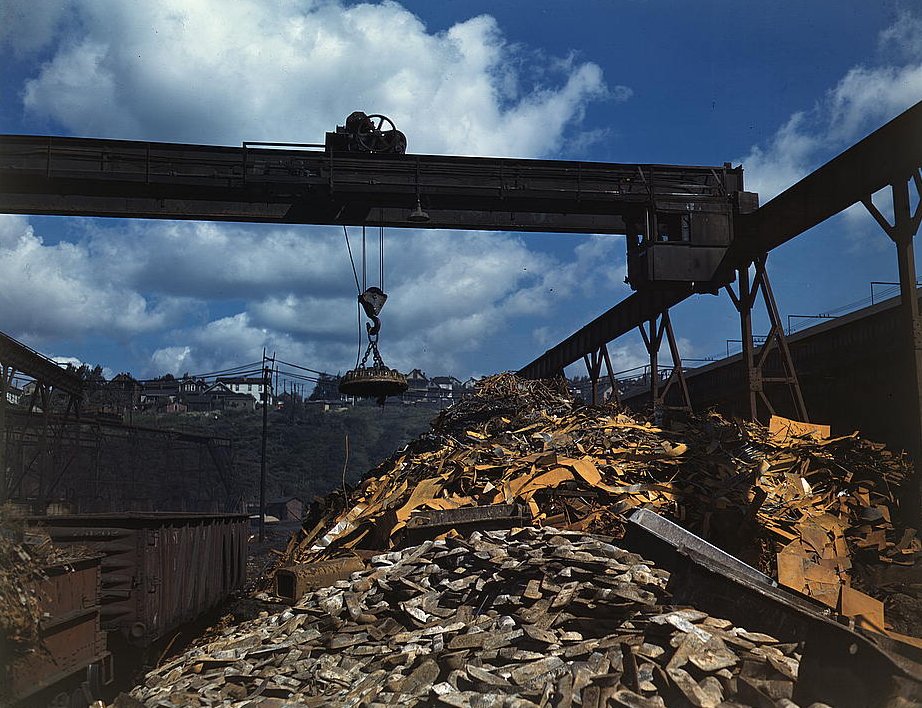
Following the announcement made by the Minister of Finance in the 2020 Budget Review regarding the introduction of export taxes on scrap metal, the National Treasury today publishes for consultation the basic approach for such tax. This proposal is related to the phasing out of the current price preference system for scrap steel, and follows the recommendations from a feasibility study conducted by the International Trade Administration Commission (ITAC).
Given the need to consult all stakeholders, including possible winners and losers, the consultation will take place in two phases. The first phase will be a shorter and broader public comment process on the objective, implementation, functioning and economic and financial impact of such an export tax, including the level of rates and base for such a tax. Comments on the impact to current firms and industries, and the implications for the tax and trade system will also be welcome, as well as comments on strengthening the administrative capacity of SARS to implement such export taxes.
The first phase will be followed by a more intensive second phase of public comment, on the proposed legislative provisions to give effect to specific export taxes on scrap metal, to be included in the 2020 draft Taxation Laws Amendment Bill (TLAB). The first phase will commence immediately and run up to the end of April 2020, while the second phase will commence with the publication of the Taxation Laws Amendment Bill in mid-July and run up to the end of August/September 2020.
As recommended by ITAC, the proposed export taxes to apply to scrap metal are as follows:
Scrap metal category Equivalent specific tax (Rand per tonne) Ferrous metals (including stainless steel) R1000.00 per tonne Aluminium R3000.00 per tonne Red Metals R8426.00 per tonne Other (waste and scrap metals) R1000.00 per tonne
Written comments on the proposal on export taxes on scrap metal must be submitted by no later than 9 April 2020.
Upon receipt of the comments and submissions on the proposal on export taxes on scrap metal, the National Treasury (working with the Department of Trade, Industry and Competition and other governmental stakeholders) will engage directly with stakeholders until the end of April through technical workshops to discuss the comments received. Thereafter, the proposed provisions on the export taxes on scrap metal will be developed for inclusion in the TLAB, which will be published in mid-July 2020 for public comment.
Further, as part of the TLAB consultation process, National Treasury will also engage with stakeholders through the usual workshops held after the receipt of written comments on the draft Bill. The Standing and Select Committees on Finance in Parliament are expected to make a similar call for public comment, and convene public hearings on the TLAB before the formal introduction of the Bill in Parliament. Thereafter, a response document on the comments received will be presented at the parliamentary committee hearings, after which the 2020 draft Taxation Laws Amendment Bill will then be revised, taking into account public comments and recommendations made during committee hearings, before the Bill is tabled formally in Parliament for consideration.
The proposal on export taxes on scrap metal is included in Chapter 4 of the 2020 Budget Review, which can be found on the National Treasury (www.treasury.gov.za) website.
The IBM development is unarguably one of the leading bodies driving global adoption, with the development of a blockchain platform built with flexibility and ability to run on any cloud. The blockchain platform allows upcoming projects to build, operate, govern and grow blockchain solutions across any computing environment through its blockchain technological advancement.
IBM successfully introduced its TradeLens platform in partnership with the Danish transport giant, Maersk in 2018. TradeLens has recorded huge success, partnering with major organizations and government agencies across the world due to its ability to deliver services such as cross border goods shipping at a faster rate.
Blockchain taking the Centre Stage
With blockchain gaining more followers and the adoption race picking up pace, many organizations, countries, agencies, and more seem to be jumping on the blockchain train before they get left behind with IBM blockchain technology in the forefront of delivering products that are needed by upcoming blockchain projects to strive. Recent news coming from Indonesia, revealed that after several months of working towards implementing a new partner on its platforms, the Indonesian Customs and Excise Department have announced that it would make use of IBM TradeLens technology.
Indonesia’s customs department is set to be the 11th government agency to be part of the TradeLens consortium after the realization of the benefit and advantage of making use of the TradeLens platform, other countries whose custom departments have partnered with TradeLens includes Thailand, Canada, Azerbaijan, among others.
The effects of customs agency deploying IBM TradeLens technology
The company’s stated goal is to facilitate faster trade and to eliminate altogether paper-based verification processes thereby paving the way for quicker trade and customs validation
By digitizing the supply chain industry using blockchain, the country stands to boost its production potential by around fifteen percent (15%), which is a substantial figure in an industry driven by extremely thin margins
The president/director of IBM Indonesia, Tan Wijaya is optimistic that the partnership with Indonesia’s custom departments will be beneficial to all stakeholders in the entire logistics ecosystem and it will encourage the overall modernization of trade.
The company’s stated goal is to facilitate faster trade and customs verification and eliminate paper-based processes which are in line with Indonesia’s custom and excise service.
TradeLens growth
As TradeLens continues to onboard new projects and partnership with other organizations, its platforms which allows supply chain data to be immutably tracked and broadcasted using a permissioned blockchain. The company’s highlighted objectives are to facilitate faster trade and customs verification and also to eliminate completely the strenuous paper-based procedures. Other constraints include the inability to provide a comprehensive risk assessment, complex promotion, inefficient and expensive stakeholder communication, and lack of transparency.
IBM initially launched TradeLens in partnership with Danish transport conglomerate Maersk during August, 2018. Earlier this month, Maersk estimated that approximately 10 million supply chain events are being tracked on TradeLens each week which points to how successful the platform is turning out to become.
Early February, The United States Federal Maritime Commission granted an antitrust exemption to five US-based members of the TradeLens consortium to be able to share data in regards to American supply chain events with the agreements between the five (5) parties coming into effect on 6th February,2020.
Regulators from Indonesia embrace Blockchain
It is worth noting that TradeLens Partnership with Indonesian custom authorities is not the first venture of the country’s positive nature towards the adoption of blockchain and its technologies.
The recent partnership announcements between TradeLens and Indonesia customs departments comes three weeks after Indonesia’s oldest cryptocurrency exchange, Indodax formerly known as bitcoin.co.id, received full license from the country’s Commodity Futures Trading Regulatory Agency (BAPPEBTI) to operate in the country.
This and other partnerships of blockchain projects in Indonesia shows that the country is primed and set to grow along with the new blockchain technologies.
ICC is partnering with government, business and other stakeholders to create digital solutions that will advance economic prosperity for all.
In line with ICC’s Declaration for the Next Century of Global Business, we are committed to maximising the benefits of the digital economy through establishing key partnerships to unify, simplify, and transform trade processes for all.
Here are seven ICC digital initiatives that will prepare business for the future of global trade:
1). TradeTrust facilitating ICC TradeFlow
During the World Economic Forum Annual Meeting in Davos, ICC joined the Singapore Government and major firms from key industries to launch TradeTrust, a public-private partnership that uses blockchain technology to digitalize global trade. The TradeTrust framework allows for interoperability across different trade platforms for the exchange of trade documents on a public blockchain.
ICC TradeFlow, a blockchain platform developed by ICC and Perlin to simplify the trade documentation process for all, was the first project built on the TradeTrust network. The platform, launched by ICC, DBS Bank, Trafigura, Infocomm Media Development Authority (IMDA), Enterprise Singapore, and Perlin, enables businesses to visually map out trade flows, issue instructions to partners, and analyse trade actions in real time.
2). Digital Trade Standards Initiative
The ICC Banking Commission has announced the creation of the Digital Trade Standards Initiative (DSI) to establish open technology standards that will promote interoperability among existing blockchain and technology platforms.
3). Digitalisation in Trade Finance Working Group
ICC’s Digitalisation in Trade Finance Working Group coordinates the ICC Banking Commission’s work related to the digitalisation of global trade, including the Internet of Things (IoT), artificial intelligence, and blockchain.
Formed in 2017, the Working Group evaluated all existing ICC rules for electronic compatibility, leading to the release of the eUCP version 2.0 and eURC version 1.0. In addition, the Working Group conducted a legal survey to understand the rights of third parties under e-Bills of Landing and developed a Digital Trade Roadmap, a communication tool for policymakers engaged in digital trade work.
4). Partnership with Perlin
In May 2019, ICC Secretary General John W.H. Denton AO announced the formation of a technology partnership between ICC and Perlin, a Singapore-based blockchain technology company. As part of this partnership, ICC and Perlin will work in close association to develop innovative blockchain products that will simplify and transform global trade for all.
AirCarbon, Perlin, and ICC at COP25
In recognition of the significant environmental impact of commercial air traffic, ICC, Perlin, and AirCarbon, formed a partnership on the side-lines of COP25 to facilitate carbon credit schemes to reduce worldwide aviation emissions. ICC will work with its global network to pursue adoption of the AirCarbon Exchange, the world’s first blockchain backed trading network for CORSIA compliant carbon credits. CORSIA, International Civil Aviation Organization’s Carbon Offset and Reduction Scheme for International Aviation, was signed in Montreal in 2016 by 191 countries.
Chambers Climate Coalition
The Chambers Climate Coalition is an initiative launched by ICC to mobilise chambers of commerce to take climate action, aligned with limiting global temperature rise to 1.5°C above pre-industrial levels and reaching net-zero emissions by no later than 2050. The Coalition, which was recognised as part of the landmark Climate Ambition Alliance at COP25, aims to reduce the greenhouse footprint from chamber service activities without delay.
Chambers of commerce can use Perlin’s blockchain technology to trace their value chains and implement a more sustainable model for their services to local businesses.
ICC Centre of Future Trade
ICC, Perlin, and Enterprise Singapore, established the ICC Centre for Future Trade in Singapore, an innovation hub for the creation and development of blockchain solutions for business. From the Centre for Future Trade, ICC and Perlin will work together to accelerate the commercial adoption of blockchain technologies for business.
International E-Registry of Ships (IERS)
In collaboration with Perlin and the Singapore Shipping Association, ICC has announced the creation of the International E-Registry of Ships, the world’s first blockchain-backed digital ship registration system. IERS will standardise the international shipping registration and renewal system through the use of digital technology.
Perlin Clarify
ICC’s partnership with Perlin enables ICC’s global membership network with access to Perlin Clarify, a blockchain solution that enables businesses to trace their value chains. Perlin Clarify allows businesses to track their compliance with government regulations, environmental standards, and other industry indicators.
The Incoterms® rules and smart contacts
ICC with support from Perlin is piloting customisable, self-executing digital sales agreements, that incorporate the latest edition of the Incoterms® rules into contracts. The creation of these blockchain-backed Incoterms® rules with smart contracts will help facilitate trade by reducing costs faced by importers and exporters worldwide.
The project was announced by Mr Denton, Dorjee Sun, CEO and co-founder of Perlin, and Satvinder Singh, Assistant CEO for Enterprise Singapore at an event in Singapore in August 2019.
5). Partnership with GIST Advisory
On the side-lines of the World Economic Forum Annual Meeting in Davos, Mr Denton joined Pavan Sukhdev, CEO of GIST and President of the World Wildlife Foundation, to launch two digital platforms that track the environmental impact of business operations for companies of all sizes. The platforms, I360X and SME360X, utilise analytics and global databases to measure the environmental impacts of market goods and services.
With the analytical information provided by these platforms, companies can transition their operations toward a more sustainable model for the future.
6). eATA Carnet
In November 2019, ICC successfully piloted the first ever digital ATA Carnet, a customs document allowing duty- and tax-free movement of goods for up to one year. The project, known as the Mercury II pilot, was initially launched by ICC in 2018 as part of the organisation’s commitment to using digital technology to simplify the trade documentation process.
Over the next six months, the project will enter a testing phase with six participating pilot countries, including Belgium, China, Russia, Switzerland, the United Kingdom and the United States. The European Union Directorate-General for Taxation and Customs Union actively supports the implementation of the eAta Carnet.
7). Digital platforms with the World Trade Organization (WTO)
Global Dialogue on Trade
In October 2018, Mr Denton and World Trade Organization Director-General Roberto Azevedo launched the Global Dialogue on Trade digital platform to gather input from policymakers, business leaders, and academia on the future of global trade.
The first series of debates, which concluded in March 2019, resulted in a set of concrete policy recommendations to provide guidance to stakeholders for strengthening multilateral trade.
Trade Dialogues
At the request of the WTO and B20, ICC is responsible for hosting Trade Dialogues, a digital platform connecting stakeholders from around the world to spark discussions among WTO members on critical business issues.
ICC has launched the Digital Trade Standards Initiative (DSI) – a collaborative cross-industry effort to enable the standardisation of digital trade.
The ICC Digital Trade Standards Initiative (DSI) will build on work done by various likeminded initiatives, many of which aim to digitise trade, notably through the development of open trade and technology standards to promote interoperability.
The ICC DSI will promote greater economic inclusion through the development of open trade standards. This will facilitate technical interoperability among the variety of blockchain-based networks and technology platforms that have entered the trade space over the past two years.
“Universal standards will connect existing digital islands and enable market forces to improve customer experience,” said ICC Secretary General John W.H. Denton AO. “As a leading and neutral voice in the industry, it made sense to bring this project under the umbrella of ICC. This will allow the ICC DSI to lead and coordinate efforts in developing standards and protocols to digitise trade.”
The ICC DSI is unique among trade digitisation initiatives due to its collective nature. Too often, digitisation is enacted through bilateral agreements between institutions that require members to run on the same platform. This has resulted in siloed data and bespoke trade and trade finance processes.
“The ICC DSI seeks to coordinate all parties in the standardisation of data formats and processes, rather than duplicate existing efforts. In turn, membership will be open to all organisations across industries and geographies supporting the project’s core mandate, including existing industry associations and initiatives,” explained Steven Beck, Head of Trade Finance at the Asian Development Bank.
The ICC DSI will be supported by seed-funding committed by the Asian Development Bank and the Government of Singapore, in addition to ICC’s support. The ICC DSI will be run as an independent entity out of the recently-established ICC Centre for Future Trade.
“We have seen the tremendous impact of technology in growing businesses and facilitating international trade,” said Gina Lim, Director of Financing Ecosystem Development at Enterprise Singapore. “The ICC DSI will promote greater adoption of technology within the trade ecosystem and facilitate greater inclusiveness for small businesses. We are excited for the establishment of the ICC DSI office in Singapore and look forward to working with our global partners across geographies and sectors.”
ICC anticipates the implementation of a full-time management team, and a global and diverse steering committee to provide guidance and set priorities for the project’s development.
ICC has opened the recruitment process to hire a managing director to lead operations within the ICC DSI, with an official launch event to follow once this first process completed.
The following article was published by Bloomberg and sketches the day-to-day hardship for cross border trucking through Africa. In a sense it asks the very questions and challenges which the average African asks in regard to the highly anticipated free trade area. While rules of origin and tariffs form the basis of trade across borders, together with freedom of movement of people, these will mean nothing if African people receive no benefit. As globalisation appears to falter across Europe and the West, it begs the question whether this is in fact is the solution for Africa; particularly for the reason that many believe globalisation itself is an extension of capitalism which some of the African states are at loggerheads with. Moreover, how many of these countries can forego the much need Customs revenue to sustain their economies, let alone losing political autonomy – only time will tell.
Nyoni Nsukuzimbi drives his 40-ton Freightliner for just over half a day from Johannesburg to the Beitbridge border post with Zimbabwe. At the frontier town—little more than a gas station and a KFC—he sits in a line for two to three days, in temperatures reaching 104F, waiting for his documents to be processed.
That’s only the start of a journey Nsukuzimbi makes maybe twice a month. Driving 550 miles farther north gets him to the Chirundu border post on the Zambian frontier. There, starting at a bridge across the Zambezi River, trucks snake back miles into the bush. “There’s no water, there’s no toilets, there are lions,” says the 40-year-old Zimbabwean. He leans out of the Freightliner’s cab over the hot asphalt, wearing a white T-shirt and a weary expression. “It’s terrible.”
By the time he gets his load of tiny plastic beads—the kind used in many manufacturing processes—to a factory on the outskirts of Zambia’s capital, Lusaka, he’s been on the road for as many as 10 days to traverse just 1,000 miles. Nsukuzimbi’s trials are typical of truck drivers across Africa, where border bureaucracy, corrupt officials seeking bribes, and a myriad of regulations that vary from country to country have stymied attempts to boost intra-African trade.
The continent’s leaders say they’re acting to change all that. Fifty-three of its 54 nations have signed up to join only Eritrea, which rivals North Korea in its isolation from the outside world, hasn’t. The African Union-led agreement is designed to establish the world’s biggest free-trade zone by area, encompassing a combined economy of $2.5 trillion and a market of 1.2 billion people. Agreed in May 2019, the pact is meant to take effect in July and be fully operational by 2030. “The AfCFTA,” South African President Cyril Ramaphosa said in his Oct. 7 weekly letter to the nation, “will be a game-changer, both for South Africa and the rest of the continent.”
It has to be if African economies are ever going to achieve their potential. Africa lags behind other regions in terms of internal trade, with intracontinental commerce accounting for only 15% of total trade, compared with 58% in Asia and more than 70% in Europe. As a result, supermarket shelves in cities such as Luanda, Angola, and Abidjan, Ivory Coast, are lined with goods imported from the countries that once colonized them, Portugal and France.
By lowering or eliminating cross-border tariffs on 90% of African-produced goods, the new regulations are supposed to facilitate the movement of capital and people and create a liberalized market for services. “We haven’t seen as much institutional will for a large African Union project before,” says Kobi Annan, an analyst at Songhai Advisory in Ghana. “The time frame is a little ambitious, but we will get there.”
President Nana Akufo-Addo of Ghana and other heads of state joined Ramaphosa in hailing the agreement, but a number of the businesspeople who are supposed to benefit from it are skeptical. “Many of these governments depend on that duty income. I don’t see how that’s ever going to disappear,” says Tertius Carstens, the chief executive officer of Pioneer Foods Group Ltd., a South African maker of fruit juices and cereal that’s being acquired by PepsiCo Inc. for about $1.7 billion. “Politically it sounds good; practically it’s going to be a nightmare to implement, and I expect resistance.”
Under the rules, small countries such as Malawi, whose central government gets 7.7% of its revenue from taxes on international trade and transactions, will forgo much-needed income, at least initially. By contrast, relatively industrialized nations like Egypt, Kenya, and South Africa will benefit from the outset. “AfCFTA will require huge trade-offs from political leaders,” says Ronak Gopaldas, a London-based director at Signal Risk, which advises companies in Africa. “They will need to think beyond short-term election cycles and sovereignty in policymaking.”
Taking those disparities into account, the AfCFTA may allow poorer countries such as Ethiopia 15 years to comply with the trade regime, whereas South Africa and other more developed nations must do so within five. To further soften the effects on weaker economies, Africa could follow the lead of the European Union, says Axel Pougin de La Maissoneuve, deputy head of the trade and private sector unit in the European Commission’s Directorate General for Development and International Cooperation. The EU adopted a redistribution model to offset potential losses by Greece, Portugal, and other countries.
There may be structural impediments to the AfCFTA’s ambitions. Iron ore, oil, and other raw materials headed for markets such as China make up about half of the continent’s exports. “African countries don’t produce the goods that are demanded by consumers and businesses in other African countries,” says Trudi Hartzenberg, executive director of the Tralac Trade Law Center in Stellenbosch, South Africa.
Trust and tension over illicit activity are also obstacles. Beginning in August, Nigeria shut its land borders to halt a surge in the smuggling of rice and other foodstuffs. In September, South Africa drew continentwide opprobrium after a recurrence of the anti-immigrant riots that have periodically rocked the nation. This could hinder the AfCFTA’s provisions for the free movement of people.
Considering all of these roadblocks, a skeptic would be forgiven for giving the AfCFTA little chance of success. And yet there are already at least eight trade communities up and running on the continent. While these are mostly regional groupings, some countries belong to more than one bloc, creating overlap. The AfCFTA won’t immediately replace these regional blocs; rather, it’s designed to harmonize standards and rules, easing trade between them, and to eventually consolidate the smaller associations under the continentwide agreement.
The benefits of the comprehensive agreement are plain to see. It could, for example, limit the sort of unilateral stumbling blocks Pioneer Foods’ Carstens had to deal with in 2019: Zimbabwe insisted that all duties be paid in U.S. dollars; Ghana and Kenya demanded that shippers purchase special stickers from government officials to affix to all packaging to prevent smuggling.
The African Export-Import Bank estimates intra-African trade could increase by 52% during the first year after the pact is implemented and more than double during the first decade. The AfCFTA represents a “new pan-Africanism” and is “a pragmatic realization” that African countries need to unite to achieve better deals with trading partners, says Carlos Lopes, the former executive secretary of the United Nations Economic Commission for Africa and one of the architects of the agreement.
From his closer-to-the-ground vantage point, Olisaemeka Anieze also sees possible benefits. He’s relocating from South Africa, where he sold secondhand clothes, to his home country of Nigeria, where he wants to farm fish and possibly export them to neighboring countries. “God willing,” he says, “if the free-trade agreement comes through, Africa can hold its own.”
In the meantime, there are those roads. About 80% of African trade travels over them, according to Tralac. The World Bank estimates the poor state of highways and other infrastructure cuts productivity by as much as 40%.
If the AfCFTA can trim the red tape, at least driving the roads will be more bearable, says David Myende, 38, a South African trucker resting after crossing the border post into South Africa on the way back from delivering a load to the Zambian mining town of Ndola. “The trip is short, the borders are long,” he says. “They’re really long when you’re laden, and customs officers can keep you waiting up to four or five days to clear your goods.”
Source: article by Anthony Sguazzin, Prinesha Naidoo and Brian Latham, Bloomberg, 30 January 2020
This edition’s “Dossier” focuses on how Customs can foster sustainability for people, prosperity and the planet, the WCO’s theme for 2020, and includes a selection of articles on the implementation of Multilateral Environmental Agreements, the role of the Harmonized System, the trade in illegal timber, and tools for logistics planning and supply chain optimization.
The “Panorama” section covers various topics such as internal communication, cultural goods, partnership with express couriers to fight illicit trade, management of e-commerce transactions via blockchains, and measurement of the time required to process imports in order to boost logistic service providers’ efficiency.
You can also read an insightful “Point of View” article on how machine learning can automate the determination of the valuation of goods, as well as an “Events” article containing highlights from the WCO Communication Strategies Conference held in October 2019.




 What Happened to the Portcullis?
You must be logged in to post a comment.