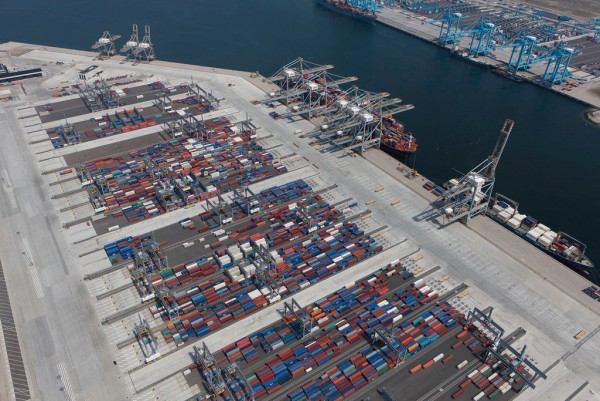
 Rotterdam World Gateway says it is the first deep sea container terminal with minimal customs presence in the European Union. Ronald Lugthart, Managing Director of Rotterdam World Gateway,has received the definitive customs permit and AEO certificate for RWG, handed over by Anneke van den Breemer, Regional Director of customs at the port of Rotterdam.
Lugthart said: “Due to the high degree of automation at RWG, the introduction of a 100% pre-announcement procedure for containers and cargo via Portbase and the implementation of simplified customs procedures, over 95% of the administrative process is now completely digitised.
“This means that the administrative process can operate independently of the logistic process at the terminal, enabling fast and reliable handling.”Anneke van den Breemer commented: “As Dutch customs, our goal is to minimise any disruption to the logistic process caused by the required customs formalities. RWG and customs have recently been collaborating intensively.
“At the RWG terminal, optimal use is now being made of the simplified customs procedures. This is in the best interest of all parties: not just of the terminal and customs, but of freight forwarders and hauliers as well.”
By applying these simplified customs procedures, RWG is able to implement a fully automated gate process for road hauliers. This has great benefits for hauliers because no physical customs handling has to take place at the RWG terminal and thus no stop has to be made.
RWG adds that it is the first terminal in the port of Rotterdam to act as an Authorised Consignee, which means the customs transit will be automatically ended upon arrival at the terminal. This gives parties involved extra assurance that this transit has been cleared properly.
In addition to simplified customs procedures, constructive cooperation between customs and RWG has resulted in the establishment of a new scanning facility that is fully integrated into the terminal’s automated logistic process and operates 24/7.
Furthermore, nuclear radiation detection takes place for all truck and rail handling, and a high percentage of the containers arriving and departing by barge will be inspected as well. Source: WorldCargoNews
 The implementation of the Government’s new pre-shipment regulations under the Consignment Based Conformity Assessment (CBCA) programme (essentially a fancy term for plain old pre-shipment inspection – who they trying to fool?) took off with host of challenges last Tuesday. The new regulations that were gazetted into law on 18 December last year and requires that goods be tested for conformity with required standards prior importation into Zimbabwe, went into operation on 1 March.
 The World Customs Organization (WCO) has made the “Technical Guidelines on Advance Rulings for Classification, Origin and Valuation” publicly available. These guidelines were developed in order to support the implementation of Article 3 (Advance rulings) of the Bali Ministerial Decision on the Agreement on Trade Facilitation (TFA) and shared only among the WCO Members.
 What Happened to the Portcullis?
You must be logged in to post a comment.