International Customs Day – 2015

For more information about Co-ordinated Border Management visit the WCO website.

WSC raises concern over New EU shipper rules – ‘could reveal confidential data’

Buyer-sellerCurrent plans to identify ‘buyer’ and ‘seller’ before vessel loading could lead to disclosure of sensitive business information, claim carrier, forwarder and cargo-owner representatives, according to the World Shipping Council (WSC).

Latest European Commission amendments to the EU advance cargo data reporting requirements scheduled for adoption later this year need further clarification. The WSC along with shipper and forwarder representatives is opposing the Commission’s proposals in their current form.

The Commission is now in the final stages of completing its proposals for advance cargo data reporting requirements as part of the implementation of the new Union Customs Code which is scheduled to be adopted in May and could then take effect as early as May 1, 2016. But the WSC claims that the Commission’s efforts to find a short-cut way of obtaining the identity of the ‘buyer’ and ‘seller’ of the imported goods before vessel loading could lead to the disclosure of sensitive business information.

Instead of getting it from the importer, like the US does, the Commission has proposed regulation that would require this information be provided to the carrier or NVOCC, or in the alternative, to the ‘consignee’, to be filed in an ENS (entry summary declaration) as a condition of vessel loading.

Based on their understanding and experience with shippers, the WSC has advised the Commission that ‘buyer’ and ‘seller’ data may be business-confidential information, and that it is not appropriate to require its disclosure to ocean carriers/NVOCCs or to these parties’ consignees, who may not be parties to the goods’ sales contract.

The WSC also noted that carriers’ current documentation systems had no data fields to capture this information. The Council has been joined by the European Shippers’ Council, the European freight forwarders’ association (CLECAT) and the European Community Shipowners Association (ECSA) in opposing the Commission’s proposals.

If the regulation is implemented as proposed, exporters to the EU should recognize that they will be required to provide the identity of the buyers of their goods to their carrier or NVOCC or to their consignees prior to vessel loading, so that this information could be provided by the carrier or NVOCC in its required advance ENS filing. Source: LloydsLoading

For more detailed information in this regard refer to the World Shipping Council’s website – Advance Cargo Shipment Data

Port of Shanghai – extends its lead as world’s busiest container port

Port of Shanghai, China [Picture: DaliyMail.co.uk]

Port of Shanghai, China [Picture: DaliyMail.co.uk]

Shanghai retained its title as the world’s busiest container port for a fifth consecutive year after widening the gap with its closest rival Singapore.

Singapore handled 33.9 million 20-foot containers last year, according to a statement posted on the Maritime & Port Authority of Singapore’s website dated Jan. 16. Last month, Shanghai said it expects to process about 35.2 million boxes in 2014. A year before, the gap between the two ports was about 1 million boxes.

Shanghai, Shenzhen and other ports in China are dominating the global container-shipping market while the facility in Ningbo overtook South Korea’s Busan last year as the world’s fifth-busiest harbor. Seven of the world’s 10 top container ports were in China in 2013, with Hong Kong coming in fourth.

Shipping companies are adding larger container ships to meet demand as economic growth helped consumers to spend more money on clothes and food. Global trade last year probably grew 3.8 percent, according to the International Monetary Fund.

Global containerized trade reached 124 million boxes in the first 11 months of 2014, an increase of 4.3 percent from 118.9 million a year ago, according to Container Trade Statistics Ltd.

Geneva-based Mediterranean Shipping Co., the world’s second-largest container shipping company, currently operates the biggest vessel that can carry 19,224 boxes between Asia and Europe. Last year, China Shipping Container Lines Co. launched a ship that could carry about 19,100 containers. Source: Bloomberg/GCaptain

Vietnam Tightens Container-Weighing Rules

High quality 3D render shipping container during transportIn a bid to tackle overweight containers at its ports, Vietnam is seeking to address this issue with domestic legislation on container weighing practices. This is in contrast to the International Maritime Organisation, which had agreed on an amended rule that would see shipping containers being weighed before they are loaded onto ships – a rule which will come into effect in 2016.

Weighbridges have since been installed at Vietnamese ports, container yards and even highways to monitor weights of containers for both importing and exporting. A new law was endorsed in 2014 by the Vietnamese government that limited the total weight of 20 and 40ft containers to a maximum of 20 tonnes, including the weight of the container itself.

Containers found to violate the weight limits are likely to incur a fine. Source: Port Technology International

Kenya Single Window Agency accuses KRA of Sabotage

KentradeThe Kenya Trade Network Agency, operator of the National Electronic Single Window System, has refuted claims by some clearing agents that the platform is lapsing. KenTrade has instead blamed slow integration of its system on the continued parallel use of the Kenya Revenue Authority’s systems – the Orbus and Simba. Currently, importers are using both systems to process documents such as import permits.

Project director Amos Wangora said there is need to retire Orbus system for agents to embrace the Single Window System, particularly in filing Import Declaration Forms. Kentrade accused KRA officials of avoiding the Single Window System.

“We don’t have any problem in the use of the Single Window System. It’s only people who don’t want to embrace the new system. Those using it are doing good only for some KRA officials who still want to use the Orbus system,” said Wangora in an interview on Friday.

KenTrade is the state agency tasked with facilitating cross-border trade through the Single Window System.

Wangora said only three modules remain for the Single Window System to be completed fully – include on declaration submission, bonds and exemption. Testing of the declaration submission module is on and is expected to be completed by 20 January 2015.

A section of clearing agents had raised concerns over delays in cargo clearance at the port of Mombasa under the Single Window System. Yesterday, the Kenya International Freight and Warehousing Association, Mombasa chapter, said KRA officials prefer their own system, which “lacks transparency”.

A clearing agent told the Star that one has to personally push for services, which involves handouts, under the KRA system. Kentrade has since written to KRA commissioner-general to halt the Orbus system on January 31.

The Single Window System integrates about 24 government agencies’ functions, offering a one-stop shop for processing import and export permit documents.  More than 6,000 imports and exports permits were issued under the new system last year, including permits from Kenya Bureau of Standards and Ministry of Health’s veterinary and pharmaceutical departments.

About 1,200 clearing agents, shipping agents, consolidators and partner government agencies will be trained on the remaining modules. Kentrade targets to have the system fully embraced by all stakeholders by July, with the country set to go paperless by 2015. Source: The Star (Kenya)

21st Century Silk Railway – Chinese freight train makes world record trip

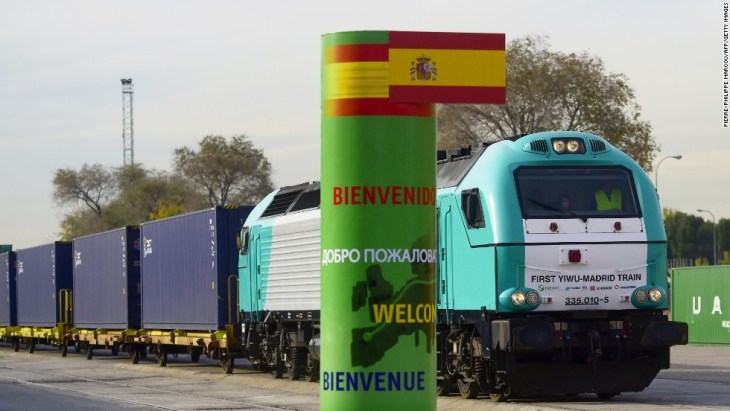
141212174829-yixinou-worlds-longest-train-journey-horizontal-large-galleryThe longest rail link in the world and the first direct link between China and Spain is up and running after a train from Yiwu in coastal China completed its maiden journey of 8,111 miles to Madrid. En route it passed through Kazakhstan, Russia, Belarus, Poland, Germany and France before arriving at the Abroñigal freight terminal in Madrid.
The railway has been dubbed the “21st-century Silk Road” by Li Qiang, the governor of Zhejiang province, where Yiwu is located. Its route is longer than the Trans-Siberian railway and the Orient Express. The first train was met by the mayor of Madrid, Ana Botella, and Spain’s minister of public works, Ana Pastor. It consisted of 30 containers carrying 1,400 tonnes of cargo – mostly toys, stationery and other items for sale over Christmas across Europe.

Yiwu is the world’s largest wholesale hub for small consumer goods and plays host to a vast 4 sq km (1.5 sq mile) market where tens of thousands of traders work daily. The journey was a test run to assess the viability of adding Spain to a route that already links China with Germany five times a week. Those trains link Chongqing, the huge industrial city in south-west China, with Duisburg, and Beijing with Hamburg.

China is Spain’s biggest trading partner after the EU, with bilateral trade worth around £16bn. It is also Spain’s third largest source of imports, after Germany and France. About half of these imports are made up of mobile phones and clothing. The Spanish prime minister, Mariano Rajoy, was in China in September, where he signed deals reported to be worth more than £6.3bn.

A major advantage of the rail route is speed. The train took just three weeks to complete a journey that takes up to six weeks by sea. It is also more environmentally friendly than road transport, which would produce 114 tonnes of CO2 to shift the same volume of goods, compared with the 44 tonnes produced by the train – a 62% reduction.

However, the cargo had to be transferred three times during the journey as a result of incompatible rail gauges. The locomotive also had to be changed every 500 miles. The service is being operated by InterRail Services and DB Schenker Rail and in Spain by DB’s Spanish offshoot, Tranfesa.

China’s Second Continent – the new colonisation of Africa

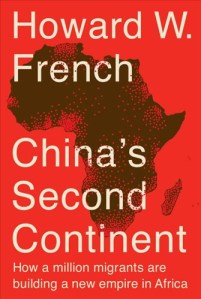
chinas-second-continent-howard-frenchFormer US Diplomat Brooks Spector takes a look at this important book (Daily Maverick) that should be on every economic policy maker’s reading list. Howard French’s China’s Second Continent, offers a very different – and provocative – perspective on China’s economic future, with special attention on Africa. Building on years of experience in both China and Africa, and following months of personal inquiry across the continent to search for answers to the questions of what China really wants in Africa, and how it is going to get there, French has effectively turned these questions on their head.

Instead of writing about China’s international economic policies in the language of the think tanks, of Wall Street and The City, or government councils in Whitehall or Washington, French has focused instead on what a million individual Chinese have done – or are now doing – throughout Africa, almost without regard to what the Chinese government may have planned or been thinking. In tackling the topic through this optic, French has given this vast Chinese movement into and across Africa crucial human dimensions. For the full review please visit this hyperlink. China’s Second Continent is available in hardcopy and electronic publication from online book stores. Source: Daily Maverick

Chinese Customs Inspectors – Snow Storm is Business as Usual

Officers of Weihai Customs House (affiliated to Qingdao Customs District) remained at their posts and inspected the goods as heavy snow hits the Shandong Province in December 2014. During the two days of heavy snow, officers of Weihai Customs House had worked over time and to exercise control over ‘stopped’ consignments. Source: General Administration of Customs of the People’s Republic of China

Port of Felixstowe hosts Worlds Biggest Container Ship

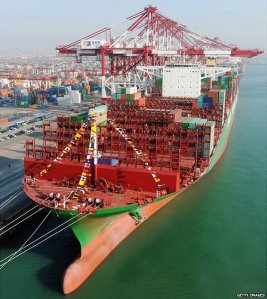
CSCL GlobeThe world’s largest container ship has arrived in the UK for the first time at the Port of Felixstowe. The Hong Kong-registered CSCL Globe, measuring more than 400m (1,313ft) in length is longer than four football fields placed end-to-end.

The record-breaking aspect of the Globe, owned by Shanghai-based China Shipping Container Lines and built-in South Korea, is its capacity. It can carry 19,100 standard 20ft containers. That’s estimated to be enough space for 156 million pairs of shoes, 300 million tablet computers or 900 million standard tins of baked beans.

Laid end-to-end, the maximum number of containers on board would stretch for 72 miles, the distance between Felixstowe and London, or Birmingham and Manchester.

The Globe’s period as the world’s biggest cargo ship is due to end later this month, however. The Oscar, owned by the Mediterranean Shipping Company and built by Daewoo in South Korea, is scheduled for its official launch on Thursday. Named after company president Diego Aponte’s son Oscar, it will be able to carry 19,224 20ft containers. Source: BBC News