
Belissima!

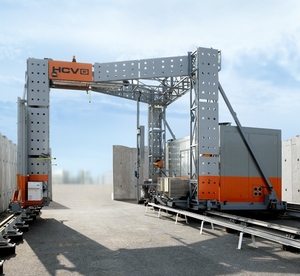
HCVG Inspection System - Smiths Detection

HCVG Inspection System – Smiths Detection

Smiths Detection has announced a €19m contract with the Italian Customs Agency to supply high-energy X-ray cargo scanners for deployment at six major ports including Naples, Genoa and Bari. According to Smith’s – “We have worked closely with Italian customs for many years, not only supplying detection systems but also providing the highest standard of after-market service. This latest contract underlines the continuing success of our customer-driven approach.”

The HCVG inspection systems, which can detect contraband, narcotics and weapons, will also be used for confirming cargo details to ensure customs and excise duty and trade taxes are in order. Click here for more technical details of the HCVG inspection system 

Able to inspect up to 20 containers, trucks or vans an hour, the gantry-mounted scanners can penetrate steel 330mm thick. A detailed X-ray image, which features organic and inorganic material discrimination using viZual imaging software, is produced by a single scan of the load.

Smiths Detection offers advanced security solutions in civil and military markets worldwide, developing and manufacturing government-regulated technology products that help detect and identify explosives, chemical and biological agents, radiological and nuclear threats, weapons, narcotics and contraband. It is part of Smiths Group, a global leader in applying integrated, advanced technologies to markets in threat and contraband detection, energy, medical devices, communications and engineered components. Smiths Group employs around 23,000 people in more than 50 countries. Source: Business Wire

SARS – Modernisation milestone materialising

Interfront logo2

Its been some time since I’ve penned an article on the South African Customs Modernisation Programme. Aside from it being the SA Revenue Service’s prerogative to communicate and publish notice of its internal developments and plans, some caution always needs to be exercised observing bureaucratic protocol, ensuring that the official message is forthcoming from SARS. Given the widespread interest in the programme as well as the development of the Interfront [formerly Tatis] integrated customs border management solution (iCBMs) as a wholly owned development of South Africa, I think it not out of place to inform the public interest on this matter. Readership of this blog has an extensive global following and a specific interest in Interfront developments.

Unlike ASYCUDA, Sofix, e-Biscus, and a host of other integrated Customs-tailored business solution offerings, Interfront’s solution for SARS will not include a client user frontend. In other words, the Interfront system (iCBMs) will essentially drive declaration backend processing. This comprises a fully integrated declaration validation and processing engine, supported by a sophisticated tariff engine and duty calculator; the latter offering future web-based services for customs users. In order to compliment the SARS corporate and standardised user interface approach, the iCBMs interfaces with SARS’s revenue accounting, trader registration, risk management, and case management workflow systems. Not only does this leverage cost savings and efficiencies, but ensures a unified ‘workspace’ for all of SARS employees.

Much of the Interfront technology is therefore hidden to the customs user, with traders experiencing an identical interface with SARS Customs, as it does today. From the outset of the Customs Modernisation Programme (July 2010), the approach has followed pragmatic migration of customs electronic clearance processing – across its 30 odd legacy systems – towards an integrated clearance process that could mimic the functionality featured on the new iCBMs. The modern technology and scalability of Interfront offers the ability and agility to enhance service levels and efficiencies to another level. At the same time, operational policies and procedures have been modernised with the aim and intent of meeting the requirements contained in Customs new Control and Duty Bills.

Much of the ‘change’ experienced by both customs officers and the trade over the last 2 years has prepared the country for the eventual migration to the new system. These have been significant, and at times painful changes, not without anxiety and apprehension. Over the last 6 months an even more painstaking and taxing effort has been expended by the Customs Modernisation Team, Interfront and other service providers in addressing a seamless harmonisation and switchover of customs business from disparate legacy systems to a new customs technology platform. The “Parallel Run” has witnessed the daily comparison of customs clearance data between the old and new systems, identification and logging of disparities (bugs), modification of the two environments to ensure the same result is achieved. This has not been an easy and simple process, as any country having undergone a system switchover can attest to.

This month, February 2013, service providers to the customs industry are readying their resources to commence user testing. This implies that service providers (computer bureaus) will engage their clients to prepare test cases for submission to customs to test the new Interfront process. Given that Customs legacy systems and Interfront have been synchronised to a high level of compatibility, the process for traders should not reveal much difference to what they have experienced over the period of modernisation over the last 2 years. One area of note will be the structure and content of Customs Response messages. Traders will have to familiarise themselves and test their interpretation of these messages to ensure they perform or respond appropriately to the instructions.

Satya Prasad Sahu - Technical Officer at the WCO provided members of SACU, SADC and the EAC comprehensive guidelines for the development of the GNC Utility Block concept in Africa (February 2012)

Satya Prasad Sahu – Senior Technical Officer at the WCO provided members of SACU, SADC and the EAC comprehensive guidelines for the development of the GNC Utility Block concept in Africa (February 2012)

In terms of compliance and compatibility with international developments, the new iCBMs is engineered on the WCO Data Model. All relevant simplification processes as exemplified in the Revise Kyoto Convention are likewise factored into its design, although not all of these will be immediately available with the initial rollout. Introduction of the new Customs Control and Duty Acts will require these principles to be fully functional and operational, however.

The WCO Data Model is the pivotal design component around which most of the new system’s business and validation rules are centred. This in itself is a major achievement as it bodes well for all future ‘cross border’, customs-2-customs connectivity initiatives. In this regard SARS is well advanced in bilateral and multilateral projects with key trading partners, for example IBSA (cross-global trilateral initiative), and in Africa, we are working with SACU, SADC, COMESA and the EAC to bring about regional customs connectivity. On a bilateral basis, initiatives with Swaziland, Mozambique and Zimbabwe are developing nicely. A significant contributor to cross border/cross global customs connectivity is undoubtedly the excellent work brought about by the dedicated members of the WCO’s Globally Networked Customs adhoc workgroup. In June last year, the WCOs policy Commission unanimously endorsed the GNC architecture and Utility Block approach. African customs connectivity efforts have likewise adopted this model which ensures harmonisation and uniformity in approach, legal dispensation, data exchange, risk management and procedure. The WCO moreover plays a overseeing role in many of these GNC and capacity building initiatives across the globe – this assists greatly in sharing and learning of experiences.

I would think that the above should be sufficient to wet the appetites of customs practitioners, traders, ICT technocrats, and perhaps even legislators and bureaucrats on developments in South Africa. Subsequent to the launch of Interfront SARS will make its ideas and strategy relating to forthcoming initiatives known to trade and the business community. A Year of Innovation? Yes, and hopefully a happy tale that will bode well for the South African trade and supply chain logistics community, and some good fortune for Interfront in its business development in the region and beyond!

How the Groenewald Gang made millions off illicit wildlife trafficking

rhino-1Dawie Groenewald of South Africa and 11 conspirators were arrested in September of 2010 on 1,872 counts of racketeering, including illegal trade of rhino horns. Among those arrested are two veterinarians, Karel Toet and Manie Du Plessis, as well as several professional hunters. This case is one of the biggest wildlife cases seen in South Africa and has been postponed several times since 2010. It is currently scheduled for early May 2013.

Groenewald owns a big game farm in Polokwane, South Africa as well as Out Of Africa Adventurous Safaris. A burial site of over a dozen horn-less rhinos was found on his property in 2010. Investigators show that these rhinos are thought to have been purchased from the South African National Parks in 2007-2010. In order to increase his profit margin, Groenewald decided to slaughter the rhinos after removing their horns; thus eliminating any upkeep costs associated with live rhinos.

Rhino horns are worth up to $60,000 per kilo in parts of East Asia, namely China and Vietnam. They are thought to possess medicinal value, including curing cancer and small ailments such as fevers and headaches.  Rhino poaching in South Africa has been rising steadily over the past several years. According to South Africa’s Department of Environmental Affairs, approximately 588 rhinos were poached in 2012. One could point to China and Vietnam’s increased affluence as having increased this demand.

Investigators have so far seized $6.8 million in assets from Groenewald, Toet, and Du Plessis. They also uncovered Valinor Trading CC, a “closed company” Groenewald used to launder money. However, this was not Groenewald’s first run in with the law. Groenewald is a former police officer and was discharged because of his ties to a car smuggling ring allegedly outfitted by ZANU PF, the ruling party of Zimbabwe’s notorious Robert Mugabe. Groenewald was arrested in Alabama in April 2010 for importing an unlawfully hunted leopard trophy. He was banned from the U.S. and ordered to pay a $30,000 fine as well as a $7,500 fee to the buyer in Alabama.

There is some evidence that the Groenewald Gang is part of a bigger international syndicate of illegal wildlife trafficking headed by high-ranking officials in Zimbabwe.

Groenewald and his associates are out of business, but many more like them remain. Poaching is a big business, and like any illicit business only exists at the scale it does because of the global shadow financial system. Money that Valinor Trading CC conceals becomes an illicit financial flow, and eventually must be deposited in a financial institution somewhere. Authorities have frozen $6.8 million of Groenewald’s assets, but who knows how much more is hiding behind a shell company’s bank account in some far-off tax haven.

It makes no sense that while Western countries work to protect endangered and threatened species from people like Groenewald and his clients, they simultaneously undermine these same policy goals by allowing money to be easily concealed. Article by Regina Morales who is a Policy Intern at Global Financial Integrity.

Nigeria – Maximizing Opportunities in Free Trade Zones

Lagos Free Trade Zone

Lagos Free Trade Zone

So how come FTZs, IDZs, EPZs, etc are working in other African countries and not here in South Africa? This Day Live (Nigeria) offers some of the critical success factors which delineate such zones from the normal economic operations in a country. Are we missing the boat? The extent of economic and incentive offering can vary substantially between the different economic and trade zone models – some extremely liberal while others tend to the conservative. Obviously the more liberal and free the regulations are the more stringent the ‘guarantees’ and controls need to be. However, in today’s e-commercial world, risk to revenue can more than adequately be mitigated and managed with through risk management systems. Manufacturing and logistical supply chain operations are likewise managed in automated fashion. I guess the real issue lies in governments appetite for risk and more particularly its willingness to relax tax and labour laws within such zones. Furthermore, a sound economic roadmap demonstrating backward linkages to the local economy and outward linkages to international markets must be defined. Herein lies some of the difficulties which have plagued South African attempts at such economic offerings – no specific economic (export specific) goals. Limited financial/tax incentives for investors, and poor cooperation between the various organs of state to bring about a favourable investment climate.

Free Trade Zones (FTZs) are at the crux of the growth attributed to emerging markets. All the BRIC nations have used the FTZs as a buffer to economic meltdown particularly in the wake of the most recent financial and economic crises. The “great recession” of 2007 – 2009 saw the BRIC nations growing at the rates of 7% to 13%. Consequently, the importance of FTZs as well as maximizing opportunities therein cannot be over-emphasized. The literature defining FTZs vary, but they all have the following characteristics in common:

  • A clearly delimited and enclosed area of a national customs territory, often at an advantageous geographical location, with an infrastructure suited to the conduct of trade and industrial operations and subject to the principle of customs and fiscal segregation.
  • A clearly delineated industrial estate, which constitutes a free trade enclave in the customs and trade regime of a country, and where foreign manufacturing firms, mainly producing for export, benefit from a certain number of fiscal and financial incentives.
  • Industrial zones with special incentives set up to attract foreign investors, in which imported materials undergo some degree of processing before being re-exported.
  • Fulfilling their roles in having a positive effect on the host economy, regulators look at FTZs from a nationalist perspective. Inevitably, they seek the following benefits:
    • Creating jobs and income: one of the foremost reasons for the establishment of FTZs is the creation of employment.
    • Generating foreign exchange earnings and attracting foreign direct investment (FDI): measures designed to influence the size, location, or industry of a FDI investment project by affecting its relative cost or by altering the risks attached to it through inducements that are not available to comparable domestic investors are incentives to promoting FDI. Implicit in this statement lies the definition of FTZ. Other traits that are recognizable when discussing FDI’s include specially negotiated fiscal derogations, grants and soft loans, free land, job training, employment and infrastructure subsidies, product enhancement, R&D support and ad hoc exceptions and derogations from regulations. In addition to FDI, by promoting non-traditional exports, increased export earnings tend to have a positive impact on the exchange rate.
    • Transfer of technology: trans-national corporations (TNCs) are a dominant source of innovation and direct investment by them is a major mode of international technology transfer, possibly contributing to local innovative activities in host countries. It is a government’s primary obligation to its citizenry to provide attractive technology, innovative capacities and mastering, upgrading, and diffusing them throughout the domestic economy. Nevertheless, through national policies, international treaty making, market-friendly approaches, a host country gravitates from providing an enabling environment to stronger pro-innovation regimes that perpetually encourage technology transfer.

FTZs can be both publicly (i.e. government) and or privately owned and managed. Governments own the more traditional older zones, which tend to focus more on policy goals that are primarily socio-economic. They emphasize industry diversification, attracting FDI, job creation and the like. Privately-owned FTZs have the advantage of eliminating government bureaucracy, are more flexible, and are better prepared to deal with technological changes. The global trend towards privatization has made privately-run zones more popular and a number are highly successful. The role of government in the case of privately-run zones is to provide a competitive legal framework with attractive incentive packages that meet the World Trade Organization (WTO) requirements.

FTZ Operations in Nigeria

FTZs were established in 1991 in order to diversify Nigeria’s export activity that had been dominated by the hydrocarbon sector. By 2011, there were nine operational zones; ten under construction; and three in the planning stages. The governing legislation includes the Nigeria Export Processing Zones Act (NEPZA) and the Oil and Gas Export Free Zone Act (OGEFZA). Zones may be managed by public or private entities or a combination of both under supervision of the Authority. For the full article go to – This Day Live

China fancies Mozambique exotic timbers

China is the biggest recipient of Mozambique timber

China is the biggest recipient of Mozambique timber

Mozambique news agency AIM reported last week that the Mozambican customs service has seized 30 containers full of logs that were about to be exported illegally to China through the port of Maputo.

The report said that the seizures began on 16 January in the town of Marracuene about 30 kilometres north of Maputo, where Customs located ten containers, each measuring 15 cubic metres, in a yard belonging to the Chinese firm Heng Yi.

As the investigations continued, the authorities discovered a further 20 containers already in the port waiting to be loaded onto a ship heading for China.

The containers in the Heng Yi yard contained mondzo, a species classified as a first grade hardwood, which cannot be exported without processing. Yet the mondzo logs had been packed into the containers without any inspection by the relevant authorities.

China is the biggest consumer of timber from Mozambique accounting for 85 percent of the 430,000 cubic metres of logs to leave the African country between 2000 and 2010, according to a study from the Mozambican Environmental Research Agency.

The study, cited by Mozambican daily newspaper Notícias also said that the value of wood exports to China in the period had risen from US$8 million to US$100 million between 2001 and 2010.

Mozambican wood is exported to China, South Africa, Germany, Japan, France, Mauritius, Malaysia, Thailand, Tanzania, Portugal, Israel, Vietnam, Singapore, Turkey, Zimbabwe, Botswana, Croatia, Namibia, Dubai, India, Pakistan, the United States, Reunion Islands, and Italy.

Last week the containers in the port were still being unpacked to check exactly what types of wood they contain. Staff of the Mozambican Tax Authority (AT) said that the origin of the logs is still unclear, but their nature and diameter indicate that they came from the forests of Nampula and Zambezia provinces, or possibly from the northern part of Gaza.

China is the largest consumer of Mozambican timber, and the Chinese market accounted for 85 percent of the 430,000 cubic metres of logs that left Mozambique, much of it illegally, between 2000 and 2010, according to a report from the Environmental Investigation Agency, a London-based NGO that works to fight environmental crimes. Source – AIM

For those interested in this story, a followup report from the Principal Officer, Port of Ngqura can be found at www.ports.co.za under the heading ‘Portwatch: News from around the ports‘.