Mafikeng IDZ fails!

A state-owned enterprise, the Mafikeng Industrial Development Zone (MIDZ), once mooted as an industrialisation solution and economic booster for the province, has been dissolved. The failure of the industrial development zone was confirmed at the weekend following a review by the provincial government of state-owned enterprises in the North West. Established in 2000, the development zone was said to have the potential to industrialise the North West, starting in Mafikeng with a staggering R7bn turnover, once the entity was operational.

However, it got off to a rocky start and has for the past several years been dormant despite having millions of rands pumped into its coffers. But it turned into a white elephant.Provincial government spokesperson Lesiba Kgwele said: “The decisive resolve to wind down the development zone was taken because the organisation was technically insolvent as its liabilities had exceeded its assets.”

He pointed out that an administrator had been appointed and former MIDZ CEO Tebogo Kebotlhale’s contract had recently been terminated. After the appointment of a caretaker administrator on January 18, the contract of its former CEO, who had been on suspension from April 2011, was terminated on February 29. The provincial government had noted that besides the completion of the first phase of the development amounting to R126m, the entity has not achieved any of its strategic intents.The entity was intended to design, build, operate and manage a world-class industrial development zone from the Mafikeng Airport. It was supposed to establish viable investment opportunities and recruit potential public and private investors, but the entity failed.

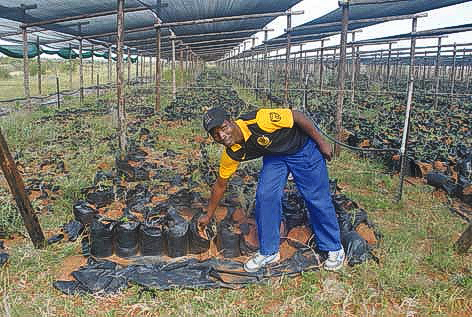
As part of the winding down process, assets belonging to the zone, irregular payments, verification of past salary adjustments and overpayments to staff are to be recovered. For instance, a bio-diesel project started on the outskirts of Mafikeng was a huge flop as the jatropha plants never left the nursery and the site currently resembles a wasteland.

Democratic Alliance provincial leader Chris Hattingh said the MIDZ was a waste from its inception. “The entity should never have been started and should have been closed at least six years ago. It received millions for nothing and has only succeeded in downgrading a Grade 7 airport to Grade 1 standards, making it equal to a farm airstrip,” he said. Source: The New Age

Related articles

SA auto industry to gain from 2013 policy shift

Trade remedies are by their very nature complex and most often ill-thought-out. This is said not so much from an entity whom gains to benefit from such an incentive scheme but more from an administrative and compliance perspective. These schemes require more than your average customs and trade consultant; someone who in fact not only knows  customs and trade law very well, but the motor industry as well. Similarly, on the side of the administrating authority an equally adept and experienced team is required to audit this process. I would like to believe that every attempt has been made to ensure that clear legal and procedural guidelines are in the offing, compared to the current MIDP process. On the other side of the coin, exactly how will the local community benefit from the ‘auto cartel’s’ new fortune? Based on SARS recent publication of its Compliance Programme it is noted that the tobacco and textile industries are singled out for scrutiny. Has the motor industry been purposely overlooked?

The SA motor industry stands to benefit from the introduction of a new programme next year, which will affect firm-level strategies, according to Standard Bank research analyst, Shireen Darmalingam. The Automotive Production Development Programme (APDP) aims to raise volumes to 1.2 million vehicles produced per annum by 2020, and to diversify and deepen the components supply chain. The new programme replaces the Motor Industry Development Programme (MIDP), which has been in existence since 1995. The soon-to-be phased out programme centred, among other things, on encouraging motor vehicle and component exports by allowing duty-free imports or reduced import tariffs, depending on the level of local content of exports.

Darmalingam said the replacement of the MIDP should not be viewed as a failure but rather as a point from which to move on and encourage further development of the SA motor industry. She said the APDP would offer the local automotive industry a sense of certainty through to 2020, which should encourage further growth.

“Whether the APDP will benefit certain industries more than others is still a contested question. Indeed, it appears that some benefits may be in favour of larger firms. Nonetheless, all firms are in line to benefit from the new APDP programme.” She said there was a concern that multinational companies were choosing to source leather products from suppliers closer to the major markets. She added that there was a further concern that the APDP, which aimed to provide a production incentive rather than an export incentive, might impact negatively on export-orientated component companies such as those in the leather sector.
However, she said sectors that supplied the aftermarket should benefit from the shift in policy, from MIDP to APDP, due to be implemented from January next year. Source: Business Live


South Africa to introduce Smartcard ID

The South African government has reaffirmed that the green barcoded identity (ID) book will be phased out and replaced with a new smartcard ID after Cabinet endorsed a Department of Home Affairs (DHA) pilot project to test the hardware and software used to produce the cards. The new card would be phased in over a period of about four years and would embrace a contactless chip, which Cabinet said was based on international trends and standards.

The smartcard solution would also be integrated with the deployment of a new National Identity System that would digitally capture biometric and biographical details of all South Africans and foreign nationals living inside South Africa. Home Affairs Minister Dr Nkosazana Dlamini Zuma reported recently that the integrated system would be linked to systems for movement control, permitting, as well as asylum seeker and refugee management.

The DHA planned to issue some 2 000 smartcard ID’s during the pilot phase, which was unveiled to lawmakers earlier in the month. The pilot phase would prioritise people applying for IDs for the first time and was likely to cost about R5-million.

The first issue of the smartcard would be free of charge, with the cost implications for reissuance yet to be determined.The test phase would enable the department to test its systems and enable government to procure the required machinery to produce the volume of cards that will be required to phase out the green barcoded ID books. No indication was given as to when a tender would be issued for the procurement of the full-scale system, or what the solution was likely to cost.

The department would collaborate with the Departments of Transport, Health and Social Development to integrate the smartcard with other official documents, such as drivers and firearm licences, social grants and those that would be associated with access to the proposed National Health Insurance scheme. Source: Creamer Media

South Africa – Considering Rhino Horn Trade

South Africa is considering whether to approach the international community with a proposal to trade in rhino horn, Environment Minister Edna Molewa told MPs on Wednesday. Opening debate in the National Assembly on her department’s budget, she said this included engaging “major role players, including international and regional partners [and] potential consumer states”.

Molewa’s remarks come 10 months ahead of the 16th congress of the Convention on International Trade in Endangered Species (Cites), set to take place in Bangkok, Thailand, in March next year. According to reports, South Africa is sitting on an estimated 20-ton stockpile of rhino horn; some of it in private hands, some stored by conservation authorities. The price of the horn, should the Cites moratorium on trade be lifted, has been estimated at more than R500,000 a kilogram.

Molewa has declined to say how much rhino horn is held by government-managed parks and reserves.”Due to security risks, the department cannot publicly announce the amount of stocks being held by these agencies”. On Wednesday, she said her department was involved in an “extensive” preparatory process ahead of the Cites congress.

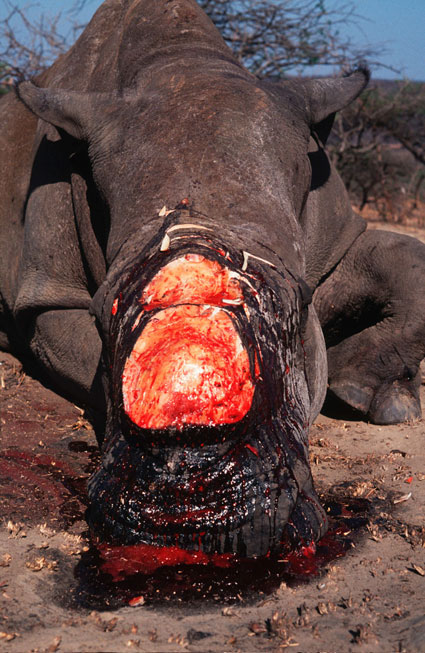
“This will include discussions on whether or not to approach the international community with a proposal to trade in rhino horn.” On the rhino poaching crisis in South Africa, Molewa said 199 rhino had been killed so far this year. “We are very, very deeply concerned,” she told the House. Earlier, briefing journalists at Parliament, Molewa said South Africa would not table a document at the next Cites meeting calling for the rhino horn trade moratorium to be lifted.

“No, not this time around. We are still considering all options, as well as probabilities towards that direction. We have not decided yet. Let it be clear. “We are still doing some very serious work in analysing whether we need to move in that direction or not.”

Among the things that needed to be done before trade could be resumed was “to ensure we get to know who the partners are on the other side”.Policies had to be in place “that do not allow any shenanigans to operate in the system,” Molewa said. “There are just too many things to do before we can place the discussion before the conference of parties. We are not yet there.”

Hmmmm! Would seem that the temptation for monetary profit is so compelling – R500,000/kg. Given the frequent outbursts at incidence of poaching and the horror pictures which normally accompany such reports how about burning the rhino horn reserves? That will send a clear message on government’s concern and intent.There exists a similar parallel where the importation of second-hand motor vehicles are banned in South Africa, but condoned because certain neighbouring countries want them. The old adage – ‘laws are meant to be broken’ comes to mind.  Source: SAPA

USCBP and EU sign C-TPAT Mutual Recognition

U.S. Customs and Border Protection (CBP) and the European Union (EU) signed today a Mutual Recognition Decision between CBP’s Customs-Trade Partnership Against Terrorism (C-TPAT) program and the EU’s Authorized Economic Operator (AEO) program.

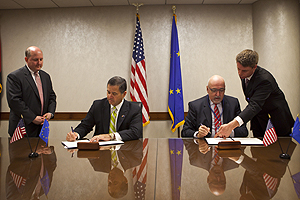
U.S. Customs and Border Protection Acting Commissioner David V. Aguilar and European Union Taxation and Customs Union Directorate Director-General Heinz Zourek sign the Mutual Recognition Decision between CBP’s Customs-Trade Partnership Against Terrorism program and the EU’s Authorized Economic Operator Program.

CBP Acting Commissioner David V. Aguilar and Director-General Heinz Zourek, European Union Taxation and Customs Union Directorate (TAXUD) signed the decision, which recognizes compatibility between the EU and the U.S. cargo security programs.

“Today’s decision on the mutual recognition of the EU and U.S. trade partnership programmes is a win-win achievement: It will save time and money for trusted operators on both sides of the Atlantic while it will allow customs authorities to concentrate their resources on risky consignments and better facilitate legitimate trade,” said Director-General Zourek.

C-TPAT is a voluntary government-business initiative to build cooperative relationships that strengthen and improve overall international supply chain and U.S. border security. C-TPAT recognized that U.S. Customs and Border Protection can provide the highest level of cargo security only through close cooperation with the ultimate owners of the international supply chain such as importers, carriers, consolidators, licensed customs brokers, and manufacturers. Source: US CBP

Related article

Zimbabwe: Dependence on SA Imports ‘Risky’

ZIMBABWE’S export trade promotion body, ZimTrade, has warned against over-reliance on South African imports, stressing that Harare could plunge into a serious economic crisis should its southern neighbour experience unexpected production and supply challenges. South African producers of basic commodities, automobile services, chemicals, agricultural inputs and farm produce have taken advantage of a significant weakness in Zimbabwean firms’ capacity to service the domestic market, which has triggered widespread shortages of locally manufactured goods.

South Africa and Zimbabwe have intensified trade relations, but the balance of trade has always been in favour of South Africa, Africa’s largest economy. In March, South Africa’s Deputy Minister of the Trade and Industry, Elizabeth Thabethe, flew into Zimbabwe with a delegation of 45 businesspeople to intensify the hunt for new markets for her country’s companies north of the Limpopo. The business delegation comprised companies in the infrastructure (rail, telecommunication and energy), manufacturing, agriculture and agro-processing, mining and mining capital equipment, as well as information and communication technology.

Zimbabwe labour unions are reportedly facing tremendous pressure from workers to campaign against an overflow of South African products into Zimbabwe to allow for the resuscitation of local industries to create jobs, have said Harare had “turned into a supermarket” for South African products. (Huh? strange since so many of the eligible working Zimbabweans have gainful employment in South Africa. Sounds more like labour union politicking)

If South Africa, for example, is to experience a supply hitch, this will be transmitted directly into Zimbabwe’s production and consumption patterns. The appreciation of the rand in the second quarter of 2011, for instance, resulted in price increases on the domestic market.In other words, heavy dependency on imports will leave an economy susceptible to world economic shocks, according to ZimTrade.

Statistics provided by the Department of Trade and Industry (dti) of South Africa in March, indicated that exports to Zimbabwe increased to R15,5 billion in 2011, from R15,1 billion in 2010, while Zimbabwe’s exports to that country increased to R2,9 billion in 2011, from R1,3 billion in 2010. The statistics indicate that South Africa imported US$1 billion worth of goods and services from the Southern African Development Community trade bloc, with 37 percent of the imports coming from Zimbabwe. The dti said imports from South Africa represented 45 percent of Zimbabwe’s total imports. Therefore, according to ZimTrade, “A growing trade deficit could increase the country’s risk of imported inflation and a direct transmission of shocks into the economy.

South Africa has also been Zimbabwe’s major source market for industrial inputs. The United States, Kuwait, China, Botswana and Zambia were Zimbabwe’s other major trading partners in 2011.However, the dti statistics indicated that Harare had narrowed its trade deficit with Africa’s largest economy in 2011 to R12,6 billion, from R13,7 billion in 2010. This translates to about US$12 million and US$13 million respectively

The dti deputy minister, Thabethe acknowledges that “South Africa and Zimbabwe are not only geographical neighbours. The two countries share historical and cultural linkages. Furthermore, South Africa’s economy is inextricably linked to Zimbabwe’s economy due to its geographical proximity to Zimbabwe whose political and economic welfare has a direct impact on South Africa”. Source: The Herald (Zimbabwe)