Zim-EU Agreement to Suffocate Trade

ZimbabweThe Interim Economic Partnership Agreement (IEPA) Zimbabwe signed with the European Union (EU) is set to suffocate the country’s trade and industrial development policies due to the removal of taxes, a regional non-governmental organisation has warned. Zimbabwe alongside Mauritius, Seychelles and Madagascar concluded the IEPA with the EU that would result in the removal of taxes between the African countries and the EU.

But in an analysis of the trade pact, the Southern and Eastern Africa Trade, Information and Negotiations Institute (Seatini) said the elimination of the export taxes is a blow to both the National Trade Policy (NTP) and Industrial Development Policy (IDP) meant to promote the trade and industrial revival respectively.

Last year, the Zimbabwean government launched the Industrial Development Policy 2012-2016 that advocates value-addition or beneficiation and the NTP to guide the country’s trade with the rest of the world.

“There is no doubt that for Zimbabwe to successfully implement the NTP and IDP it will need to use tools such as export taxes. However, Article 15 of the interim EPA agreement that Zimbabwe signed and ratified provides for elimination of export taxes, thereby suffocating the policy space Zimbabwe is referring to in its National Trade policy on the need for value-adding natural resources,” Seatini said in a discussion paper, Zimbabwe’s control over its natural resources in the WTO context.

Article 15 of the IEPA provides that for the duration of the agreement, the parties shall not institute any new duties or taxes on, or in connection with, the exportation of goods to any other party in excess of those imposed on products destined for sale. The organisation recommended that Zimbabwe “must exercise its right to develop its economy and protect the environment through the use of export taxes, until such a time when the economy can competitively trade with the rest of the world enabling it to then gradually eliminate the taxes on a product by-product basis”.

It also recommended that government should consult widely all relevant ministries and the private sector on its existing and proposed laws relating to any prohibitions and restrictions on the export of natural resources especially metals and minerals. Seatini warned that the use of export restrictions would be in violation of World Trade Organisation (WTO) rules.

Article XI:2(a) of the General Agreement on Tariffs and Trade does not allow WTO members to impose prohibitions and restrictions on the importation of any product, unless they (restrictions and prohibitions) are temporary, addresses critical shortages, relates to foodstuffs or other products and are essential to the exporting WTO member. It said it would be difficult for Zimbabwe to prove the critical shortage requirement. Source: The Standard – Zimbabwe

Shrinking Pool of Port Talent

The supply of proven port executives is drying up. Credit: Off beat Mum

The supply of proven port executives is drying up. Credit: Off beat Mum

Indeed the pool of experienced business expertise is in short supply and dwindling towards extinction. The following article published by Port Strategy reveals a pattern not only affecting employment trends in the international port business, but one which exists in just about every other industry of the international supply chain, the Customs included.

Successive years of hammering home the crewing ‘crisis’ message have firmly ingrained the matter on our minds: red alert, a dearth of qualified seafarers is about to bring the industry to its knees. However, that record has been re-played for at least the last two decades and the anticipated crisis has yet to materialise.

But there is a more pressing employment crisis in our very own backyard, if recruitment specialists are to be believed. With the growth of terminals coming on a pace, there is a demand for C-level executives with a proven track record in bringing start-ups to life. However, by definition this is a very select pool of individuals and these individuals can only be stretched so far.

Years ago, the industry would have handled CVs with regular eighteen month hops to pastures new with extreme caution: ‘a lack of commitment’… ‘ambition over loyalty’… ‘chasing the buck rather than the ambitions of the job’. Yet now, browse some port chief executive profiles and eighteen months could be considered a long term commitment as these sought after individuals jump from one top hot seat to the next to bring terminals up to speed in a matter of months rather than years.

Many are very successful, so perhaps I shouldn’t knock their career drivers. However, the whole exercise demonstrates how very reliant we are as an industry on an elite group of port positioning gurus.

With global container port throughput expected to grow by an average of around 7.5% a year over the next six years, how are we going to find the top brass to steer these terminals on the right course?

A specialist recruitment head-hunter recently confirmed to me that we are facing a challenge. It is already difficult to find the right people for positions that can often be in inhospitable environments, expecting them to uproot family and move lock, stock to a new country and culture.

And if we can find enough of these magic-makers, is the industry willing to pay for their worth? In a word, no, my recruitment colleague tells me. This is simple economics: the pot of suitable candidates contracts, the salary they can command goes up.

Port authorities and global operators need to wise up to the fact that not only is it becoming increasingly difficult to source talent – with no sign of improvement any time soon – but they will need to dig deeper if they want to win over that talent before another operator sweeps them off the available list. Source: Portstrategy.com

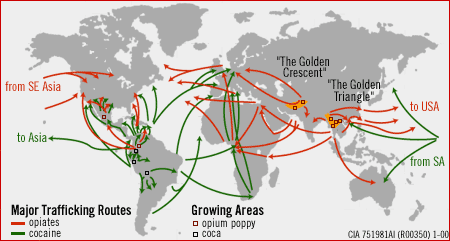
Southern African Narcotic Trafficking Landscape

Drugroutemap

See what the CIA’s Factbook has to say about Southern African countries and their role in the international narcotics supply chain –

Zimbabwe A transit point for cannabis and South Asian heroin, mandrax, and methamphetamines en route to South Africa
Zambia A transshipment point for moderate amounts of methaqualone, small amounts of heroin, and cocaine bound for southern Africa and possibly Europe; a poorly developed financial infrastructure coupled with a government commitment to combating money laundering make it an unattractive venue for money launderers; major consumer of cannabis
South Africa A Transshipment center for heroin, hashish, and cocaine, as well as a major cultivator of marijuana in its own right; cocaine and heroin consumption on the rise; world’s largest market for illicit methaqualone, usually imported illegally from India through various east African countries, but increasingly producing its own synthetic drugs for domestic consumption; attractive venue for money launderers given the increasing level of organized criminal and narcotics activity in the region and the size of the South African economy
Mozambique Southern African transit point for South Asian hashish and heroin, and South American cocaine probably destined for the European and South African markets; producer of cannabis (for local consumption) and methaqualone (for export to South Africa); corruption and poor regulatory capability make the banking system vulnerable to money laundering, but the lack of a well-developed financial infrastructure limits the country’s utility as a money-laundering center
Angola Used as a transshipment point for cocaine destined for Western Europe and other African states, particularly South Africa

Cracking Down on Cheating by Foreign Companies

Customs LawThe following article and its ensuing piece of legislation would seem to suggest that current Customs’ automated risk management is not doing its job, or at least is not as successful as authorities would often have one believe. Will this legislation signal a return to good old-fashioned ‘manual’ customs investigative work based on human intelligence? What the Congressman appears to overlook is that it is the US importers who are liable for correct clearance of foreign supplied goods. If CTPAT (and any other AEO scheme for that matter) have any worth, then surely the USCBP would look at de-accrediting US importers who fall foul of its import compliance levels? For many, the question remains – how successful (or even relevant) are the post 9/11 Customs Security measures? Besides creating significant expense budgets for Customs administrations, lucrative business opportunities for scientists, technology vendors, standards bodies, and of course consulting opportunities for the hundreds of audit firms and donor agencies – are the benefits, cost-savings and efficiencies in our current era of “Security” that visible? For many traders, all of this has been accepted as little more than the cost of doing and remaining in business. Period!

Congressman Dan Lipinski introduced legislation that will help American manufacturers grow their businesses and add jobs by cracking down on foreign companies that illegally avoid paying millions of dollars in customs duties. The Customs Training Enhancement Act (click on hyperlink to view the Bill) will facilitate the sharing of information between the private sector and U.S. Customs and Border Protection, enabling the government to do a better job of identifying schemes that cheat American taxpayers by importing foreign goods without paying duties.

The bill, which was folded into Democratic and Republican versions of more comprehensive Customs legislation in the previous Congress, further advances the goal of levelling the playing field so American businesses have a fairer shot against their foreign competitors.

“Blatant cheating by foreign firms has become more widespread at a time when American employers and workers are already at a serious disadvantage. This is not only bad for American business, but it hurts taxpayers by robbing the federal government of taxes it is rightfully owed,” Rep. Lipinski said. “The Customs Training Enhancement Act offers a common-sense approach by allowing impacted industries to  provide our Customs agents the critical intelligence they need to spot the cheaters.”

Since 2001, importers and exporters of goods into the United States have avoided paying $600 million in duties, according to the U.S. Government Accountability Office, which estimates that 90 percent of all transhipped or mislabelled items originated in China. Foreign companies have avoided duties by misclassifying and undervaluing products or by shipping goods from one country to another on their way to the United States in order to disguise the country of origin.

Under Rep. Lipinski’s bill, Customs and Border Protection would be required to seek out companies and trade groups that have information that can identify misrepresented shipments. That information, in turn, would be shared directly from these industry experts to Customs agents working on the front lines.

The Customs Training Enhancement Act is modelled on a successful program forged between the steel industry and Customs and Border Protection in which company and industry officials have taught Customs agents how to spot products that have been deliberately mislabelled.

“The steel industry has shown us a public-private partnership that saves taxpayers millions of dollars while costing the federal government very few, if any, resources,” Lipinski said. “We need to expand this program and fight back against the lying and cheating by foreign companies that are hurting American taxpayers, businesses, and workers. The Customs Training Enhancement Act is an important first step.” Source: www.lipinski.house.gov