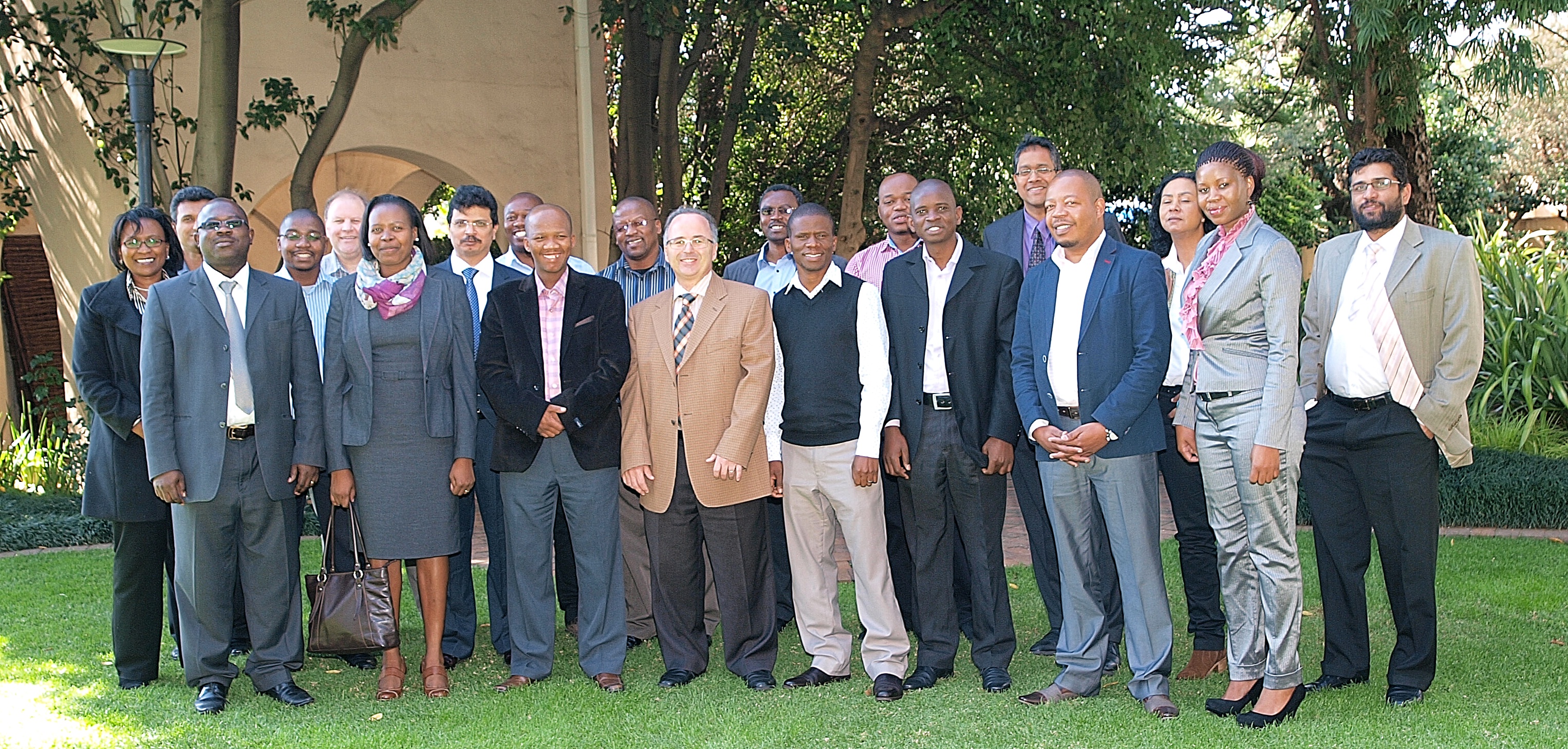
Delegates attending the WCO/SACU IT Connectivity Conference – May 2013
Representatives of the SACU member states recently met in Johannesburg to progress developments concerning IT Connectivity and Customs-to-Customs data exchange in the region. The session served as a follow up to the session held last year in February 2012 in Pretoria. The conference was convened by the SACU secretariat under the sponsorship of the Swedish International Development Agency (SIDA), and was once again pleased to have SP Sahu, senior technical expert from the World Customs Organisation, to facilitate the work session over 3 days. Representatives of UNCTAD ASYCUDA were also in attendance to observe developments. UNCTAD currently supports three (soon to be four) of the five SACU Customs administrations. The session provided an opportunity for delegates to progress this work as well as develop a terms of reference for an independent assessment of the two connectivity pilot projects that are currently being pursued between Botswana-Namibia and South Africa-Swaziland, respectively.
IT Connectivity serves as a catalyst for various customs-to-customs cooperation initiatives seeking to bring about a seamless end-to-end flow of information between point of departure and destination. Some examples include export/transit data exchange, approved economic operator, commercial fraud, eATA and at least 5 other key areas of customs mutual exchange. The concept is driven out of the newly establish WCO model known as Globally Networked Customs (GNC). GNC was formally adopted by the WCO Council in June 2012 where a capacity building approach based on protocols, standards and guidelines (PSG) using utility blocks was recognised to provide the most realistic means to achieve efficiency gains, and a more effective way to manage the negotiation of international agreements between customs administrations.
There exist several pilot projects across the globe wherein customs agreements are being piloted under the GNC approach. Development of a Utility Block and supporting data clusters for interconnectivity within SACU and the broader Southern Africa sub-region already commenced at last year’s session. The concept gained sufficient traction and was soon adopted by both SACU and SADC member states as the means to implementing IT connectivity within the respective regions.
A review of the Utility Block and data clusters was conducted to ensure alignment of customs data requirements across the member states. The resulting product now provides a standard ‘data set’ which members agree as the minimum data required to facilitate data exchange and advance risk management needs. It covers export and transit declaration requirements. Two important criteria exist for successful data exchange and data matching. The first being the availability of appropriate legal provision for two countries to exchange data. The second requires the use of an agreed unique identifier. The identifier is important for Customs as well as the trade community.
Delegates were also presented with current and future developments occurring at the WCO, in particular the on-going work being done to formalise standards for the “My Information Package” concept as well as the WCO Data Model, currently at version 3.3. Another interesting on-going development involves a unique Trader ID.
Member states involved in respective pilot programmes are now preparing themselves for an up-coming evaluation, later this year.


 What Happened to the Portcullis?
You must be logged in to post a comment.