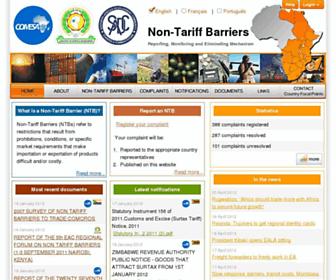
Non-Tariff Barriers – SADC Secretariat requested to intervene in Mozambique

0b8a0ce6140c04b4f629a97cb5e8d8f34e69d4a1The SADC, COMESA and EAC Tripartite alliance has been urged by various Zimbabwean, Zambian and Malawian exporters to salvage a potential crippling situation occurring at Mozambique borders. This follows the recent implementation of a new transit bond guarantee system which in conjunction with the Single Window system is allegedly causing significant delays, including loss of business and spiralling demurrage for transit goods emanating from these landlocked countries, en route for export from various Mozambique ports, Beira in particular.

Complaint no. NTB-000-578 in terms of ‘Lengthy and costly customs clearance procedures’ was lodged and can be viewed in full on the Tripartite’s NTB portal. Amongst the various problems sited, the complainants request the following of Mozambique –

  • Mozambique Ministry of Finance is requested to get customs to consider a parallel system to run with the electronic single window programme to clear the backlog in Beira port now and also consider providing release against Report orders to reduce further downtime in port . This will be a stop-gap measure until the customs staff are well versed , fully trained and that the new system can work well.
  • Mozambique authorities to facilitate arrangements with Cornelder to consider waiving storage for this special situation or at least offer 75% credit on the bills due which I must say are now astronomical based on the days the cargo has stayed in port both imports and exports.
  • Mozambique authorities to facilitate arrangements with shipping lines to consider waiving completely the demurrage due on the empty containers or at least give say 15-21 more days grace period before demurrage starts accruing.
  • Mozambique authorities to facilitate arrangements that Mozambique customs get technical assistance to assist roll this new programme out without causing huge catastrophes like this.

Mozambique has acknowledged the complaint and expressed regret over the developments. Mozambique reported that the issue was receiving urgent attention and they would provide feed back shortly.

Port of Genoa Control Tower Collapses Following Ship Collision

Prized location is not always practical. An Italian-flagged cargo ship crashed into a control tower at the Italian port of Genoa late Tuesday night, causing it to collapse. The 30,217 DWT Jolly Nero, a containership/ro-ro owned by Genoa-based Ignazio Messina & Co., slammed into the control tower at about 11 p.m. local time. Part of the 50-metre tower is said to have fallen into the water when it was hit by the Jolly Nero as the vessel was leaving the port for Sicily.

BBC reports that 3 people have been killed and others are injured. The report says that 10 people were in the tower at the time of the accident. According to Reuters, harbour officials confirmed on local television that 3 people were killed and 6 others injured. As many as 10 more may be missing, the report said. Two of the dead are believed to be harbour officials and the third was a pilot, local Primocanale quoted officials as saying. The Jolly Nero was under the control of two pilots and was leaving the port when the accident occurred. All that was left of the control tower was the exterior staircase, tilted on its side. The tower itself, which was located on the very edge of  the quay, was either in the water or in a heap of wreckage on the dock. The pictures below bear testimony of the tragedy. Source: gCaptain.com. Picture credits: Reuters and various.

Giant Rubber Duck Arrives in Hong Kong

Today’s ship photos come to us via Hong Kong, where on May 2nd internationally renowned artist Florentijn Hofman’s Rubber Duck project made its way into the harbour. The duck measures 16.5 meters tall, easily dwarfing its escort tugs.

About the project from the Hofman’s website (because it makes more sense when he explains it): The Rubber Duck knows no frontiers, it doesn’t discriminate people and doesn’t have a political connotation. The friendly, floating Rubber Duck has healing properties: it can relieve mondial tensions as well as define them. The rubber duck is soft, friendly and suitable for all ages.

Since 2007, the duck has been making its way around the world and has already been seen in St. Nazaire, Sao Paulo, Auckland, Hasselt ,Osaka and Hiroshima, Sydney, Nürnberg, and Amsterdam, among other places. But Hofman’s art isn’t just limited to giant rubber ducks. He also has a Fat Monkey, Slow Slugs, and Mickey the Pig exhibits on display in cities throughout the world. The Rubber Duck will be in Hong Kong until June 9th.

Invisible Patterns – to thwart clothing counterfeiters

Invisible textile patternWondering whether the $50 Armani suit you bought in that alley in Hong Kong is the genuine article? Soon, there may be a definitive way of knowing. A new system has been developed, in which designer-specific invisible patterns can be woven into fabric. Professor Christian Müller, at Sweden’s Chalmers University of Technology, started by applying a special dye to a polyethylene thread. The dye absorbs visible light, but can be seen using a polarizing filter. The idea is that each designer would have their own unique pattern that would be woven into their garments, that people such as customs officials could see using simple equipment.

That’s all very well and good, but what would stop counterfeiters from just reading and then copying those patterns? A number of different types of the dye can be used, and they can be bonded not only to polyethylene, but also to a variety of other synthetic and natural fibres. Depending on the specific combination of dye and fibre types, the optical spectrum of the pattern is different. Unless the counterfeiters knew the secret combination used, they wouldn’t be able to copy the exact look of an existing pattern – it’s not unlike the technology presently used on some banknotes. According to Müller, it would be relatively easy and inexpensive for clothing companies to manufacture their own custom dyed threads for use in the system. Source and picture: gizmag.com